Southern Austria
Carinthia
Austria's warm southern lake region decoded for UK travellers: swimmable Wörthersee summers, the Grossglockner high road, where to base around Klagenfurt and Villach, fares in pounds and the airport you'll actually fly into.
In short
Carinthia at a glance
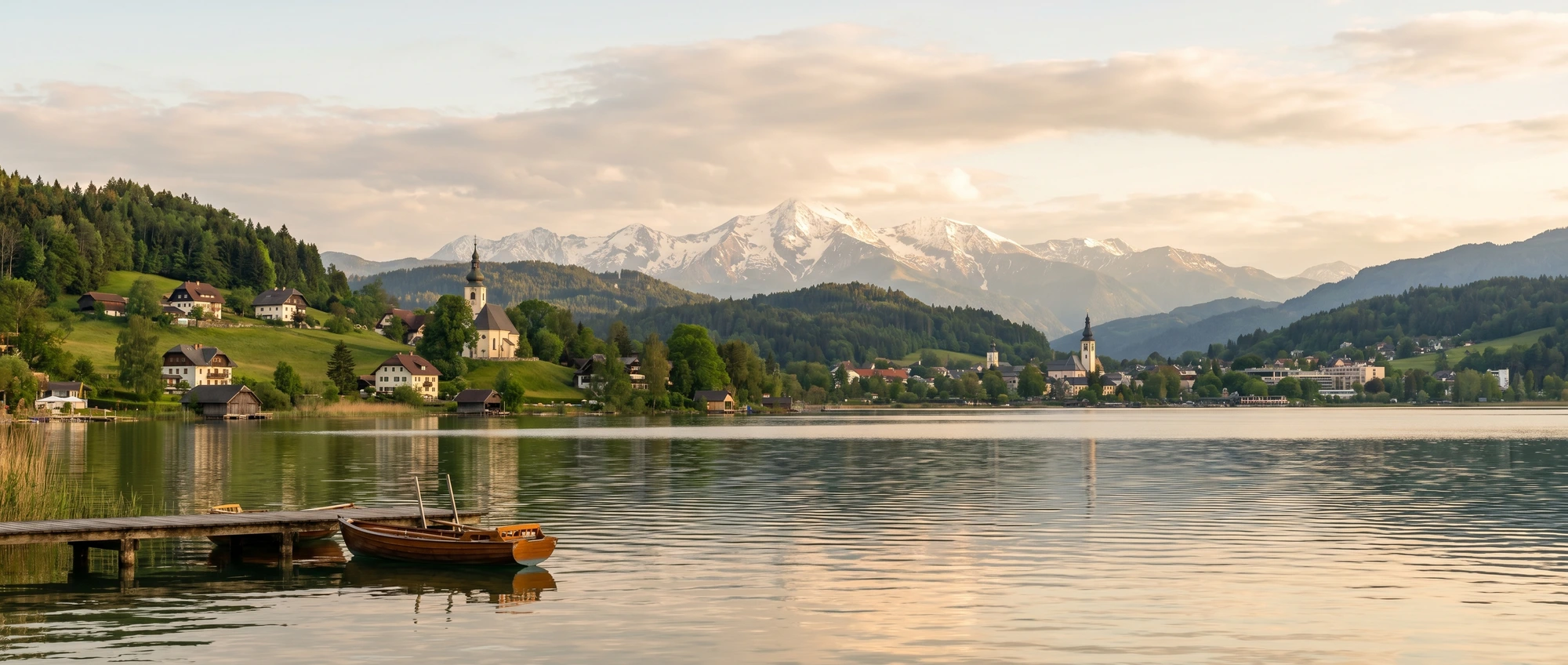
Carinthia is Austria's warm corner — the southern lake region tucked against the Italian and Slovenian borders, where the summers are hot enough to swim and the lakes warm to 24–27°C by July. The headline is the Wörthersee, a 17km strip of turquoise water lined by Klagenfurt at one end and the glossy resort of Velden at the other, but the quieter Millstätter See and Faaker See are the locals' choice. Above it all sits the Grossglockner High Alpine Road, the toll mountain pass to Austria's highest peak and the region's one unmissable drive. This is summer-first Austria you reach by car: there's a small airport at Klagenfurt but most UK travellers fly to Salzburg, Ljubljana or Venice and drive in. Allow a week to combine a lake base with the Grossglockner and the surrounding Hohe Tauern.
Most people don’t think of Austria as a place to swim, which is exactly why Carinthia surprises them. Pressed against the Italian and Slovenian borders in the country’s warm southern corner, it trades the chilly glacial lakes of the postcard Alps for water you can actually sit in all afternoon — the Wörthersee and Faaker See climb past 24°C by midsummer. It is summer Austria: lakeside promenades, paddleboards and ice cream, with the high mountains kept at arm’s length as the dramatic backdrop and the one great drive rather than the main event.
The mistake first-timers make is arriving by train and expecting it to work like Vienna. It won’t — the lakes, the mountain valleys and the toll passes that make Carinthia worth the trip are scattered and awkward without a car, and there’s no useful rail spine stringing them together. The other trap is the airport: people search for flights to Klagenfurt, find almost nothing from the UK, and give up. Fly to Ljubljana, Salzburg or Venice instead, hire a car at the door, and the region opens up — a warm lake base for the swimming and the Grossglockner road for the day you want the Alps proper.
The route
A relaxed week pairing a warm-lake base with Carinthia's two great mountain drives — the Grossglockner road and the Nockalmstrasse — without backtracking. Drive times are estimates on the region's valley roads and the A2 Süd Autobahn; the Grossglockner and Nockalm passes are seasonal toll roads, closed by snow in winter.
-
Days 1–3
The Wörthersee (Klagenfurt or Velden)
Settle into a lake base for swimming, paddleboarding and the lakeside promenades. Klagenfurt has the city sights — the old town, the Lindwurm dragon and the Minimundus miniature park — while Velden across the lake (about 30 min by car or the lake steamer) is the resort end. Ride the lift up the Pyramidenkogel, the world's tallest wooden viewing tower at 100m, for the full lake view.
-
Day 4
The Grossglockner High Alpine Road
Drive north-west to Heiligenblut (about 1h40 from the Wörthersee) and take the Grossglockner High Alpine Road — a €41.50 car toll for the day. The 48km of hairpins climb to the Kaiser-Franz-Josefs-Höhe viewpoint facing the Pasterze Glacier and the Grossglockner, Austria's highest mountain at 3,798m. Allow the whole day; it's the region's headline drive and best done early before the coaches.
-
Days 5–6
Millstätter See & the Nockalmstrasse
Shift to the quieter, deep-blue Millstätter See (about 1h from Heiligenblut) for calmer swimming and lakeside walks. From here the Nockalmstrasse toll road (€19 per car) loops through the gentle Nockberge mountains — a slower, greener scenic drive than the Grossglockner and far less crowded. A good two-night base to wind down.
-
Day 7
Villach & the southern lakes, or home
On the way out, stop in Villach — Carinthia's second city and spa town — or swim a final morning at the warm, family-friendly Faaker See nearby (about 20 min from Villach). From here it's roughly 1h20 to Ljubljana airport or 3h to Venice if you flew in that way.
Where to base yourself
Pick one or two bases rather than moving every night.
Wörthersee (Velden & Pörtschach)
£££ premiumThe lively resort end of Carinthia's biggest lake — Velden is the glossy, see-and-be-seen base with a casino, marina and a nightlife scene, while neighbouring Pörtschach is a touch calmer and just as central. Best for watersports, lakeside bars and easy day-trips to Klagenfurt across the water by steamer. Premium prices in July and August; book the lakefront rooms well ahead.
Best for: Watersports, lake nightlife and first-timers wanting the buzz
Klagenfurt
££ mid-rangeThe regional capital at the eastern end of the Wörthersee — an arcaded old town, the Lindwurm dragon fountain, the Minimundus model park and the lakeside Strandbad bathing area a short bus ride out. The practical base: cheaper than the resort villages, with the airport, train station and car-hire desks, and a proper city to eat and stroll in. Less of a beach-on-your-doorstep feel than Velden.
Best for: A city-plus-lake base, value and easy logistics
Millstätter See (Millstatt & Seeboden)
££ mid-rangeCarinthia's deepest lake and the calmer, more natural alternative to the Wörthersee — warm, clean swimming, lakeside walking trails and the medieval Millstatt Abbey, with the Nockberge mountains rising behind. Quieter and more family-paced, and the best base for the Nockalmstrasse and a slower trip. Fewer late-night options, which is rather the point.
Best for: Swimming, families and a slower scenic-drive trip
Getting around Carinthia
Carinthia is a driving region, not a rail one. The A2 Süd Autobahn runs east–west along the valley linking Klagenfurt and Villach, but the lakes, mountain valleys and toll passes that make the region worth visiting are awkward or impossible to reach without a car — so hire one at whichever airport you land at. The two signature drives are seasonal toll roads: the Grossglockner High Alpine Road (€41.50 per car, open roughly early May to early November) and the gentler Nockalmstrasse through the Nockberge (€19 per car), both snow-closed in winter. Note that Austrian motorways need a vignette toll sticker — the digital 10-day vignette is about €12.40 and most hire cars from Austrian airports already include one, but check, and budget separately for the special toll roads, which the vignette does not cover. Within the Wörthersee, the lake steamers are a pleasant car-free way to hop between Klagenfurt, Pörtschach and Velden in summer. Drive on the right.
Book the essentials
Where to stay
Tours & tickets
Airport transfers
Car hire
Stay connected
Trains & rail passes
Carinthia FAQs
Which airport should I fly into for Carinthia?
Can you swim in the lakes in Carinthia?
Is the Grossglockner High Alpine Road worth it?
Ready to book?
Compare car hire