


In short
What do UK travellers most need to know before booking Sri Lanka?
The ETA is now free for UK passport holders for 30 days (apply online before you fly), flights are ~11 hours nonstop from Heathrow on SriLankan, and there's no GHIC cover so comprehensive insurance is essential. The make-or-break decision is timing, because two opposite monsoons mean you must match your coast to your dates.
Sri Lanka is the best-value long-haul trip a UK traveller can take right now, and the easiest one to mistime. It is a small island that looks like a week on the map but moves slowly on the ground, and its two opposite monsoons punish anyone who books on instinct. This guide is built around the one call that decides the whole trip — when to go and which coast — plus the two decisions that move the needle before you book (your health cover and your transport), and the UK-specific detail competitor pages gloss over: the free ETA, the plug in the wall, the card in your pocket and the price in pounds.
The short version
- The ETA is now free for UK citizens for 30 days — apply on the official government site, never a paid reseller.
- Match your coast to your dates: Dec–Apr for the south/west and hill country, May–Sep for the east.
- Your GHIC is worthless here and rural care is limited — buy comprehensive insurance with repatriation cover.
- Don't self-drive — use the train, a private driver-guide and the PickMe app, not a hire car.
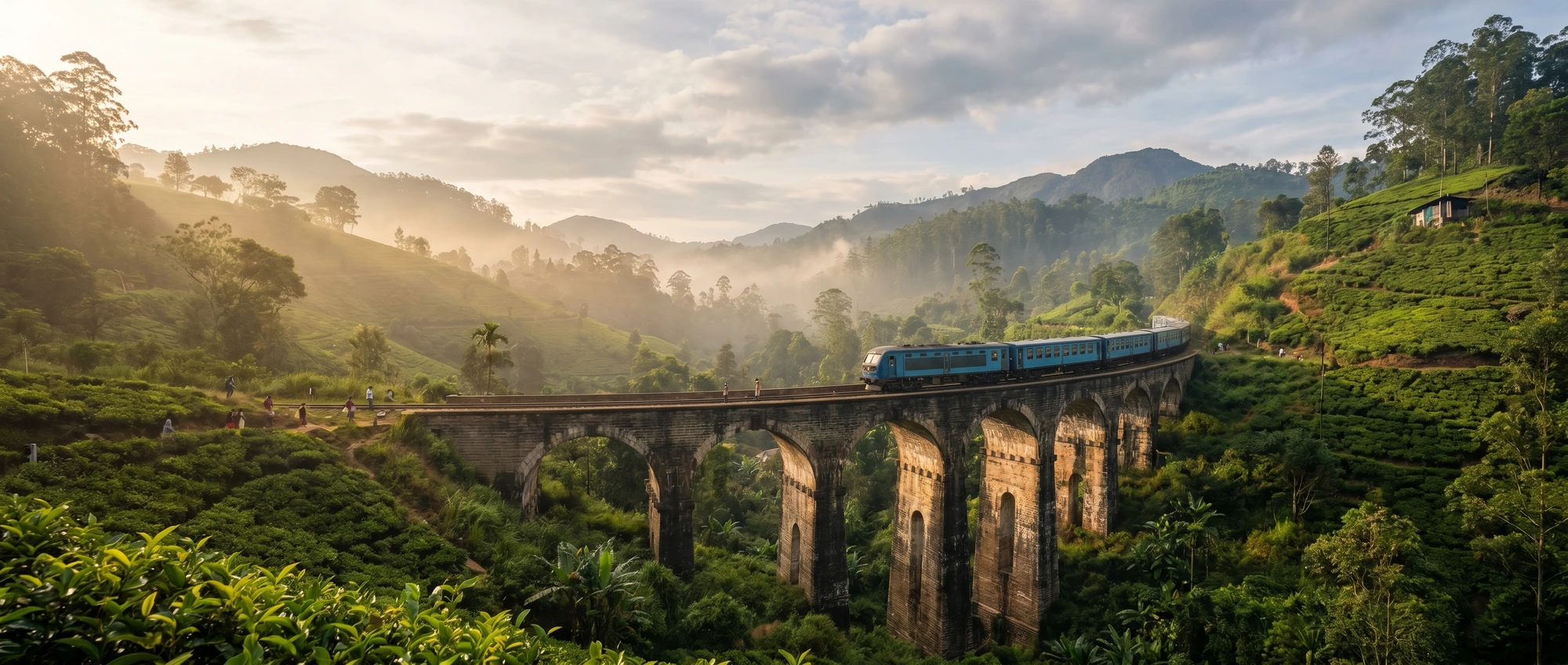
- Take the Kandy–Ella hill train (~£1–3); it's the highlight, not a travel day to skip.
Entry requirements for UK travellers
Sri Lanka is straightforward to enter on a UK passport, and as of 2026 cheaper than it used to be: British citizens need an Electronic Travel Authorisation (ETA), which is now issued free of charge and valid for 30 days. Apply online before you fly through Sri Lanka’s official immigration portal — and only that portal, because copycat sites charge a fee for an authorisation the government gives away. Your passport must have an expiry date at least six months after the day you arrive. Everything below is taken from the GOV.UK foreign travel advice for Sri Lanka; rules can change, so confirm on GOV.UK before you travel.
The pre-departure work that genuinely matters here isn’t the ETA — it’s health and timing. There’s no UK–Sri Lanka healthcare deal, care outside the main cities is limited, and the island’s two monsoons mean a beautifully dry south coast can sit a few hours from a washed-out east coast on the very same dates.
Key points before you book
- Free ETA, valid 30 days — apply on the official site before you fly; don't pay a reseller (GOV.UK).
- Passport valid for at least 6 months after your arrival date (GOV.UK).
- No GHIC cover and limited care outside main cities — comprehensive insurance is essential (GOV.UK).
- Cover shoulders and legs at Buddhist temples; never turn your back on a Buddha for a photo (GOV.UK).
- Drug penalties are severe — long jail terms and heavy fines (GOV.UK).
- Use ATMs inside banks or hotels; card fraud is common (GOV.UK).
- Rules can change — confirm on GOV.UK before you travel.
Passport validity
Your passport must have an expiry date at least 6 months after the day you arrive in Sri Lanka (GOV.UK). Check the date now and renew early if it's tight — UK passport renewals can take weeks in peak season, and a passport that's fine for the trip dates but inside the six-month window can still be refused.
Visas
British citizens need an Electronic Travel Authorisation (ETA) to enter Sri Lanka. ETAs are issued free of charge and are valid for 30 days (GOV.UK). Apply online before you travel through Sri Lanka's official immigration portal — do not pay a third-party site, which charges a fee for a free authorisation. Extensions beyond 30 days are handled through the immigration department once you're in the country. No visa is needed for air transit of under 24 hours.
Health
There's no UK–Sri Lanka reciprocal healthcare deal, so your GHIC/EHIC does nothing and you pay for treatment. GOV.UK warns that emergency medical treatment outside the main cities is not readily available, private hospitals are expensive and medical repatriation is very expensive — so comprehensive travel insurance with strong medical and repatriation cover is essential, not optional. Check vaccine recommendations on TravelHealthPro at least 8 weeks before you travel, and note a yellow fever certificate is required if you're arriving from a country with transmission risk. Some medicines that are routine in the UK are restricted here, so check before you pack. The emergency ambulance number is 1990 (the Suwa Seriya service).
Safety & security
GOV.UK states that terrorist attacks in Sri Lanka cannot be ruled out and advises vigilance in crowded places such as hotels, beaches and places of worship. Day to day, the bigger risks for visitors are practical: bank-card fraud is common (use ATMs inside banks or hotels, not street machines), low-level theft has risen, drink-spiking has been reported so don't accept drinks from strangers, and women have reported harassment in crowded areas. Roads are the real hazard — driving is erratic, accidents are frequent especially at night, and motorbikes and public buses are particularly dangerous. The two monsoons bring flooding and landslides in their wet seasons, and tropical cyclones are a risk; Cyclone Ditwah affected much of the island in November 2025 (GOV.UK).
Local laws & customs
Drug offences carry severe penalties, including long jail sentences and heavy fines for possession or smuggling (GOV.UK). Dress modestly at Buddhist temples — cover your shoulders and legs, and remove shoes and hats; never pose for photos with your back to a Buddha statue, which is treated as a serious offence and has had tourists arrested. Don't photograph military bases, government buildings or VIP vehicles, and register any drone with the Civil Aviation Authority. Alcohol isn't sold on Poya (full-moon) religious holidays and public drinking is frowned on then. Same-sex sexual activity remains technically illegal, though GOV.UK notes no known recent prosecutions.
GOV.UK is the official source for Sri Lanka entry rules — always check it before you book.
Read GOV.UK adviceGOV.UK updated 26 May 2026 · Departly checked 9 Jun 2026
Why insurance, not your GHIC, is the one to get right
Your GHIC does nothing in Sri Lanka
There is no UK–Sri Lanka reciprocal healthcare agreement, so the GHIC you’d use in Europe is worthless here. GOV.UK warns that emergency treatment outside the main cities isn’t readily available, and that private hospitals and medical repatriation are very expensive. Comprehensive travel insurance with strong medical and repatriation cover is essential, not optional, for Sri Lanka.
Buy it the same day you book the flights, before the dates blur into the holiday. Beyond the headline medical cover, two things matter more here than on a typical trip: repatriation, because getting a serious case from a rural area to Colombo or home is the expensive part, and the activity small print — surfing, hiking, safaris and any scooter use are common exclusions, and Sri Lanka tempts you into all four.
Travel insurance for Sri Lanka
This is the one to get right. There's no UK–Sri Lanka reciprocal healthcare deal, so your GHIC does nothing, and GOV.UK warns that emergency care outside the main cities isn't readily available and that private hospitals and medical repatriation are very expensive.
- Buy comprehensive cover with emergency medical, hospital and repatriation — from ~£18pp for a single trip.
- Make sure the policy covers the activities you'll actually do — surfing, hiking, safaris and scooter use are common exclusions.
- Repatriation cover matters most here: getting a serious case from a rural area to Colombo or home is the expensive part.
Flights from the UK
SriLankan Airlines flies the only nonstop from the UK — a daily Heathrow–Colombo service of about 10h45 out and 11h50 back against the wind, so the honest figure is “around 11 hours”, not the 18-hour totals some sites quote for connecting routes. From Manchester, Birmingham, Edinburgh and other regional airports you connect through a Gulf hub such as Doha, Dubai or Abu Dhabi, which adds a few hours but frequently undercuts the direct fare. You land at Bandaranaike (CMB), about 35km north of Colombo near Negombo — so plan a first night there rather than a tired drive straight inland.
Flights from the UK
Long-haulSriLankan Airlines flies the only nonstop from the UK — a daily Heathrow–Colombo service of about 10h45 outbound and 11h50 back against the wind. From Manchester, Birmingham, Edinburgh and other UK airports you connect through a Gulf hub such as Doha, Dubai or Abu Dhabi (Qatar Airways, Emirates, Etihad), which often costs less than the direct flight but adds several hours. Ignore the '18-hour' figures some sites quote — those are connecting itineraries, not the direct block time.
Fly from
Main arrival airports
- CMB Colombo Bandaranaike — the main international gateway, ~35km north of Colombo near Negombo
- HRI Mattala Rajapaksa — a quiet second airport in the south, rarely useful for UK arrivals
When to go — the decision that makes or breaks the trip
This is the single most important choice for Sri Lanka, because the island has two monsoons pulling in opposite directions. The south-west monsoon soaks the south and west roughly May to September; the north-east monsoon soaks the east and north roughly October to January. So the classic loop — south/west coasts, hill country and the Cultural Triangle — wants December to April, while the east coast (Arugam Bay, Trincomalee) is at its best May to September. You cannot have both coasts at their best in one trip. Pick a coast to match your dates, and avoid the wet, cyclone-prone October–November inter-monsoon.
When to go
Sweet spot: There's no single best month for the whole island, because the two monsoons pull in opposite directions. For the west and south coasts, the hill country and the Cultural Triangle — the classic loop most UK travellers do — aim for December to April, the dry season. For the east coast (Arugam Bay, Trincomalee, Batticaloa), the sweet spot is roughly May to September. The all-rounder shoulder months are late March and early April, when the south and west are still dry and the east is starting to clear, but they're also the hottest. Avoid trying to do both coasts at their best in one trip — pick a coast to match your dates.
Sri Lanka has two monsoons: the south-west (Yala) monsoon brings rain to the south and west roughly May to September, while the north-east (Maha) monsoon soaks the east and north roughly October to January. That means December to April is the prime window for the popular south/west coasts and the hill country — dry, sunny and the calmest sea for swimming and whale-watching off Mirissa. The east coast flips this: it's at its driest and best from about May to September, when the rest of the island is wet. The October–November inter-monsoon is the wettest, most unsettled stretch islandwide, with the highest cyclone and flooding risk — Cyclone Ditwah hit in November 2025. The hill country is cool and can be chilly at night year-round, so pack a layer whatever the season.
What it costs
Everything here is priced in pounds at roughly 450 rupees to £1 (June 2026), and the rupee’s slide through 2026 keeps Sri Lanka genuinely cheap for UK visitors. Direct return flights from Heathrow run about £600–£900, with Gulf-hub connections sometimes cheaper, and once you’re there a rice and curry is under three pounds and a guesthouse double £12–£25. A mid-range 12-night classic loop for two, including flights and a private driver for the inland days, comes to around £3,100–£3,400 — about £1,550–£1,700 each. The one cost that surprises people is the foreigner pricing at major sites: Sigiriya alone is about £27 a head.
What it costs
Direct return economy from Heathrow on SriLankan runs roughly £600–£900, dipping to ~£500 on cheap dates. Connecting fares through a Gulf hub (Qatar, Emirates, Etihad) from Manchester, Birmingham or Edinburgh are often £450–£700 and sometimes undercut the direct. The cheapest months are the May–September off-season for the south and west; avoid the December–January Christmas peak when fares jump.
Daily budget per person
| Rice and curry at a local spot | ~£1.50–3.50 |
|---|---|
| Guesthouse double, per night | ~£12–25 |
| Kandy → Ella scenic train (2nd/3rd class) | ~£1–3 |
| Tuk-tuk, per km | ~£0.20–0.25 |
| Tuk-tuk driver for a full day | ~£18 |
| Sigiriya Rock entry (foreigner price) | ~£27 |
All rupee figures use £1 ≈ 450 LKR (June 2026). Sri Lanka is a cash-first country once you leave the cities — keep Rs 10,000–20,000 (~£22–45) on you, and be aware foreigner ticket prices at major sites are far higher than local prices.
A realistic first-trip itinerary
The mistake UK travellers make is trying to ring the whole island in 10 days — Sri Lanka is small on the map but slow on the ground, and the roads are tiring. The classic loop runs anticlockwise from Colombo through the Cultural Triangle (Sigiriya, Anuradhapura, Dambulla), down to Kandy, onto the famous hill-country train to Ella, then to a southern beach around Galle, Mirissa or Unawatuna. This is a 10-day skeleton you can stretch to two weeks by slowing down rather than adding stops. Crucially, this loop only works in the December–April dry season for the west/south; come May–September and you'd flip to the east coast instead.
- 1Day 1
Land near Colombo — don't rush inland
You'll land at Bandaranaike (CMB), which is ~35km north of Colombo near Negombo, not in the city. After an ~11-hour flight, sleep your first night in Negombo by the airport rather than battling traffic into Colombo or straight to Sigiriya. Activate your eSIM or grab a cheap local SIM, draw rupees from a bank ATM, and rest.
- 2Days 2–4
The Cultural Triangle
Head to the Sigiriya/Dambulla area for the ancient sites: the Sigiriya rock fortress (climb it at opening, around 7am, before the heat and crowds — the foreigner ticket is steep at ~£27), the Dambulla cave temples, and a Minneriya or Kaudulla safari for wild elephants. This is hot, dry-zone country; base yourself one place and day-trip rather than hotel-hopping.
- 3Days 5–6
Kandy
Move south to Kandy, the cultural capital, for the Temple of the Sacred Tooth Relic and the lake. It's where the hill country starts and where most people board the Ella train. Two nights is plenty — Kandy itself is busy and traffic-clogged, and the real reward is what comes next.
- 4Days 7–8
The hill-country train to Ella
Take the Kandy–Ella train through tea plantations and cloud forest — one of the most scenic rail journeys anywhere, and at ~£1–3 absurdly cheap. Book a reserved seat (first/second class) at least a couple of weeks ahead in high season, as they sell out; the unreserved third-class carriages are a scrum but have the best open doorways. Ella itself is a small, walkable hill town with Little Adam's Peak and the Nine Arch Bridge.
- 5Days 9–10
South coast beaches
Drop down to the south coast — Galle's Dutch fort, then a beach base at Mirissa, Unawatuna or Weligama. December to April is whale-watching season off Mirissa and the calmest sea for swimming. End here and transfer back to the airport (it's a long ~3.5–4h drive, so build in a buffer or an airport-area final night).
Where to base yourself
Sri Lanka rewards staying put and day-tripping rather than hotel-hopping, because the roads are slow and tiring. Book a practical first and last night near the airport at Negombo, base yourself once in the Sigiriya/Dambulla area for the ancient sites, treat Kandy as a two-night staging post for the hill train, and pick one southern beach — Galle, Mirissa or Unawatuna — rather than chasing several. In the May–September monsoon, flip the beach leg to the east coast.
Negombo (near the airport)
A practical first and last night by Bandaranaike airport, saving you a tiring transfer when you're jet-lagged or catching an early flight home. A working beach town rather than a showpiece — fine for a night, not a destination in itself.
Good for: Arrival and departure nights
Sigiriya / Dambulla (Cultural Triangle)
The base for the ancient sites and elephant safaris, in the hot dry zone. Stay one place and day-trip the area rather than moving hotels — the sites are close together and the heat makes hopping miserable.
Good for: Ancient cities and wildlife
Kandy
Where the hill country begins, handy for the Tooth Temple and the start of the Ella train. Busy and traffic-heavy, so book somewhere up the lake or out of the centre for quiet, and treat it as a two-night staging post.
Good for: Culture and onward trains
Ella
A small, walkable hill town that's become the backpacker hub of the tea country — cooler, green and easy to potter around. It can feel over-touristed in peak season, but the surrounding hikes and the train ride in are the point.
Good for: Hill-country walking and cool air
Mirissa / Unawatuna / Galle (south coast)
The southern beach belt: Galle for the Dutch fort and boutique stays, Mirissa for whale-watching and surf, Unawatuna for an easy swimming beach. Best December to April; in the May–September monsoon the sea here is rough and the east coast takes over.
Good for: Beaches, surf and whale-watching
Getting around — trains and a driver, never self-drive
Getting around Sri Lanka
Forget self-drive — Sri Lankan roads are chaotic, GOV.UK calls the driving erratic and accident-prone, and a UK licence plus an International Driving Permit gets you nothing but stress. The two ways travellers actually get around are the train and a private driver-guide. The train is the joy of the country: the Kandy–Ella hill line is one of the world's great rail journeys and costs ~£1–3, while the coastal line south from Colombo to Galle is a cheap, scenic alternative to the road. Reserved first- and second-class seats on the hill route sell out, so book a couple of weeks ahead; third class is unreserved and packed but has the famous open doorways. For the inland legs between the ancient sites, where there are no useful trains, hiring a car with a driver-guide for ~£40–55 a day is the standard move and far less stressful than buses. In towns, use the PickMe app (the local Uber, with the widest coverage) or Uber in Colombo to get metered tuk-tuk and car prices, rather than haggling with street drivers who quote tourist rates.
- Don't self-drive — roads are erratic and accident-prone (GOV.UK); use trains, drivers and tuk-tuks.
- Kandy–Ella hill train: book reserved 1st/2nd class ~2 weeks ahead in season; 3rd class is unreserved.
- Hire a car with a driver-guide for the inland Cultural Triangle legs — ~£40–55/day and far less stress.
- Use the PickMe app (local Uber) for metered tuk-tuks and cars; Uber covers Colombo.
- Tuk-tuks run ~£0.20–0.25/km or ~£18 for a full day with a driver.
- The coastal train Colombo–Galle is a cheap, scenic alternative to the southern road.
The instinct to hire a car and roam is the mistake here. GOV.UK calls the driving erratic and accident-prone, especially at night, and a UK licence plus an International Driving Permit buys you only stress. The two ways travellers actually move are the train — the Kandy–Ella hill line is one of the world’s great rail journeys at ~£1–3, so book a reserved seat a couple of weeks ahead in season — and a private car with a driver-guide for the inland legs at ~£40–55 a day. In towns, the PickMe app gives you metered tuk-tuk and car prices instead of tourist-rate haggling.
Staying connected
UK roaming to Sri Lanka is expensive — it sits well outside the EU-style inclusive zones, so the networks charge around £5–£8 a day, far more than the ~£2.25 you’re used to in Europe. Over a fortnight that’s £50–£100+. A travel eSIM at £8–£18 for the trip is the obvious value move; install it before you fly and activate on landing. If you don’t mind a quick passport-registration stop at the airport, a local Dialog or Mobitel tourist SIM is cheaper still.
Stay connected in Sri Lanka
UK roaming to Sri Lanka is expensive — it sits well outside the EU-style inclusive zones, so Vodafone, EE and Three charge roughly £5–£8 a day, far more than the ~£2.25/day you pay in Europe. Over a 10–14 day trip that's £50–£100+.
- A travel eSIM is typically £8–£18 for the trip's worth of data — a big saving on daily roaming.
- Alternatively, a local Dialog or Mobitel tourist SIM is very cheap and sold at the airport, if you don't mind a quick passport-registration stop on arrival.
- Activate your eSIM on landing — coverage is good on the coasts and in towns but patchy in the hill country and remote dry zone.
Money: cash, cards and the rupee rule
Sri Lanka is a cash-first country the moment you leave Colombo and the bigger hotels. Cards work in city restaurants, mid-range hotels and supermarkets, but guesthouses, tuk-tuks, local eateries, train tickets and site entries often want rupees in hand. The rupee is a closed currency, so don't try to buy it in the UK — instead withdraw from a bank ATM on arrival (use machines inside banks or hotels, as GOV.UK flags card fraud) and keep Rs 10,000–20,000 (~£22–45) on you. Two money rules save you: when a card terminal or ATM asks whether to charge in GBP or rupees, always choose rupees, because choosing pounds (dynamic currency conversion) hands the merchant a poor rate and costs you 3–5%; and budget for the foreigner-pricing gap at major sites — Sigiriya is ~£27 for visitors against a token local fee, and these add up fast across the Cultural Triangle. Tipping is appreciated but modest: round up tuk-tuk fares and leave ~10% in restaurants that don't already add a service charge.
Fee-free travel money
Skip the airport exchange desk — a fee-free travel card gives you the real exchange rate abroad.
Before you fly
Two small UK-specific jobs round out the trip: pre-book your airport parking, which is almost always cheaper booked ahead than on the day, and double-check the essentials before you fly — the free ETA, insurance, your vaccines, your reserved train seats — so nothing slips through in the last 48 hours.
Airport parking & lounges
Pre-book your UK airport parking or a lounge — it's almost always cheaper booked ahead than on the day.
How we know this
How we know this
- GOV.UK foreign travel advice — Sri Lanka — entry, passport validity, ETA, health, safety and local laws
- Sri Lanka Department of Immigration & Emigration (eta.gov.lk) — the official, free ETA application — avoid paid resellers
- NHS Fit for Travel / TravelHealthPro — vaccine and antimalarial recommendations
- Seat61 & Sri Lanka Railways — hill-country train classes, fares and booking lead times
GOV.UK last updated 26 May 2026.