




In short
What do UK travellers most need to know before booking Australia?
Apply for the free eVisitor visa (not the A$20 ETA app), expect ~22 hours to Sydney with one stop, and don't rely on the reciprocal healthcare deal — it covers urgent hospital care only, so buy comprehensive insurance. Pick two or three regions, not the whole continent: Sydney to Perth is a 5-hour flight.
Australia is the long-haul trip UK travellers most often under-budget on time and over-budget on map. The instinct is to fit Sydney, Uluru, the reef, Melbourne and Perth into a fortnight; the reality is that the country is the size of continental Europe, and that itinerary is mostly airports. This guide is built around getting the few high-stakes calls right — the free visa versus the paid one, what the healthcare deal actually covers, and the distances — plus the UK-specific details competitor pages gloss over: the route you fly, the plug in the wall, the card in your pocket and the price in pounds.
The short version
- Apply for the free eVisitor visa (subclass 651) — the A$20 ETA app gives the same access for no reason.
- There's no nonstop UK–Sydney flight in 2026 — it's ~22 hours with one stop; only London–Perth is nonstop.
- The reciprocal deal covers urgent hospital care only — not GPs, prescriptions, ambulances or evacuation.
- Treat the distances as continental: fly between regions, hire a car only for the set-piece drives.
- Pick the east-coast triangle — Sydney, the reef and Melbourne — over trying to 'do Australia' in one trip.
Entry requirements for UK travellers
Every British citizen needs a visa before flying to Australia — you can’t turn up and get stamped in — but the right one for UK tourists is free. Apply online for the eVisitor visa (subclass 651): no application charge, no service fee, valid for 12 months, multiple entries, up to three months per visit. The heavily advertised ETA app gives the same access but charges an A$20 (~£11) service fee and is aimed at other nationalities, so most UK visitors are simply paying for nothing. Everything below is taken from the GOV.UK foreign travel advice for Australia; rules can change, so confirm on GOV.UK before you travel.
The other pre-departure job that genuinely matters is biosecurity. Australia enforces some of the strictest quarantine rules in the world: you complete an Incoming Passenger Card and must declare all food, plant material and animal products, and the fines for getting it wrong are heavy. When in doubt, declare it — declaring something that turns out to be fine costs nothing, while not declaring something that isn’t can cost you hundreds.
Key points before you book
- Every UK citizen needs a visa before travel — apply for the free eVisitor (subclass 651), not the paid ETA app (GOV.UK).
- Passport valid for your stay; no extra Australian validity rule, but your transit country may want 6 months (GOV.UK).
- The reciprocal deal covers urgent hospital care only — not GPs, prescriptions, ambulances or evacuation (GOV.UK).
- Declare all food, plant and animal products on the Incoming Passenger Card — biosecurity fines are heavy (GOV.UK).
- Swim between the red-and-yellow flags; rip currents are the biggest risk to visitors in the water (GOV.UK).
- Bushfire season runs October to February and conditions change fast — check warnings before heading rural (GOV.UK).
- Rules can change — confirm on GOV.UK before you travel.
Passport validity
Your passport must be valid for the length of your planned stay — Australia sets no extra months-beyond-departure rule (GOV.UK). Watch your connecting country instead: many transit hubs, including some Middle East and Asian stops, want six months' validity, so the practical rule for a one-stop Sydney trip is to travel on a passport with at least six months left.
Visas
Every British citizen needs a visa or visa-equivalent before travelling — you cannot just turn up (GOV.UK). The right one for UK tourists is the free eVisitor visa (subclass 651): no application charge, no service fee, applied for online through the Department of Home Affairs, valid for 12 months, multiple entries, up to 3 months per visit. The ETA (subclass 601) gives the same access but is applied for via an app that charges an A$20 (~£11) service fee — it's pitched at US and other travellers, and most UK visitors don't need it. Whichever you hold, it's electronic and linked to your passport; there's nothing to print.
Health
There is a UK–Australia reciprocal healthcare agreement, so you can get free essential and urgent hospital treatment — but it's narrower than the GHIC you'd use in Europe (GOV.UK). It does not cover GP appointments or prescriptions (you pay for those), ambulances, non-urgent care, or medical evacuation — and an evacuation from a remote area or the outback is very expensive (GOV.UK). You can enrol in Medicare on arrival to recover some costs, but that doesn't close the gaps, so comprehensive travel insurance is still essential. A yellow fever certificate is required only if you're arriving from a country with transmission risk. Check vaccine recommendations on TravelHealthPro at least 8 weeks before you travel.
Safety & security
Australia is a safe, developed country for tourists; the real risks are environmental, not criminal. The standout natural hazards are bushfires (worst October to February, and they can start and change direction with no warning), tropical cyclones in the north (November to April), flash flooding, and extreme heat (GOV.UK). In the water, rip currents are the biggest killer of visitors — always swim between the red-and-yellow flags on patrolled beaches — and there are sharks, marine stingers and venomous fish. GOV.UK also notes terrorists are likely to try to carry out attacks, after the December 2025 Bondi Beach attack. Petty theft happens in tourist areas, so use hotel safes and don't leave bags unattended.
Local laws & customs
Carry photo ID — a UK driving licence is widely accepted and saves risking your passport (GOV.UK). Smoking is banned in all enclosed public spaces and vaping rules vary by state. Drug penalties are severe and trafficking can mean a long prison sentence and deportation (GOV.UK). Australian beer and wine are often stronger than the UK equivalents. Same-sex marriage is legal and recognised. Drink-driving is heavily enforced and penalties are severe; seatbelts are compulsory for everyone in the car.
GOV.UK is the official source for Australia entry rules — always check it before you book.
Read GOV.UK adviceGOV.UK updated 19 Mar 2026 · Departly checked 9 Jun 2026
Why insurance still matters, despite the healthcare deal
The reciprocal deal covers urgent hospital care only
The UK and Australia do have a reciprocal healthcare agreement, so essential and urgent hospital treatment is free — but GOV.UK is clear it’s far narrower than the GHIC you’d use in Europe. It does not cover GP visits, prescriptions, ambulances, non-urgent care or medical evacuation, and a flying-doctor evacuation from a remote area is very expensive. Comprehensive travel insurance with strong medical and evacuation limits is still essential here, not optional.
Buy it the same day you book the flights, before the dates blur into the holiday. Beyond the headline medical cover, push the evacuation limit up — that’s the cost the reciprocal deal won’t touch, and an outback or remote-coast evacuation is exactly where the bills run into five figures. If you’re planning to dive the reef, surf or head into the Red Centre, check the policy covers adventure activities, because a surprising number of basic ones quietly exclude them.
Travel insurance for Australia
Don't let the reciprocal healthcare deal lull you. Yes, the UK–Australia agreement covers free essential and urgent hospital treatment — but GOV.UK is clear it does not cover GP visits, prescriptions, ambulances, non-urgent care or medical evacuation, and a flying-doctor evacuation from a remote area is very expensive.
- Buy comprehensive cover with emergency medical, ambulance, repatriation and evacuation — from ~£35pp for a single trip.
- Check the medical and evacuation limits are high; remote-area evacuation is the cost the reciprocal deal won't touch.
- Add cover for adventure activities if you're diving the reef, surfing or doing the outback — many basic policies exclude them.
Flights from the UK
There’s no nonstop UK–Sydney flight in 2026 — every route stops once, typically in Singapore, Dubai, Doha or Hong Kong, for around 22 hours door-to-gate. The one nonstop option is Qantas’s London Heathrow–Perth, about 17 hours and the world’s third-longest scheduled flight, which is handy if Western Australia is your start point. Qantas plans nonstop London–Sydney from 2027 on the Airbus A350, but it isn’t flying yet, so don’t book a trip around it. From Manchester and other regional airports you’ll connect through a hub regardless, so compare total journey time, not just the headline fare.
Flights from the UK
Ultra-long-haulThere's no nonstop UK–Sydney flight in 2026 — every route stops once, typically in Singapore, Dubai, Doha or Hong Kong, for a total of around 22 hours door-to-gate. The one nonstop option is Qantas's ~17-hour London Heathrow–Perth, the world's third-longest scheduled flight. Qantas plans nonstop London–Sydney from 2027 on the Airbus A350, but it isn't flying yet, so don't book a trip around it.
Fly from
Main arrival airports
- SYD Sydney — the main UK gateway; ~13 min and ~£6 to the centre on the Airport Link train
- MEL Melbourne — the second gateway; no airport train yet, so it's the SkyBus (~£12) or a taxi
- PER Perth — the shortest hop from the UK and Qantas's London nonstop arrival point
When to go
Australia’s seasons are flipped from the UK, and “best time” depends on where you’re heading. For most of the country the shoulder months — September to November and March to May — give you mild weather and smaller crowds than the December–January peak. But the tropical north (Cairns, the Great Barrier Reef, Darwin) is at its best in the May–October dry season, while Sydney and Melbourne are warmest December to February. Avoid the southern bushfire-risk window and the northern wet/cyclone season if you can.
When to go
Sweet spot: The shoulder months — September to November (spring) and March to May (autumn) — are the best all-rounders, with mild temperatures across most of the country and fewer crowds than the December–January peak. But Australia spans the tropics to the cool south, so 'best time' depends on where you're going: the tropical north (Cairns, the reef, Darwin) is best in the May–October dry season, while the southern cities are at their warmest December to February.
Australia's seasons are flipped from the UK: December to February is high summer — hot, busy and pricey, ideal for Sydney and Melbourne beaches but the wet, cyclone-prone season up north and the worst of the bushfire risk in the south-east. March to May is autumn, a sweet spot for the southern cities and the start of the dry up north. June to August is winter — cool in Melbourne and Sydney (think a mild UK autumn), prime ski season in the Snowy Mountains, and the perfect dry, clear time for Cairns, the reef and the Red Centre. September to November is spring, warming up nicely with wildflowers and good value before the summer crowds return.
What it costs
Everything here is priced in pounds at roughly A$1.89 to £1 (June 2026). Return flights from the UK to the east coast run about £900–£1,400, and a mid-range two-week trip for two — Sydney, Melbourne and a Cairns reef leg with two domestic flights — comes to around £6,400–£6,800, or about £3,200 each before shopping. Day to day, Australia is broadly UK-priced: a flat white is a couple of pounds, a pub meal under a tenner, and a pint around a fiver thirty.
What it costs
Return economy from the UK to the east coast runs roughly £900–£1,400, dipping to ~£800 on cheap dates and topping £1,500+ over the December–January peak and school holidays. The cheapest months to fly are typically May, June and early February. London–Perth nonstop on Qantas is usually the priciest single leg but saves you the connection.
Daily budget per person
| Sydney Opal single ride (train/bus) | ~£1.90–2.70 |
|---|---|
| Flat white in a café | ~£2.10–2.65 |
| Pub or RSL club meal | ~£6.50–13 |
| Pint of beer | ~£5.30 |
| Hostel dorm bed, per night | ~£12–21 |
| Domestic flight Sydney → Melbourne (budget) | ~£26–52 one way |
All dollar figures here use £1 ≈ A$1.89 (June 2026). Australia is overwhelmingly card-based — contactless works almost everywhere — but carry ~A$50–100 (~£26–53) for the odd rural café, market or honesty box.
A realistic first-trip itinerary
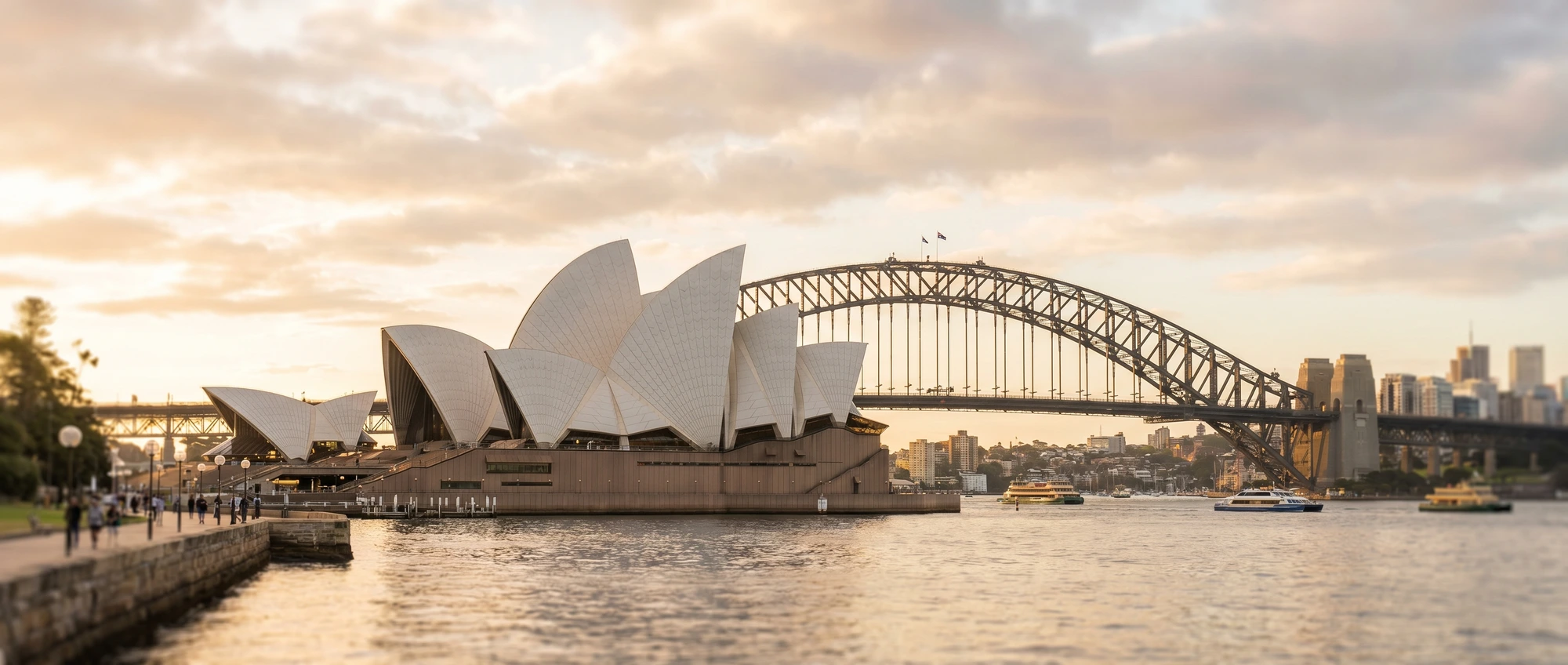
The mistake almost every first-timer makes is trying to 'do Australia' in one trip — Sydney, Uluru, the reef, Melbourne and Perth in two weeks. The country is the size of Europe; that itinerary is mostly airports. Pick a lane. The classic and most efficient first trip is the east-coast triangle: Sydney, Melbourne and a tropical north leg around Cairns and the Great Barrier Reef, linked by short domestic flights. This is a 14-day skeleton — stretch it by adding the Red Centre (Uluru) or swapping in Tasmania, not by squeezing more in.
- 1Days 1–4
Sydney — land and slow down
You'll arrive wrecked after ~22 hours and a 9–11-hour time jump, so don't schedule day one. The Airport Link train is ~13 minutes and ~£6 to the centre. Do the harbour properly: walk Circular Quay to the Opera House, ferry to Manly, and swim between the flags at Bondi or Coogee. Use the walk-up Opera House tour rather than an expensive evening show on a jet-lagged first trip.
- 2Days 5–8
Cairns & the Great Barrier Reef
Fly north (~3 hours) to the tropics. Base in Cairns or Port Douglas and pick one good reef day on a smaller boat to an outer-reef site rather than the cheapest big-pontoon trip — the snorkelling is far better with fewer people. Add a Daintree rainforest day. This is the leg most worth the domestic flight.
- 3Days 9–11
Melbourne — the city counterpoint
Fly south (~3 hours from Cairns, or ~1h30 from Sydney). Melbourne is laneways, coffee, galleries and food rather than headline sights — let it be a slower city stay. Day-trip the start of the Great Ocean Road to the Twelve Apostles if you have a hire car, but treat the full road as a 2–3-day thing you're not doing on this trip.
- 4Days 12–14
A choice: Great Ocean Road, Tasmania or back to Sydney
Use the last stretch to go deep on one thing rather than add a fourth city. Either a Great Ocean Road overnight from Melbourne, a short Tasmania hop for MONA and the wilderness, or an easy return to Sydney for the Blue Mountains before the long flight home. Don't try to fit Uluru into a 2-week east-coast trip — it deserves its own 3-week itinerary.
Where to base yourself
In Sydney, base in the CBD, The Rocks or Circular Quay for your first few jet-lagged days — the harbour, the ferries and the airport train are all on the doorstep — then trade down to Surry Hills or Newtown if you want more food-and-bar character for less. For the reef, Cairns is the cheaper, busier base and Port Douglas the quieter, closer-to-the-Daintree one. In Melbourne, the CBD or Southbank keeps you central, while Fitzroy and St Kilda swap a central postcode for neighbourhood character.
Sydney — CBD, The Rocks or Circular Quay
The most walkable first-timer base: harbour, Opera House, ferries and the train to the airport all on the doorstep. It's the priciest part of the city, so trade down to Surry Hills or Newtown if you want more food-and-bar character for less.
Good for: First-timers who want the harbour on their doorstep
Sydney — Bondi or Coogee
Beach-side and relaxed, with the coastal walk between them, at the cost of a longer commute into the centre. Best if you're here for the beach lifestyle rather than ticking off city sights.
Good for: Beach-first travellers
Cairns or Port Douglas
Cairns is the cheaper, busier reef-trip base with the airport and the esplanade lagoon; Port Douglas, an hour north, is quieter and closer to the Daintree and the outer reef. Pick Port Douglas if you'd rather pay a bit more for calmer surrounds.
Good for: Reef and rainforest access
Melbourne — CBD or Southbank
Central, on the free City Circle tram, and walkable to the laneways, the river and the galleries. Fitzroy and Collingwood are the move for a more local, café-and-bar stay a short tram ride out.
Good for: City, coffee and culture
Melbourne — Fitzroy or St Kilda
Fitzroy is the inner-north creative quarter of bars, record shops and brunch; St Kilda is the bayside beach suburb with the pier and penguins. Both swap a central postcode for more neighbourhood character.
Good for: A local-feeling base over a central one
Getting around — and respecting the distances
Getting around Australia
Distance is the thing UK travellers under-estimate most. Australia is roughly the size of continental Europe, so you fly between regions rather than drive the lot: Sydney to Melbourne is ~1h30 in the air against ~9 hours' driving, and Sydney to Perth is a 5-hour flight — further than London to Cairo. Qantas, Virgin Australia, Jetstar and Rex link every major city; book budget carriers like Jetstar 4–8 weeks ahead and one-way fares are often A$49–150 (~£26–80). Within cities, contactless tap-on/tap-off transit is excellent and you don't need a paper ticket: Sydney's Opal, Melbourne's myki and Brisbane's go card all take a contactless bank card or phone directly at the gate, so you just tap your normal card. Hiring a car earns its keep for the set-piece drives — the Great Ocean Road, the Daintree, the Red Centre loops — but is pointless for getting between the big cities. Remember Australia drives on the left like the UK, your UK photocard licence is valid as a visitor, and outback distances between fuel stops are huge, so plan range carefully.
- Fly between regions — Sydney–Melbourne is ~1h30, Sydney–Perth a 5-hour flight; driving the lot wastes the trip.
- Book Jetstar/Virgin domestic flights 4–8 weeks ahead for ~A$49–150 (~£26–80) one way.
- Tap a contactless bank card or phone at the gate — Opal (Sydney), myki (Melbourne) and go card (Brisbane) all accept it.
- Sydney Airport Link train into the centre is ~13 minutes and ~£6 — far quicker than a peak-hour taxi.
- Hire a car only for set-piece drives (Great Ocean Road, Daintree, Red Centre), not city-to-city hops.
- Drive on the left as in the UK; your UK photocard licence is valid for visitors, and outback fuel stops are far apart.
The single mental shift that fixes most Australia itineraries is treating it like Europe, not a country you can drive across in a few days. Sydney to Perth is a 5-hour flight, further than London to Cairo, so you fly between regions and use the excellent contactless city transit on the ground — just tap your normal bank card on Sydney’s Opal, Melbourne’s myki or Brisbane’s go card. Save the hire car for the set-piece drives where the road is the point: the Great Ocean Road, the Daintree, the Red Centre loops. Australia drives on the left like the UK and your UK photocard licence is valid as a visitor, but outback fuel stops are far apart, so plan your range.
Staying connected
UK roaming to Australia is expensive — it sits well outside the inclusive EU-style zones, so the networks charge around £6–£8 a day, far more than the ~£2.25 you’re used to in Europe. Over a two-to-three-week trip that’s £85–£170+. A travel eSIM at £8–£20 for the whole trip is the obvious value move; install it before you fly and activate on landing. Coverage is excellent in the cities on Telstra and Optus but drops off fast in the outback, so download offline maps before any remote drive.
Stay connected in Australia
UK roaming to Australia is expensive — Australia sits well outside the EU-style inclusive zones, so Vodafone, EE and Three charge roughly £6–£8 a day, far more than the ~£2.25/day you're used to in Europe. Over a two-to-three-week trip that's £85–£170+.
- A travel eSIM is typically £8–£20 for 10–20GB for the whole trip — a big saving on daily roaming.
- Activate on landing — Telstra and Optus have the widest coverage, and the city 4G/5G is excellent.
- Coverage drops off fast in the outback and on remote drives, so download offline maps before you leave a city (GOV.UK notes patchy rural mobile coverage).
Money: cards, cash and the dollar rule
Australia is one of the most cashless countries you'll visit — contactless cards and phones work almost everywhere, from city cafés to reef-boat bars, and many small businesses no longer take cash at all. The practical kit is one Visa or Mastercard you can tap, plus about A$50–100 (~£26–53) in notes for the occasional rural café, weekend market, parking machine or honesty box. Two rules save you money. First, when a card terminal or ATM asks whether to charge in GBP or AUD, always choose Australian dollars — choosing pounds (dynamic currency conversion) hands the merchant a poor rate and costs you 3–5%. Second, tipping isn't expected: staff are paid a proper wage, so a service charge or rounding up is genuinely optional, not the 10–20% habit you might bring from elsewhere. Use a fee-free travel card to dodge the foreign-transaction charges high-street debit cards still add on every tap.
Fee-free travel money
Skip the airport exchange desk — a fee-free travel card gives you the real exchange rate abroad.
Before you fly
Two small UK-specific jobs round out the trip: pre-book your airport parking, which is almost always cheaper booked ahead than on the day, and double-check the essentials before you fly — the free visa, insurance, your sun kit — so nothing slips through in the last 48 hours.
Airport parking & lounges
Pre-book your UK airport parking or a lounge — it's almost always cheaper booked ahead than on the day.
How we know this
How we know this
- GOV.UK foreign travel advice — Australia — entry, visa, passport validity, health, safety and local laws
- Australian Department of Home Affairs — eVisitor (subclass 651) and ETA (subclass 601) visa details and fees
- NHS Fit for Travel / TravelHealthPro — vaccine recommendations and travel-health advice
- Qantas, Jetstar & Virgin Australia — route, flight times and domestic fares
GOV.UK last updated 19 Mar 2026.