In short
What do UK travellers most need to know before booking Albania?
UK passport holders get 90 days visa-free in any 180-day period (no advance application), flights are ~3 hours from London for as little as £60–£150 return, and there's no GHIC cover so comprehensive insurance with evacuation cover is essential. The one risk that stands out is the roads — Albania has among the highest road-death rates in Europe — so weigh a hire car against the cheap furgon minibuses.
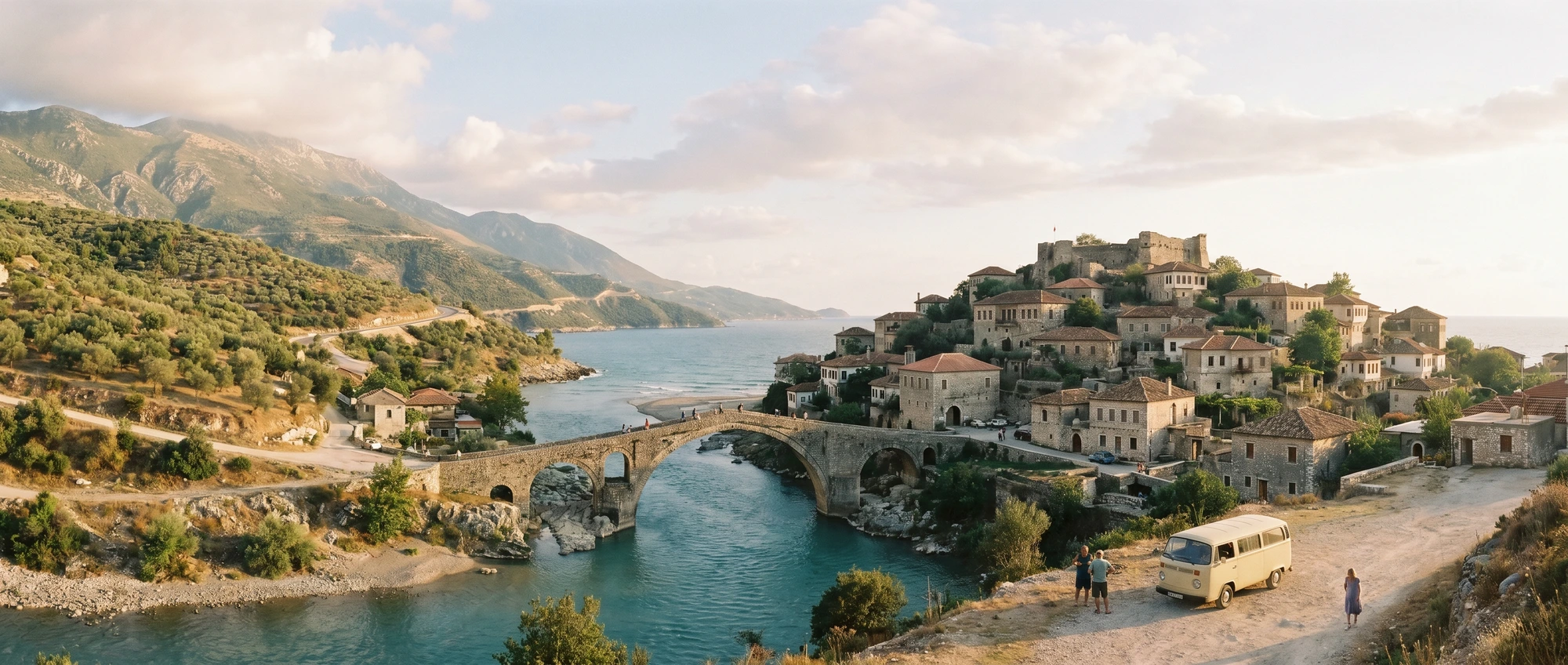
Albania is the Mediterranean trip that’s still genuinely cheap, and it’s only about three hours from London — Wizz Air and Ryanair fares dip under £100 return. You get Greek-quality beaches on the Riviera, Ottoman hill towns like Berat and Gjirokastër, and the dramatic Accursed Mountains in the north, at a fraction of what the same scenery costs in Greece or Croatia next door. This guide is built around the two decisions that actually move the needle before you book — your health cover and how you’ll get around — plus the UK-specific details competitor pages gloss over: the passport rule that’s stricter than you’d expect, the lek-versus-euro question, the plug in the wall and the price in pounds.
The short version
- You get 90 days visa-free in any 180-day period — but your passport needs at least 3 months left beyond your departure date.
- Your GHIC is worthless in Albania and medical facilities are poor outside Tirana — insure with a high medical-evacuation limit.
- Albania has among the highest road-death rates in Europe; lean on the cheap furgon minibuses before you reach for a hire car.
- Carry lek — euros are taken on the coast but at a worse rate, and ATM fees run a flat €5–8 a withdrawal.
- Do the south (Riviera plus a hill town) or the northern Alps, not both, on anything under 12 days.
Entry requirements for UK travellers
Albania is simple to enter on a UK passport: 90 days visa-free in any 180-day period for tourism or business, with no application before you fly. The one thing to check now is validity — your passport needs at least three months left beyond the date you leave Albania, which is stricter than the “valid for your trip” rule some countries use. British dual nationals must carry a valid British passport to re-enter the UK. Everything below is taken from the GOV.UK foreign travel advice for Albania; rules can change, so confirm on GOV.UK before you travel.
The pre-departure work that genuinely matters here isn’t paperwork. Albania sits outside the EHIC scheme, so your GHIC does nothing and you pay for treatment, and GOV.UK rates medical facilities as poor outside Tirana. The other everyday catch is water: don’t drink it from the tap, stick to bottled, and make sure milk is UHT or pasteurised.
Key points before you book
- 90 days visa-free in any 180-day period for UK tourists — no pre-application needed (GOV.UK).
- Passport valid for at least 3 months beyond your departure date from Albania (GOV.UK).
- No GHIC cover and poor medical facilities outside Tirana — insurance with evacuation cover is essential (GOV.UK).
- Among the highest road-death rates in Europe — drive defensively or skip the hire car (GOV.UK).
- Don't drink the tap water; stick to bottled, and milk should be UHT or pasteurised (GOV.UK).
- Drug possession means 5–10 years' jail; airports use advanced detection (GOV.UK).
- Rules can change — confirm on GOV.UK before you travel.
Passport validity
Your passport must have at least 3 months' validity beyond the date you leave Albania (GOV.UK). That's stricter than the 'valid for your trip' rule some countries use, so check the expiry date before you book — a passport with under three months left when you fly home can see you turned back at the border.
Visas
UK citizens can visit Albania visa-free for up to 90 days in any 180-day period, for tourism or business, with no application before you travel (GOV.UK). British dual nationals must carry a valid British passport or certificate of entitlement to re-enter the UK.
Health
There is no UK–Albania reciprocal healthcare deal, so your GHIC/EHIC is useless and you pay for treatment. GOV.UK rates medical facilities as poor, especially outside Tirana, and advises holding comprehensive travel insurance with accessible funds for medical evacuation — a serious case may mean being flown out. Don't drink the tap water; stick to bottled, and make sure milk is UHT or pasteurised. A yellow fever certificate is required only if you're arriving from a country where it's a risk. Check vaccine recommendations on TravelHealthPro at least 4–6 weeks before you go.
Safety & security
GOV.UK says reports of crime targeting foreigners are rare, though pickpocketing happens in tourist areas and on public transport in the larger cities. Terrorist attacks can't be ruled out and could be indiscriminate. The standout risk here isn't crime — it's the roads: Albania has among the highest road-death rates in Europe, with poor surfaces and erratic driving. Natural hazards include earthquakes (tremors are common), winter flooding (December–February, worst in northern Albania), wildfires (April–October), and unexploded landmines in remote areas near the northern border with Kosovo — stay on marked paths and avoid uncultivated land near the borders.
Local laws & customs
Drug laws are severe: possession carries 5–10 years' imprisonment and supplying up to 15, and the airports use advanced detection technology (GOV.UK). Causing a wildfire or forest fire is a criminal offence carrying fines or imprisonment, so take real care with cigarettes and barbecues in the dry April–October season (GOV.UK). Emergency numbers are 112 for police, 127 for ambulance and 128 for fire.
GOV.UK is the official source for Albania entry rules — always check it before you book.
Read GOV.UK adviceGOV.UK updated 10 Dec 2025 · Departly checked 9 Jun 2026
Why insurance, not your GHIC, is the one to get right
Your GHIC does nothing in Albania
Albania isn’t part of the UK’s reciprocal healthcare arrangements, so the GHIC you’d use in the EU is worthless here and you pay for treatment. GOV.UK rates medical facilities as poor — especially outside Tirana — and advises holding comprehensive travel insurance with accessible funds for medical evacuation, because a serious case can mean being flown abroad. The evacuation cover, not a routine clinic visit, is the expensive part to protect against.
Buy it the same day you book the flights, before the dates blur into the holiday. Beyond the headline medical cover, check the medical-evacuation limit is genuinely high, and — because so much of Albania’s appeal is active — confirm that hiking the Theth–Valbona trail, driving, and Riviera boat trips are covered if you plan to do them.
Travel insurance for Albania
This is the one to get right. There's no UK–Albania reciprocal healthcare deal, so your GHIC does nothing, and GOV.UK rates medical facilities as poor — especially outside Tirana — and tells you to have accessible funds for medical evacuation. A serious case can mean being flown abroad.
- Buy comprehensive cover with emergency medical, hospital and crucially repatriation/evacuation — from ~£20pp for a single trip.
- Check the medical-evacuation limit is high; getting flown out of Albania to better care is the expensive part, not a clinic visit.
- If you'll hike the Alps, drive, or do boat trips on the Riviera, confirm those activities are covered.
Flights from the UK
Tirana is Albania’s only international airport, and it’s well served from London: Wizz Air from Gatwick and Luton, Ryanair from Stansted and British Airways from Heathrow, with around 86 London–Tirana flights a week in summer 2026 and a flight time of about three hours. The low-cost carriers are the value play — return fares dip under £100 — while BA tends to run £200–£350. If you’re heading straight for the southern Riviera (Sarandë, Ksamil), it’s worth pricing up a flight to Corfu and the 30-minute ferry across, which often beats the five-hour drive south from Tirana.
Flights from the UK
Short-haulWizz Air flies direct from Gatwick and Luton, Ryanair from Stansted, and British Airways from Heathrow; there are around 86 London–Tirana flights a week in summer 2026. Tirana is Albania's only international airport, so for the southern Riviera (Sarandë, Ksamil) some UK travellers instead fly to Corfu and take the 30-minute ferry across — often cheaper and quicker than the 5-hour drive south from Tirana.
Fly from
Main arrival airports
- TIA Tirana (Nënë Tereza) — Albania's only international airport; ~25 min and ~€4/400 lek by airport bus to central Tirana
When to go
July and August are the beach peak — coastal temperatures in the mid-30s°C, packed beaches dominated by the returning Albanian diaspora and Corfu day-trippers, the Vlorë–Sarandë road clogged, and the highest prices of the year. For the best balance of warm, swimmable weather and breathing room, target May–June or September–October instead. Early June is the sweet spot on the Riviera: warm enough to swim, before the diaspora arrives in force.
When to go
Sweet spot: May–June and September–October are the best-balanced windows: warm, reliable weather, sea temperatures still good for swimming into September, lighter crowds and better prices than peak. Early June is the sweet spot on the Riviera — warm enough to swim, before the Albanian diaspora arrives in force. July and August are hot (coastal mid-30s°C, inland up to 38°C) and busy, with packed beaches, the Vlorë–Sarandë road clogged and prices at their highest.
Spring (April–June) greens the country and fills the rivers; the Alps trails are reliably open from roughly June. July and August are the beach peak — hot, crowded and pricey, dominated by returning Albanian diaspora and Corfu day-trippers. September stays warm with the sea still swimmable and crowds thinning fast; October is mild and quiet, good for the hill towns and the last warm beach days. Winter (December–February) is cool and wet with flooding risk, and many coastal hotels and ferries scale right back — it's a Tirana-and-culture season, not a beach one.
What it costs
Everything here is priced in pounds at roughly €1.17 and 115 lek to £1 (June 2026). Direct return flights from London run as low as £60–£150 on Wizz Air and Ryanair, and a mid-range seven-night trip for two — flights, hotels, food, buses and a boat trip — comes to around £1,150, or about £575 each before a hire car. Day-to-day, Albania is still cheap by Western-European standards: a byrek pastry is under a pound, an espresso under 90p, and a restaurant main course a few pounds. It’s no longer Europe’s bargain basement — prices have risen sharply with the tourism surge — but it’s well under what the same trip costs in Greece or Croatia.
What it costs
Direct return from London runs roughly £60–£150 in economy on Wizz Air, Ryanair and easyJet routings, dipping under £50 on cheap off-season dates and topping £200+ in the July–August peak. British Airways from Heathrow is pricier, often £200–£350 return. The cheapest months are October to April; the dearest are July and August, when the Albanian diaspora returns and coastal demand spikes.
Daily budget per person
| Byrek (filled pastry) from a bakery | ~£0.90 |
|---|---|
| Espresso in a café | ~£0.45–0.90 |
| Local beer (Korça/Tirana) | ~£0.90–2.60 |
| Restaurant main course | ~£4.30–13 |
| Furgon (minibus) short hop, e.g. Sarandë–Ksamil | ~£1.30 / 150 lek |
| Hostel dorm bed in Tirana, per night | ~£9–17 |
All figures here use £1 ≈ €1.17 ≈ 115 lek (June 2026). Albania is no longer Europe's bargain basement — prices have risen sharply with tourism — but a meal, a beer and a coffee still cost a fraction of Greece or Croatia next door.
A realistic first-trip itinerary
The mistake most first-timers make is trying to do the whole country in a week — Albania is small on the map but slow on the road. A realistic 7-day trip is Tirana plus a southern loop: a hill town like Berat or Gjirokastër, then down to the Riviera. The Albanian Alps (Theth, Valbona) are spectacular but sit in the opposite, northern corner and want their own 3–4 days. Don't try to bolt them onto a coast trip on anything under 12 days. This is a 7-day skeleton.
- 1Days 1–2
Tirana
Land at Tirana airport and take the ~25-minute airport bus (€4/400 lek) into the centre. Skanderbeg Square, the colourful blocks, the Bunk'Art Cold-War bunker museums and the Dajti Express cable car for a view fill two easy days. Tirana is your cheapest base for stocking up on lek and sorting onward bus tickets.
- 2Days 3–4
Berat or Gjirokastër
Take an intercity bus south (~2.5h to Berat, ~4h to Gjirokastër) to an Ottoman UNESCO hill town. Berat is the 'town of a thousand windows' with a hilltop castle you can still live inside; Gjirokastër is the stone-roofed town nearer the coast. Pick one on a 7-day trip — doing both eats a day in transit.
- 3Days 5–6
The Riviera — Sarandë and Ksamil
Continue to Sarandë, the southern coast's hub, and day-trip to the turquoise coves of Ksamil (a ~£1.30 furgon hop) and the Greek-and-Roman ruins of Butrint. This is the postcard Albania, and it's busy in July–August — go shoulder-season if you can. Sarandë is also 30 minutes by ferry from Corfu.
- 4Day 7
Back to Tirana, or fly from Corfu
It's a long ~5-hour drive or bus back to Tirana airport, so build in a buffer day rather than flying out the same evening. Alternatively, if your flights allow, take the Sarandë–Corfu ferry and fly home from Corfu — often quicker and cheaper than backtracking north.
Where to base yourself
In Tirana, base yourself in central Blloku — the former communist-elite quarter, now the most walkable café-and-bar district — rather than out near the airport, which is 25 minutes away with nothing around it. On the coast, Sarandë is the practical hub for Ksamil, Butrint and the Corfu ferry, with the widest choice of hotels; Ksamil itself puts you on the best beaches at first light but is quiet out of season and pricier in peak. For the hill towns, family-run guesthouses inside the UNESCO old quarters of Berat or Gjirokastër run €15–25 with breakfast. Theth and Valbona in the Alps are worth it only if you’ve built the three to four days a mountain leg needs.
Blloku / central Tirana
The former communist-elite quarter, now Tirana's café-and-bar district and the most walkable base for the museums and Skanderbeg Square. Mid-range hotels and apartments cluster here. Skip booking near the airport — it's 25 minutes out with nothing around it.
Good for: First nights, nightlife and easy onward transport
Sarandë (Riviera hub)
The biggest southern-coast town and the practical base for Ksamil, Butrint and the Corfu ferry, with the widest choice of hotels and the cheapest off-season rates. The seafront gets loud and built-up in peak summer; quieter the rest of the year.
Good for: Riviera logistics and the Corfu connection
Ksamil
The turquoise-cove village just south of Sarandë — staying here puts you on the best beaches at first light before the day-trippers arrive, but it's quiet out of season and pricier in July–August. A car or reliable furgon timing helps.
Good for: Beach-first travellers
Berat or Gjirokastër old towns
Family-run guesthouses inside the UNESCO quarters, often in restored Ottoman houses with breakfast included, for €15–25 a night. Atmospheric and cheap, with the trade-off of cobbled, car-unfriendly lanes.
Good for: Atmosphere and budget on a hill-town stop
Theth or Valbona (the Alps)
Guesthouses deep in the northern mountains, usually with dinner and breakfast included, and the base for the famous Theth–Valbona day hike. Only worth it if you've built the 3–4 days the Alps need — they're nowhere near the coast.
Good for: Hikers on a dedicated mountain leg
Getting around — and whether to hire a car
Getting around Albania
Albania has no useful passenger rail network for tourists, so the country runs on buses — and the workhorse is the furgon, a shared minibus that leaves when it's full rather than to a fixed timetable. They're dirt cheap (a Sarandë–Ksamil hop is around 150 lek / £1.30) and cover nearly every route, but they take cash in lek, rarely post schedules online, and you often just turn up at the town's bus area and ask. Larger intercity coaches link Tirana with Berat (~2.5h), Gjirokastër (~4h) and Sarandë (~5h). The single biggest decision is whether to hire a car. The freedom is real — the Riviera and the Alps reward it — but GOV.UK flags that Albania has among the highest road-death rates in Europe, with poor surfaces, unlit roads and erratic local driving, and Albania drives on the right. If you do hire, take full insurance, avoid driving at night, and don't expect a Greek hire car to be allowed across the border. For the south specifically, the Sarandë–Corfu ferry (30 minutes, from ~€35) is often the smartest way in or out.
- There's no useful tourist rail network — plan on buses, the furgon minibus, or a hire car.
- Furgons are cash-only in lek, leave when full, and rarely have online schedules — turn up and ask at the bus area.
- Intercity coaches from Tirana: Berat ~2.5h, Gjirokastër ~4h, Sarandë ~5h.
- Weigh a hire car carefully — Albania has among Europe's highest road-death rates (GOV.UK); avoid driving at night.
- Albania drives on the right, and a hire car from Corfu/Greece usually can't cross into Albania.
- For the southern Riviera, the 30-minute Sarandë–Corfu ferry (from ~€35) is often quicker than the drive from Tirana.
The single biggest call is the hire car. The freedom is real — the Riviera coast road and the northern Alps genuinely reward having your own wheels — but GOV.UK flags that Albania has among the highest road-death rates in Europe, with poor surfaces, unlit roads and erratic local driving, and the country drives on the right. For most coast-and-hill-town trips, the cheap furgon minibuses (a Sarandë–Ksamil hop is about £1.30) and intercity coaches cover the routes without the risk. If you do hire, take full insurance, never drive at night, and don’t expect a Greek hire car to be allowed across the border.
Staying connected
Albania sits outside UK networks’ inclusive EU roaming zones, so EE, Vodafone and Three charge here — daily passes don’t always apply and out-of-bundle data can hit around £6 per GB. A travel eSIM at £5–£15 for the whole trip is the obvious value move; install it before you fly and activate on landing. Pair it with offline maps, because furgon stops, guesthouses and Alpine trailheads aren’t always signposted or searchable on the move.
Stay connected in Albania
Albania sits outside UK networks' inclusive EU roaming zones, so EE, Vodafone and Three charge roaming fees here — daily passes don't always apply, and out-of-bundle data can hit ~£6 per GB. Over a week or two that adds up fast, and signal in the mountains and on Riviera back roads can be patchy.
- A travel eSIM is typically £5–£15 for 5–10GB for the whole trip — a 60–80% saving on roaming.
- Install it before you fly and activate on landing; Tirana airport wifi is fine for setup but the coast isn't blanketed.
- Pair it with offline Google Maps — furgon stops, guesthouses and trailheads aren't always signposted or searchable on the move.
Money: lek, euros and the cards rule
Albania uses the lek (around 115 to £1 in June 2026), and while euros are widely accepted on the coast and for hotels, you'll get a poorer rate paying in euros than in lek — and inland, in taxis and in bakeries it's lek only. The practical kit: a fee-free Visa or Mastercard for cards-accepted spots, plus enough lek for everyday spending. Withdraw lek from a bank ATM (Credins, Raiffeisen, BKT) rather than the Euronet machines you'll see everywhere, which charge worse rates and fees; Albanian ATM withdrawal fees run a flat €5–8 a time regardless of amount, so take out larger sums less often. Two rules that save money: when a card terminal or ATM asks whether to charge in GBP/EUR or lek, always choose lek (choosing your home currency triggers dynamic currency conversion at a poor rate), and don't change money at the airport or hotels — the rate is markedly worse than in town.
Fee-free travel money
Skip the airport exchange desk — a fee-free travel card gives you the real exchange rate abroad.
Before you fly
Two small UK-specific jobs round out the trip: pre-book your airport parking, which is almost always cheaper booked ahead than on the day, and double-check the essentials before you fly — insurance, the passport-validity rule, bottled water.
Airport parking & lounges
Pre-book your UK airport parking or a lounge — it's almost always cheaper booked ahead than on the day.
How we know this
How we know this
- GOV.UK foreign travel advice — Albania — entry, passport validity, visa, health, safety and local laws
- NHS Fit for Travel / TravelHealthPro — vaccine recommendations and travel-health advice
- Wizz Air, Ryanair & Google Flights — London–Tirana routes, frequency and indicative fares
- Direct Ferries & Ferryhopper — Sarandë–Corfu ferry times and prices
GOV.UK last updated 10 Dec 2025.