


In short
What do UK travellers most need to know before booking South Africa?
UK passport holders get 90 days visa-free (no advance application), flights are ~11h30 overnight from Heathrow with almost no jet lag, and there's no GHIC cover so comprehensive insurance is essential. Plan around two things: pre-book your airport transfers, and pick your safari area around malaria — the northern Kruger is a malaria zone, the Eastern Cape's reserves aren't.
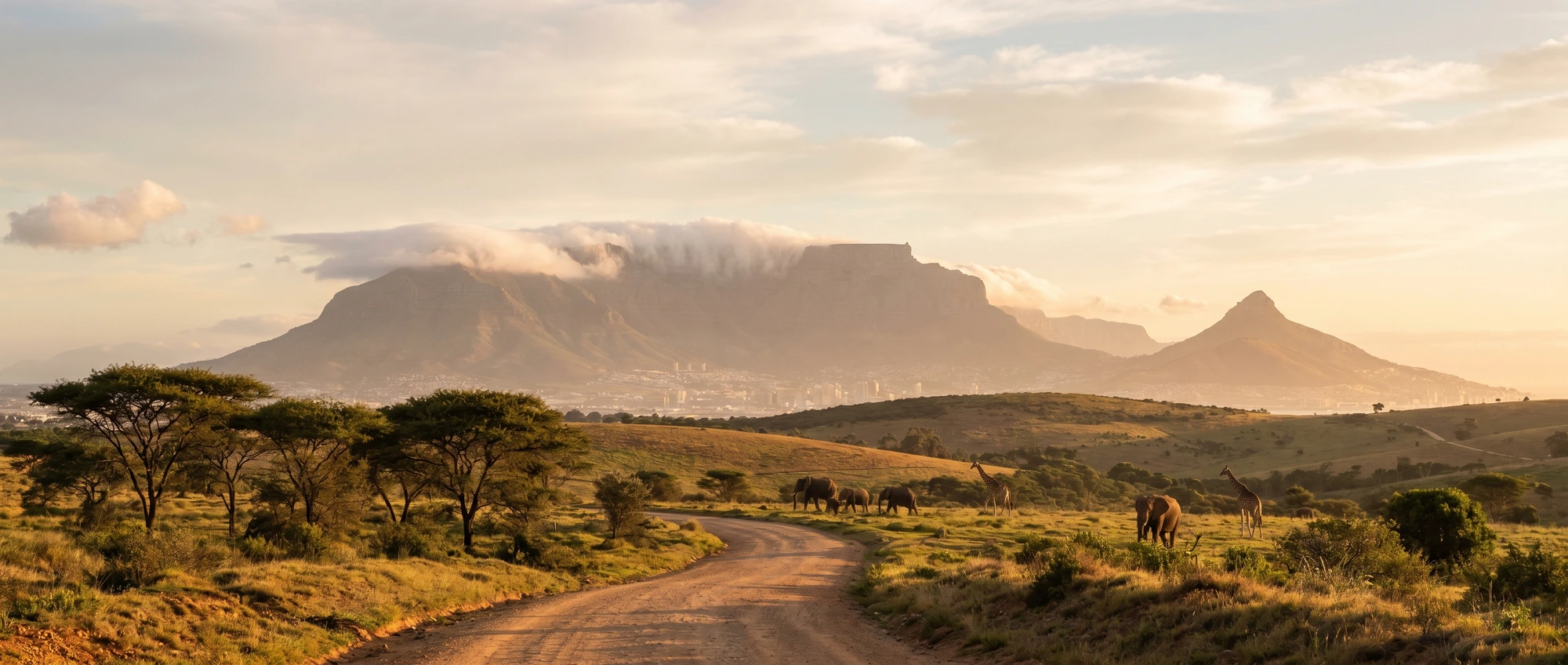
South Africa is really two holidays in one country, and the trip goes wrong when you treat it as a single destination. Cape Town and the Garden Route are a relaxed, easy self-drive coast holiday; the Kruger and the bushveld are a Big Five safari that runs on the opposite season and a different climate altogether. This guide is built around getting those two halves to fit together, plus the three decisions that actually move the needle before you book — your health cover, your airport transfers and your safari malaria call — and the UK-specific details competitor pages skate over: the plug in the wall, the card in your pocket and the price in pounds.
The short version
- Fly the long internal legs (Cape Town to a Kruger gateway) rather than driving 1,500km — it saves you two days.
- Pre-book your airport transfer, especially at Johannesburg OR Tambo — improvising at arrivals is the main avoidable risk.
- Your GHIC is worthless in South Africa — buy comprehensive insurance with medical and repatriation cover.
- Pick your safari by malaria: the northern Kruger is a risk zone, the Eastern Cape's reserves are malaria-free.
- Bring a Type M (South Africa) plug adapter — a European two-pin one often won't fit the main socket.
Entry requirements for UK travellers
South Africa is straightforward to enter on a UK passport — 90 days visa-free for tourism, with no application before you fly — but the passport rules are stricter than the ones you’re used to for Europe. Your passport must be valid for at least 30 days beyond your departure date and contain at least two completely blank pages; a full-but-in-date passport can still be turned away. Everything below is taken from the GOV.UK foreign travel advice for South Africa; rules can change, so confirm on GOV.UK before you travel.
The detail that catches families out is child travel. South Africa has unusually strict documentation rules for anyone under 18: you may need the child’s full unabridged birth certificate, and for a child travelling with only one parent or unaccompanied, parental-consent letters as well. Sort this weeks ahead — an unabridged certificate can take time to obtain.
Key points before you book
- 90 days visa-free for UK tourists — no pre-application needed (GOV.UK).
- Passport valid for 30 days beyond departure with at least 2 blank pages (GOV.UK).
- Travelling with under-18s needs extra documents (unabridged birth certificate, consent letters) — check before you fly (GOV.UK).
- No GHIC cover — treatment is paid in full, so comprehensive insurance is essential (GOV.UK).
- Malaria risk in the northern Kruger, Limpopo and Mpumalanga, highest Nov–Apr — check TravelHealthPro for your route.
- Yellow fever certificate needed only if arriving from a transmission-risk country; not from the UK (GOV.UK).
- Pre-book airport transfers — visitors have been followed from OR Tambo and robbed (GOV.UK).
- Rules can change — confirm on GOV.UK before you travel.
Passport validity
Your passport must have an expiry date at least 30 days after the day you leave South Africa, and it must contain at least 2 completely blank pages for entry and exit stamps (GOV.UK). The blank-page rule catches people out: a passport that's full of stamps but technically in date can still be refused at the border.
Visas
UK tourists can visit visa-free for up to 90 days for tourism or business, with no application before you travel (GOV.UK). Check the date written on your entry stamp and don't overstay — South Africa is strict on overstays and can ban you from returning. There are special rules for anyone travelling with children aged 17 and under, and stricter rules again for children travelling unaccompanied or with only one parent: carry the child's full unabridged birth certificate and, where relevant, parental-consent documents (GOV.UK / SA Department of Home Affairs).
Health
There's no UK–South Africa healthcare agreement, so your GHIC does nothing and you pay the full cost of any treatment (GOV.UK). Private hospitals in Cape Town and Johannesburg are excellent but charge international prices, so comprehensive insurance with medical and repatriation cover is essential. Malaria is a real consideration: the lowveld of the northern Kruger and parts of Limpopo and Mpumalanga carry a malaria risk (highest in the wet summer, roughly November to April), so check whether antimalarials are recommended for your exact route and dates on TravelHealthPro. You must show a yellow fever vaccination certificate only if you're arriving from a country listed as a transmission risk — coming directly from the UK, you don't need one. Check all vaccine recommendations at least 8 weeks before you travel.
Safety & security
South Africa has a high crime rate, and tourists are mainly affected by opportunistic and vehicle crime rather than random violence — but the risks are specific and worth planning around (GOV.UK). Carjacking and 'smash and grab' attacks happen at junctions and traffic lights, so drive with doors locked and windows up and leave nothing on the seats. GOV.UK flags repeated violent muggings of hikers on Table Mountain National Park — including Lion's Head and Signal Hill — so walk the popular trails in daylight, in groups, and avoid quiet sections early or late. Around Cape Town airport, stay on the M3 and N2 rather than the R300, and follow the signed airport approach road. The single most important rule is at arrivals: criminals have followed visitors from OR Tambo in Johannesburg and robbed them, so pre-arrange a hotel or tour-operator transfer rather than improvising.
Local laws & customs
Personal cannabis use by adults in a private space is legal, but every other drug offence — possession, use or trafficking — carries severe penalties (GOV.UK). The drink-drive limit is a blood-alcohol level of 0.05%, lower than England's, so don't drive after a drink. Same-sex relationships are legal and South Africa has strong anti-discrimination protections, the most progressive in Africa. Carry a copy of your passport photo page and entry stamp rather than the original where you can, and use ATMs inside banks or malls — crime around ATMs and bureaux de change is common, so shield your PIN and don't let 'helpful' strangers near the machine.
GOV.UK is the official source for South Africa entry rules — always check it before you book.
Read GOV.UK adviceGOV.UK updated 11 May 2026 · Departly checked 9 Jun 2026
Why insurance, not your GHIC, is the one to get right
Your GHIC does nothing in South Africa
There’s no UK–South Africa reciprocal healthcare agreement, so the GHIC you’d use in Europe is worthless here. GOV.UK is explicit that you should expect to pay the full cost of any treatment, and South Africa’s excellent private hospitals often want payment or a guarantee up front. Comprehensive travel insurance with emergency medical, hospital and repatriation cover is essential, not optional.
Buy it the same day you book the flights, before the dates blur into the holiday. Beyond the headline medical cover, check that your specific activities are included: some basic policies exclude self-drive, game drives or the light-aircraft transfers some lodges use, and a medical evacuation from a remote reserve is exactly when you don’t want a gap.
Travel insurance for South Africa
This is the one to get right. There's no UK–South Africa reciprocal healthcare deal, so your GHIC does nothing and you pay the full cost of any treatment (GOV.UK). South Africa's private hospitals are world-class but charge accordingly, and you'll likely need to pay or guarantee payment up front.
- Buy comprehensive cover with emergency medical, hospital and repatriation — from ~£25pp for a single trip.
- Check that self-drive and safari activities (game drives, light aircraft transfers, hiking) are covered — some basic policies exclude them.
- Declare any pre-existing conditions, and given a remote-area medical evacuation is expensive, don't skimp on the medical and repatriation limits.
Staying safe — the rules that actually matter
South Africa has a high crime rate, and that fact deters a lot of travellers who’d be perfectly fine. The honest picture from GOV.UK: tourists are mainly affected by opportunistic and vehicle crime rather than random violence, and the risks are specific enough to plan around. Three rules carry most of the weight. First, pre-book your airport transfer — criminals have followed visitors from OR Tambo in Johannesburg and robbed them, so don’t improvise a taxi at arrivals. Second, drive with doors locked and windows up, and leave nothing on the seats; smash-and-grabs happen at junctions. Third, walk Table Mountain’s trails — including Lion’s Head and Signal Hill — only in daylight and in a group, after repeated violent muggings of hikers. In the cities, take an Uber after dark rather than walking, and withdraw cash inside banks or malls.
Flights from the UK
British Airways flies nonstop from Heathrow to both Cape Town and Johannesburg year-round, and Virgin Atlantic runs Heathrow–Cape Town from mid-October into the southern summer. The block time is about 11h30, and because the flights leave the UK in the evening and land the next morning — with South Africa only one or two hours ahead — you arrive with almost no jet lag, which is a real advantage over Asia or the Americas. From Manchester and other regional airports you connect through a Gulf or European hub. For a first trip, fly into Cape Town: it’s the gentler arrival and the natural start of the route.
Flights from the UK
Long-haul (overnight, almost no jet lag)British Airways flies nonstop from Heathrow to both Cape Town and Johannesburg year-round; Virgin Atlantic runs a Heathrow–Cape Town route from mid-October into the southern-hemisphere summer. Flights leave the UK in the evening and arrive the next morning, and because South Africa is only 1–2 hours ahead there's almost no jet lag — a major advantage over Asia or the Americas. From Manchester and other UK airports you connect through a hub such as Doha, Dubai, Amsterdam or Frankfurt.
Fly from
Main arrival airports
- CPT Cape Town — the better arrival point for a first trip; ~20–30 min and ~£12–18 by metered taxi or Uber to the City Bowl
- JNB Johannesburg OR Tambo — the main hub and the usual jumping-off point for Kruger; arrange a pre-booked transfer, don't take a random taxi
- DUR Durban King Shaka — the third gateway, handy for the warmer KwaZulu-Natal coast
When to go
There’s no single best time, because Cape Town and the Kruger run on opposite seasons. For a Cape Town and Garden Route beach-and-wine trip, target the dry southern summer of roughly November to March. For a Kruger safari, the dry winter of May to September is best — the bush thins out, animals gather at waterholes, and malaria risk is lowest. The months that combine both well are April–May and September–October: good Cape weather, prime game viewing, lower prices and smaller crowds.
When to go
Sweet spot: There's no single best time, because Cape Town and the Kruger run on opposite seasons. For a Cape Town and Garden Route beach-and-wine trip, target the dry southern summer, roughly November to March. For a Kruger safari, the dry winter of May to September is best: the bush thins out, animals gather at waterholes, and malaria risk is at its lowest. The shoulder months of April, May, September and October are the sweet spot for combining both — decent Cape weather, prime game viewing, lower prices and smaller crowds.
December and January are Cape Town's hot, dry, sunny peak — and also the busiest and priciest, overlapping the South African school holidays, so book months ahead. February and March stay warm and quieter. April and May bring crisp, clear autumn days, great value, and the start of prime safari season. June to August is Cape winter — cooler and wetter on the coast, but the best, driest game viewing in the Kruger, plus whale watching at Hermanus from June. September and October are the all-round sweet spot: spring flowers in the Western Cape, excellent game viewing before the rains, and fewer crowds. Wildflower season on the West Coast and Namaqualand peaks in August–September.
What it costs
Everything here is priced in pounds at roughly R22 to £1 (June 2026), and the rand moves a lot, so check the live rate. Direct return flights from Heathrow run about £600–£950, and on the ground South Africa is superb value — a mid-range restaurant main is £6–11 and a glass of Stellenbosch wine under three pounds. A mid-range 11-night trip for two — Cape Town, the Garden Route and a few nights’ safari — comes to around £4,500–£4,900 including flights. The single biggest variable is the safari: a self-drive in the Kruger national park is a fraction of a private Sabi Sand reserve.
What it costs
Direct return economy from Heathrow runs roughly £600–£950 to Cape Town or Johannesburg, dipping toward £550 on cheap dates and topping £1,000+ over the December–January southern-summer peak. The best-value months are roughly April–May and September–October. Book around 6–10 weeks out; the Christmas school-holiday period is both the priciest to fly and the most crowded on the ground.
Daily budget per person
| Restaurant main course (mid-range) | ~£6–11 |
|---|---|
| Glass of Stellenbosch wine | ~£2.50–4 |
| Uber across central Cape Town | ~£3–5 |
| Kruger park entry, per adult per day (intl.) | ~£22 |
| Litre of petrol | ~£1.00–1.10 |
| Mid-range guesthouse double, per night | ~£55–110 |
All rand figures use £1 ≈ R22 (June 2026); the rand moves a lot, so check the live rate. The biggest variable by far is the safari — a self-drive in the Kruger national park is a fraction of a private Sabi Sand reserve.
A realistic first-trip itinerary
The classic first trip pairs Cape Town and the Garden Route — a self-drive coast holiday — with a few nights on safari, usually in or near the Kruger. The mistake is trying to do all of South Africa in one go: the country is the size of France plus Spain, and internal hops eat days. This 11-day skeleton does Cape Town, a slice of the Garden Route, then flies to a safari, rather than driving the 1,500km between them. Fly the long internal legs; drive the scenic short ones.
- 1Days 1–4
Cape Town and the Cape Peninsula
Land at Cape Town in the morning (almost no jet lag) and base in the City Bowl, Sea Point or the V&A Waterfront. Do Table Mountain by cableway on a clear, windless morning — book online and go early, as it shuts in high wind. Drive the Cape Peninsula loop to Boulders Beach penguins and Cape Point, and give a day to the Stellenbosch or Franschhoek winelands. Walk Table Mountain's popular trails only in daylight and in a group (GOV.UK).
- 2Days 5–7
The Garden Route self-drive
Pick up a hire car and drive east along the N2: Hermanus (whale watching June–November), then Knysna and Plettenberg Bay. This stretch is the easy, safe, scenic part of South African driving — good roads, English signage, dramatic coast. Keep the tank above half-full, lock the doors, and don't drive the rural sections after dark.
- 3Day 8
Fly to your safari
Drop the car and fly from George or Cape Town to a safari gateway — Hoedspruit, Skukuza (inside Kruger) or Nelspruit (Mbombela) for the greater Kruger, or Port Elizabeth (Gqeberha) for the malaria-free Eastern Cape reserves. This single flight saves you two long driving days versus going overland.
- 4Days 9–11
Safari, then fly home
Two to three nights is the realistic minimum to reliably see the Big Five. A self-drive in the Kruger national park is cheap but you do your own spotting; a lodge with a ranger and tracker costs more but delivers far more game. Fly back via Johannesburg or Cape Town for your evening flight home — and arrange a transfer for any airport leg rather than hailing a taxi.
Where to base yourself
In Cape Town, the City Bowl or Gardens is the best all-round first-timer base, with Sea Point and the gated, patrolled V&A Waterfront as the secure-feeling alternatives and Camps Bay for a beach splurge. On the Garden Route, Knysna and Plettenberg Bay are the two stops worth an overnight, ideally in a guesthouse with secure parking. For the safari itself, the real decision is a SANParks rest camp inside the Kruger — affordable, and you self-drive — versus a private reserve like Sabi Sand or Timbavati, which costs far more but does the spotting for you with a ranger and tracker.
City Bowl / Gardens (Cape Town)
Central, walkable to the cafés and museums, and well placed under Table Mountain. The best all-round first-timer base — but as everywhere in the city, take an Uber after dark rather than walking unfamiliar streets late at night.
Good for: First-timers who want to be central
Sea Point / V&A Waterfront (Cape Town)
Sea Point is a lively seafront promenade with good restaurants; the V&A Waterfront is the safest-feeling, most tourist-polished pocket of the city, gated and patrolled, at a premium price. Both suit travellers who want a relaxed, secure base over central buzz.
Good for: A secure, relaxed seafront base
Camps Bay (Cape Town)
Beach-and-sunset glamour under the Twelve Apostles, with the city's priciest restaurants and rentals. Lovely for a few nights, but it's a 15-minute drive from the centre, so you'll lean on Ubers or a car.
Good for: Beach views and a splurge
Knysna / Plettenberg Bay (Garden Route)
The two best overnight stops on the Garden Route — lagoon and forest at Knysna, beaches at Plett. Book a guesthouse with secure parking, and use these as your base for whale watching and forest walks.
Good for: A Garden Route coast stop
Greater Kruger lodge vs SANParks rest camp
Inside the Kruger national park, SANParks rest camps (Skukuza, Lower Sabie, Satara) are affordable and let you self-drive. The private reserves bordering it — Sabi Sand, Timbavati — cost far more but include expert-guided game drives and off-road tracking. Choose by budget and how much you want the spotting done for you.
Good for: Your safari nights
Getting around
Getting around South Africa
South Africa runs on a hire car for the scenic legs and flights for the long ones — there's no useful intercity train for tourists. The good news for UK drivers: they drive on the left like home, the main roads are good, and signs are in English. A self-drive Garden Route is one of the world's great easy road trips. The cautions are real but manageable: keep doors locked and windows up at junctions (smash-and-grabs happen at lights), keep the tank above half, avoid rural driving after dark, and note that petrol is full-service — an attendant fills up and you tip R5–R20. In the cities, Uber and Bolt are cheap, widespread and the smart way to get around after dark — a cross-town Cape Town Uber is about £3–5. For the long Cape Town–to–Kruger distances, fly: a domestic hop is a couple of hours against two days of driving. Don't rely on minibus taxis as a tourist — they're a local commuter network, not a tourist service.
- Hire a car for the Garden Route and Cape Peninsula — easy, scenic and on the left like the UK.
- Keep doors locked and windows up at traffic lights; don't leave anything visible on the seats (GOV.UK).
- Fly the long legs (e.g. Cape Town to a Kruger gateway) rather than driving 1,500km.
- Use Uber or Bolt in the cities, especially after dark — they're cheap and safer than walking late.
- Petrol is full-service; an attendant pumps it and you tip ~R5–R20 (about 25–90p).
- Pre-book airport transfers, particularly at Johannesburg OR Tambo (GOV.UK).
The mental model is simple: hire a car for the scenic short legs, fly the long ones, and Uber in the cities. A self-drive Garden Route is one of the world’s great easy road trips — good roads, English signage, dramatic coast — and UK drivers are already on the correct side. But don’t try to drive Cape Town to the Kruger; it’s about 1,500km, and a two-hour domestic flight saves you two days. Petrol is full-service, so an attendant fills your tank and you tip a few rand. Skip the minibus taxis, which are a local commuter network rather than a tourist service.
Staying connected
South Africa sits well outside the inclusive EU-style roaming zones, so UK networks charge a daily fee here — typically £5–£8 a day on Vodafone, EE or Three, far more than the ~£2.25 you’re used to in Europe. Over a fortnight that’s £50–£110+. A travel eSIM at £8–£20 for the trip is the obvious value move, and reliable data genuinely matters here for live-tracking your Uber and navigating. Install it before you fly; expect strong coverage in the cities and on the Garden Route, and patchier signal inside the reserves, where lodges run their own wifi.
Stay connected in South Africa
South Africa sits well outside the EU-style inclusive roaming zones, so UK networks charge a daily roaming fee here — typically around £5–£8 a day on Vodafone, EE or Three, far more than the ~£2.25/day you're used to in Europe. Over a 10–14 day trip that's £50–£110+.
- A travel eSIM is typically £8–£20 for a multi-day South Africa data plan — a large saving on daily roaming.
- Reliable mobile data matters here for live-tracking your Uber, navigating, and checking road and safety info — buy and install the eSIM before you fly.
- Coverage is strong in Cape Town, the Garden Route and the cities; expect patchy signal inside the Kruger and remote reserves, where lodges run their own wifi.
Money: cards, cash and the rand rule
South Africa is largely card-friendly: contactless Visa and Mastercard work in city restaurants, shops, fuel stations and most lodges, and you'll rarely need much cash in Cape Town or on the Garden Route. Carry some rand for tips, car guards, craft markets, park entry at smaller gates and rural fuel stops — R500–R1,000 (~£23–45) is plenty as a buffer. Withdraw from ATMs inside banks or malls rather than street machines, shield your PIN, and never accept help at the machine — ATM crime is common (GOV.UK). Tipping is expected: around 10–15% in restaurants (service is usually not included), R5–R20 for petrol attendants, R5–R10 for the informal car guards who watch your parked car, and roughly R100–R200 per guest per day for a safari ranger and tracker. When a card terminal or ATM offers to charge in GBP rather than rand, always choose rand — paying in pounds (dynamic currency conversion) gives you a poor rate and costs you 3–5%.
Fee-free travel money
Skip the airport exchange desk — a fee-free travel card gives you the real exchange rate abroad.
Before you fly
Two small UK-specific jobs round out the trip: pre-book your airport parking (almost always cheaper booked ahead than on the day) and double-check the essentials before you fly — insurance, malaria tablets, your transfers, the kids’ birth certificates — so nothing slips through in the last 48 hours.
Airport parking & lounges
Pre-book your UK airport parking or a lounge — it's almost always cheaper booked ahead than on the day.
How we know this
How we know this
- GOV.UK foreign travel advice — South Africa — entry, passport validity, visa, child-travel rules, health, safety and local laws
- NHS Fit for Travel / TravelHealthPro — malaria risk zones, vaccine and yellow-fever guidance
- SANParks & greater-Kruger reserves — park entry fees, rest camps and game-drive logistics
- South African Tourism — the Garden Route, the Cape Peninsula and seasonal guidance
GOV.UK last updated 11 May 2026.