





In short
What do UK travellers most need to know before booking India?
UK passport holders need an e-Tourist visa arranged online before flying — from about £20 for 30 days, applied for at the official indianvisaonline.gov.in site — not a visa on arrival. Flights are ~8h50 nonstop from Heathrow, your GHIC does nothing so comprehensive insurance is essential, and the Golden Triangle is far better done over a full week than the usual three-day dash.
India is the long-haul trip most UK travellers either rush or overthink. It’s closer than you’d guess — under nine hours nonstop from Heathrow, shorter than the Japan or Thailand haul — and the entry job is genuinely simple once you know it isn’t a visa on arrival. This guide is built around the three decisions that actually move the needle before you book: the visa you sort online, the insurance that replaces your useless GHIC, and the pace you give the classic Delhi–Agra–Jaipur loop. Plus the UK-specific details competitor pages skate over: the airport you fly from, the plug in the wall, the card in your pocket and the price in pounds.
The short version
- Apply for the e-Tourist visa online before you fly — from ~US$25 (£20) for 30 days, at the official indianvisaonline.gov.in only.
- Your passport needs 6 months' validity beyond arrival and 2 blank pages — stricter than many Asian destinations.
- Your GHIC is worthless in India — buy comprehensive insurance with medical and repatriation cover.
- Give the Golden Triangle a full week, not the usual three-day dash, and hire a car with a driver for the loop.
- The voltage is 230V like the UK, so you only need a plug-shape adapter (Type D/M), not a voltage converter.
Entry requirements for UK travellers
The single thing to get right about entering India is that there is no visa on arrival for UK tourists — you must arrange a visa before you fly. Almost everyone uses the e-Tourist visa, applied for online at the official indianvisaonline.gov.in site: you upload your passport photo page and a passport-style photo, pay the fee, and receive an Electronic Travel Authorisation by email to print and present at immigration. Apply at least 4 days before departure (the portal takes applications 4–120 days ahead), and complete the free online e-Arrival Card up to 72 hours before you land. Everything below is taken from the GOV.UK foreign travel advice for India; rules can change, so confirm on GOV.UK before you travel.
Two details catch UK travellers out. First, the passport rule is stricter than for somewhere like Japan: you need 6 months’ validity beyond arrival and 2 blank pages, so check the expiry before you book. Second, use only the official .gov.in portal — a wall of copycat sites rank well in search and charge large “service” mark-ups on the same visa.
Key points before you book
- UK tourists need an e-Tourist visa arranged online in advance — no visa on arrival (GOV.UK).
- Passport valid 6 months beyond arrival with 2 blank pages (GOV.UK).
- No GHIC cover — private treatment is paid in full, so comprehensive insurance is essential (GOV.UK).
- Check vaccines on TravelHealthPro 8 weeks ahead; never drink the tap water.
- Vapes and e-cigarettes are completely banned — don't bring them (GOV.UK).
- Avoid the Pakistan border (10km), Kashmir, Manipur and Naxalite areas (GOV.UK).
- Rules can change — confirm on GOV.UK before you travel.
Passport validity
Your passport must be valid for at least 6 months beyond your date of arrival and have at least 2 blank pages for the visa and stamps (GOV.UK). This is stricter than some Asian destinations, so check the expiry well before you book — a renewal can take weeks. Make sure the immigration officer actually stamps your passport on arrival, and keep the stamp safe; you'll need it to leave.
Visas
Most British citizens need a visa before they travel — there is no visa on arrival for UK tourists (GOV.UK). The usual route is the e-Tourist visa, applied for online at indianvisaonline.gov.in: upload your passport photo page and a passport-style photo, pay the fee, and you receive an Electronic Travel Authorisation by email to print and show at immigration. Fees are around US$25 (~£20) for 30 days, US$40 for one year and US$80 for five years, plus a roughly 2.5% bank charge. Apply at least 4 days before you fly (the portal allows 4–120 days ahead). You also complete a free online e-Arrival Card up to 72 hours before you land. Use only the official .gov.in site — copycat sites charge huge mark-ups. Overstaying is illegal.
Health
There is no GHIC/EHIC cover in India — you pay the full cost of any private treatment, often up front, so comprehensive insurance with medical and repatriation cover is essential (GOV.UK). Check vaccine recommendations on TravelHealthPro at least 8 weeks before you travel; typhoid, hepatitis A and others are commonly advised, and a yellow fever certificate is required only if you're arriving from a transmission-risk country. Dengue, malaria and chikungunya are present in parts of the country, so plan mosquito-bite avoidance. Severe air pollution is a major hazard in north India, especially October to February — anyone with a respiratory condition should speak to their doctor first. Tap water isn't safe to drink: stick to sealed bottled or filtered water and be careful with ice.
Safety & security
Terrorists are very likely to try to carry out attacks in India, so avoid large gatherings, especially around Republic Day (26 January), Independence Day (15 August), Diwali and Eid (GOV.UK). GOV.UK flags a risk of sexual assault, including attacks on female travellers in tourist areas, alongside pickpocketing and bag-snatching on buses and trains, drink spiking, methanol-tainted alcohol, and online and confidence scams. Several areas carry travel warnings: stay 10km clear of the India–Pakistan border, avoid Jammu and Kashmir (except the city of Jammu reached by air), and follow the all-but-essential warnings for Manipur and the Naxalite-affected eastern and central states. India also has one of the world's highest road-death rates — don't drive at night, and use app-based taxis like Uber or Ola rather than hailing on the street.
Local laws & customs
Alcohol is banned outright in some states — Bihar, Gujarat, Mizoram, Nagaland and Lakshadweep — where possession can mean a 5-to-10-year sentence, and public drinking is illegal nationwide (GOV.UK). E-cigarettes and vapes are completely banned; you can't import, buy or use them. Drug penalties are severe, with a minimum 6-month sentence even for small amounts and up to 10 years for larger quantities. Satellite phones and personal GPS devices are illegal without a licence, so leave them at home. Smoking in public places is restricted to designated areas. Dress modestly at temples and religious sites, and always ask before photographing people, military sites or airports.
GOV.UK is the official source for India entry rules — always check it before you book.
Read GOV.UK adviceGOV.UK updated 4 Jun 2026 · Departly checked 9 Jun 2026
Why insurance, not your GHIC, is the one to get right
Your GHIC does nothing in India
There is no UK–India reciprocal healthcare agreement, so the GHIC you’d use in Europe is worthless here. You pay the full cost of any private treatment, and good hospitals often want payment up front before they treat you. A serious case can need repatriation, which runs into five figures. Comprehensive travel insurance with emergency medical, hospital and repatriation cover is essential, not optional, for India.
Buy it the same day you book the flights, before the dates blur into the holiday. The most common claim in India is a straightforward stomach bug, so check that’s covered and keep every pharmacy and doctor receipt. If you’re planning anything beyond sightseeing — a trek, scooter hire, a tiger safari — confirm the policy actually covers it, because the standard tier often doesn’t.
Travel insurance for India
This is the one to get right. There is no UK–India reciprocal healthcare deal, so your GHIC does nothing and you pay the full cost of any private treatment — often demanded up front before you're treated. Good private hospitals in the big cities are excellent but not cheap, and a serious case may need repatriation.
- Buy comprehensive cover with emergency medical, hospital and repatriation — from ~£20pp for a single trip.
- Make sure the policy covers the activities you'll actually do — trekking, scooter hire or a tiger-safari add-on can need an upgrade.
- Stomach upsets are the most common claim; keep receipts for any pharmacy or doctor visit, and check the policy covers them.
Flights from the UK
Heathrow flies nonstop to Delhi and Mumbai on British Airways, Air India and Virgin Atlantic, and the honest block time to Delhi is around 8h40–9h eastbound — noticeably shorter than the long Asia hauls. Gatwick runs some seasonal direct service. From Manchester, Birmingham and other regional airports you connect through a Gulf hub such as Dubai, Doha or Abu Dhabi, which adds a few hours but frequently costs less than the direct fare. Delhi is the gateway for the Golden Triangle; Mumbai suits a western or southern trip.
Flights from the UK
Long-haulHeathrow flies nonstop to Delhi and Mumbai on British Airways, Air India and Virgin Atlantic, and the honest block time to Delhi is around 8h40–9h eastbound — shorter than the Japan or Thailand haul. Gatwick has some seasonal direct service. From Manchester, Birmingham and other UK airports you connect through a Gulf hub such as Dubai, Doha or Abu Dhabi, which often costs less than the direct fare.
Fly from
Main arrival airports
- DEL Delhi Indira Gandhi — the main northern gateway and the start of the Golden Triangle
- BOM Mumbai — the western and financial gateway, handy for Goa and the south
- GOI Goa Manohar (Mopa) — for a beach-first trip, usually via a hub or a domestic connection
When to go
For most of India, and the whole Golden Triangle, October to March is the sweet spot — dry, comfortable days of roughly 10–27°C and the easiest sightseeing. November and February are the peak: the best weather but the biggest crowds and the highest prices, so book hotels two to three months ahead. Avoid the April–June pre-monsoon heat in the north, when Delhi, Agra and Jaipur can hit 45°C, and weigh the July–September monsoon carefully — cheaper and greener, but genuinely wet.
When to go
Sweet spot: October to March is the sweet spot for most of India and the whole Golden Triangle — dry, comfortable days of roughly 10–27°C and the easiest sightseeing. November and February are the peak: best weather, biggest crowds, highest prices, so book hotels 2–3 months ahead. Avoid the April–June pre-monsoon heat in the north, when Delhi, Agra and Jaipur can hit 45°C, and weigh the July–September monsoon carefully — it's cheaper and greener but brings real downpours.
Winter (November–February) is the headline season: clear, cool and ideal for the north, though Delhi's morning air pollution can be severe from October to February and December nights are genuinely cold. March is a good-value shoulder, warming up and timed with Holi. April to June is brutally hot across the plains — this is when hill stations and the Himalayas come into their own instead. The southwest monsoon runs roughly July to September, soaking most of the country; it's the cheapest time and lush, but flooding and travel disruption are real, and it's better suited to Rajasthan's desert fringe or a monsoon-friendly Kerala trip than to the open-air forts of the triangle.
What it costs
Everything here is priced in pounds at roughly ₹128 to £1 (June 2026). Day-to-day, India is cheap: a street-food meal is a couple of pounds, an auto-rickshaw across town one or two. The bill is built elsewhere — direct return flights from Heathrow run about £450–£650, and a mid-range 9-night Golden Triangle trip for two with a hired car and driver lands around £2,700, or about £1,350 each before shopping. It’s the flights, the car-and-driver and the monument entry that add up, not being there.
What it costs
Direct return economy from Heathrow to Delhi runs roughly £450–£650, dipping to ~£400 on cheap dates and topping £700+ over Christmas and the October–February peak. One-stop fares via a Gulf hub from regional airports can undercut the direct price. The cheapest months tend to be the shoulder seasons of late February/March and September, plus the summer monsoon if you'll tolerate the rain.
Daily budget per person
| Street-food meal (chaat, parathas) | ~£1.60–3.10 |
|---|---|
| Mid-range restaurant main | ~£4–8 |
| Auto-rickshaw across town | ~£1–2.50 |
| Hostel dorm bed, per night | ~£4–8 |
| Mid-range hotel double, per night | ~£30–60 |
| Taj Mahal foreign-tourist ticket | ~£8.60 (₹1,100 + ₹200 for the mausoleum) |
All rupee figures here use £1 ≈ ₹128 (June 2026). India is cheap on the ground but it's the flights, the car-and-driver and monument entry that build the bill. Carry small notes — change for a ₹500 is a daily friction.
A realistic first-trip itinerary
The Golden Triangle — Delhi, Agra, Jaipur — is India's classic first trip, and it's sold as a two-or-three-day dash that leaves people frazzled and unconvinced. The fix is simple: give it a full week. The triangle is about 720km of driving in total, and the smart move is a hired car with a driver rather than self-driving or piecing together trains. This is a 7-day skeleton; stretch it to 10–14 days by adding Udaipur, Varanasi or a flight south to Kerala or Goa.
- 1Day 1
Land in Delhi — go gently
You'll land mid-morning or overnight after ~9 hours, so don't over-schedule. Use the Airport Express metro or a pre-booked Uber into the centre rather than negotiating with touts at arrivals. Base yourself in a quieter area and ease in: a first walk, a thali dinner, an early night. The half-hour time offset and the sensory overload both take a day to settle.
- 2Days 2–3
Delhi, old and new
Old Delhi's Jama Masjid, the lanes of Chandni Chowk and a rickshaw through the spice market, then New Delhi's Humayun's Tomb (the Taj's blueprint) and Qutub Minar. Don't try to also 'do' the Red Fort, India Gate and a dozen markets in one day — Delhi's traffic eats hours. Use Uber/Ola, agree the rickshaw fare before you get in, and pace it.
- 3Day 4
Drive to Agra — Taj Mahal at sunrise
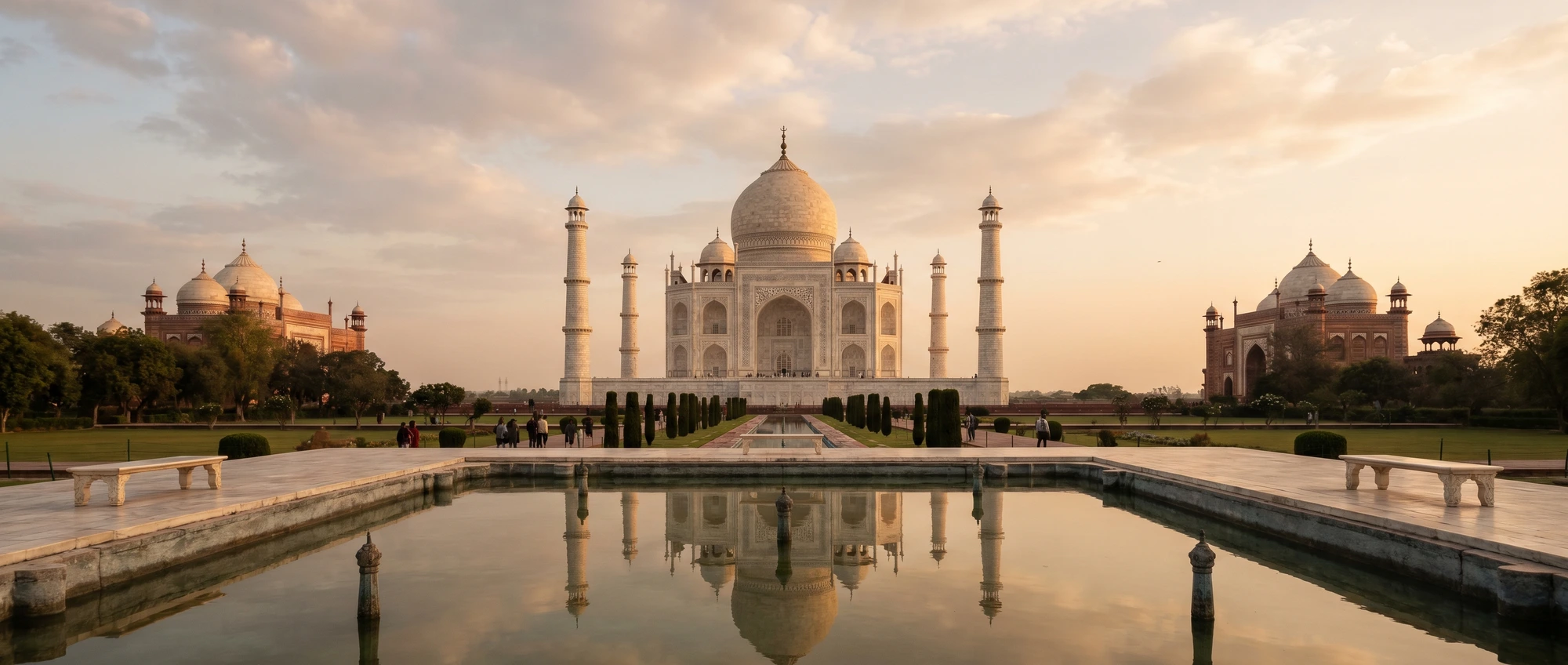
Drive down the Yamuna Expressway (~3.5 hours). See the Taj Mahal at sunrise the next morning, not midday: book the foreign-tourist ticket online, go on any day except Friday (closed), and pair it with Agra Fort and the quieter 'Baby Taj'. The Taj genuinely lives up to the hype if you avoid the crowds and the heat.
- 4Days 5–6
On to Jaipur
Drive Agra to Jaipur (~4.5 hours), ideally stopping at the abandoned Mughal city of Fatehpur Sikri en route. In the Pink City, take in Amber Fort (go early), the City Palace, Hawa Mahal and Jantar Mantar. Jaipur is the best place on the loop to shop for textiles and jewellery — and to be firm with commission-hungry 'guides' and gem-scam touts.
- 5Day 7
Back to Delhi, or fly onward
Drive back to Delhi (~5 hours) for your flight home, or use Jaipur's airport to fly onward to Udaipur, Mumbai or Goa if you're extending. Build in real buffer for traffic on any day you're flying — Indian road times are best-case figures, not promises.
Where to base yourself
In Delhi, South Delhi (Hauz Khas, Saket, Greater Kailash) is the soft-landing base — leafier and calmer than the backpacker strip of Paharganj, which is cheap and handy for the station but noisy and tout-heavy. In Agra, stay near the Taj east gate so you can be first through for sunrise; it’s a one-night stop, not a base. In Jaipur, base near the walled Pink City for the palaces and bazaars, and consider one splurge night in a converted-haveli heritage hotel. If you tack on Mumbai, Colaba keeps the main sights within walking distance.
South Delhi (Hauz Khas, Saket, Greater Kailash)
Leafier, calmer and better-value-for-comfort than the backpacker zone, with good restaurants and metro links. The sensible first-timer base if you want a soft landing rather than the full chaos.
Good for: First-timers who want a calm base
Paharganj (Delhi)
The long-running backpacker strip by New Delhi station: cheap rooms, cheap eats and easy onward transport, but noisy, hectic and heavy on touts. Fine if budget and rail access top your list; skip it if you want to sleep.
Good for: Budget travellers near the station
Taj East Gate / Taj Ganj (Agra)
Stay within walking or a short ride of the east gate so you can be first through for sunrise. Several rooftop restaurants here have a Taj view. Agra is a one-or-two-night stop, not a base — most people sleep one night and move on.
Good for: A sunrise-first Taj visit
Old City / near MI Road (Jaipur)
Staying near the walled Pink City puts Hawa Mahal, the City Palace and the bazaars on your doorstep, with Amber Fort a short drive out. Jaipur also has the loop's best heritage hotels — converted havelis and palaces — if you want one splurge night.
Good for: Atmosphere and a heritage-hotel splurge
Colaba (Mumbai)
If you're tacking on Mumbai, Colaba puts the Gateway of India, the museums and the seafront within walking distance, with a wide range of stays. The most convenient first-timer base in a sprawling, expensive-by-Indian-standards city.
Good for: A Mumbai add-on within walking distance of the sights
Getting around — and why not to self-drive
Getting around India
Don't self-drive in India — the roads are chaotic and India has one of the world's highest road-death rates (GOV.UK). For the Golden Triangle the standard, sensible choice is a hired car with a driver, booked for the whole loop: it's cheaper than you'd think (~£500 for the two-of-you couple example above), the driver handles the traffic and parking, and you set the pace. Between cities you can also use the train — the railway is vast, cheap and an experience in itself, but seats on popular routes sell out days ahead, so book early via the IRCTC site or a reseller. In cities, use Uber and Ola apps rather than hailing taxis or rickshaws on the street; if you do take a street auto-rickshaw, agree the fare before you climb in. For longer hops — Delhi to Mumbai, the north to Goa or Kerala — domestic flights on IndiGo, Air India and Akasa are quick and often under £50.
- Hire a car with a driver for the Golden Triangle — it's the standard, low-stress choice (~£500 for the loop).
- Never self-drive; India has one of the world's highest road-death rates and chaotic traffic (GOV.UK).
- Use Uber/Ola apps in cities; agree the fare before getting into any street rickshaw.
- Trains are cheap and characterful but sell out — book early on IRCTC or via a reseller.
- Domestic flights (IndiGo, Air India, Akasa) cover the long hops cheaply, often under £50.
- Build buffer into every road time — Indian estimates are best-case, not guaranteed.
Self-driving is the mistake to avoid: India has one of the world’s highest road-death rates, and the traffic is nothing like the UK’s despite the shared left-hand side. For the Golden Triangle the standard, low-stress choice is a hired car with a driver booked for the whole loop — cheaper than people expect, and the driver absorbs the traffic and parking. Between cities, the railway is vast, cheap and an experience in its own right, but popular seats sell out days ahead, so book early on IRCTC. In cities, use Uber and Ola apps rather than hailing on the street, and agree the fare before climbing into any auto-rickshaw.
Staying connected
UK roaming to India is expensive or simply unavailable — Vodafone charges around £7.86 a day, EE doesn’t cover India at all, and only some Three and O2 plans include it. A travel eSIM at £6–£15 for the whole trip is the obvious value move; install it before you fly and activate on landing. It also dodges the local-SIM faff, which needs ID, paperwork and can take a day to switch on — and you’ll want data for Uber, Ola and maps from the moment you land.
Stay connected in India
UK roaming to India is expensive and patchy — Vodafone charges around £7.86 a day, EE doesn't include India in its roaming at all, and only some Three and O2 plans cover it. Over a 10–14 day trip that's £80–£110 or simply not an option.
- A travel eSIM is typically £6–£15 for 5–10GB for the whole trip — a fraction of daily UK roaming.
- Activate it on landing — India's 4G/5G is fast and cheap once you're on a local network, and you'll want data for Uber, Ola and maps from the moment you arrive.
- Note that buying a physical local SIM in India needs ID and paperwork and can take a day to activate — an eSIM bought before you fly skips all of that.
Money: cash, cards and the rupee rule
India runs on cash far more than Japan or Europe, though cards and UPI app-payments are everywhere in cities. The rupee is a partially closed currency: you can't reliably buy it in the UK, so plan to withdraw on arrival from a bank ATM (look for HDFC, ICICI, Axis or SBI machines, which take foreign cards), and avoid the poor-rate exchange desks at the airport beyond a small first amount. Carry a mix of small notes — breaking a ₹500 for a rickshaw or a chai is a daily problem — and keep some cash for temples, markets and rural stops that don't take cards. Tipping is expected in a way it isn't in Japan: round up taxis, leave ~10% in restaurants if service isn't included, and budget small tips for drivers and hotel staff. When a card terminal or ATM asks whether to charge in GBP or rupees, always choose rupees — choosing pounds (dynamic currency conversion) hands the merchant a poor rate and costs you 3–5%.
Fee-free travel money
Skip the airport exchange desk — a fee-free travel card gives you the real exchange rate abroad.
Before you fly
Two small UK-specific jobs round out the trip: pre-book your airport parking, which is almost always cheaper booked ahead than on the day, and double-check the essentials before you fly — the e-visa, your insurance, your vaccines — so nothing slips through in the last 48 hours.
Airport parking & lounges
Pre-book your UK airport parking or a lounge — it's almost always cheaper booked ahead than on the day.
How we know this
How we know this
- GOV.UK foreign travel advice — India — entry, passport validity, visa, health, safety and local laws
- Indian e-Visa portal (indianvisaonline.gov.in) — the official e-Tourist visa application and fees
- NHS Fit for Travel / TravelHealthPro — vaccine recommendations and travel-health advice
- Taj Mahal official ticketing (tajmahal.gov.in) — Taj Mahal entry fees, timings and the Friday closure
GOV.UK last updated 4 Jun 2026.