Lower Austria (Niederösterreich)
Wachau Valley
The Wachau for UK travellers: the Melk-to-Krems Danube stretch of vineyards, apricot orchards and Dürnstein, how to do it as a day trip from Vienna, and whether to take the train, the boat or a bike.
In short
Wachau Valley at a glance
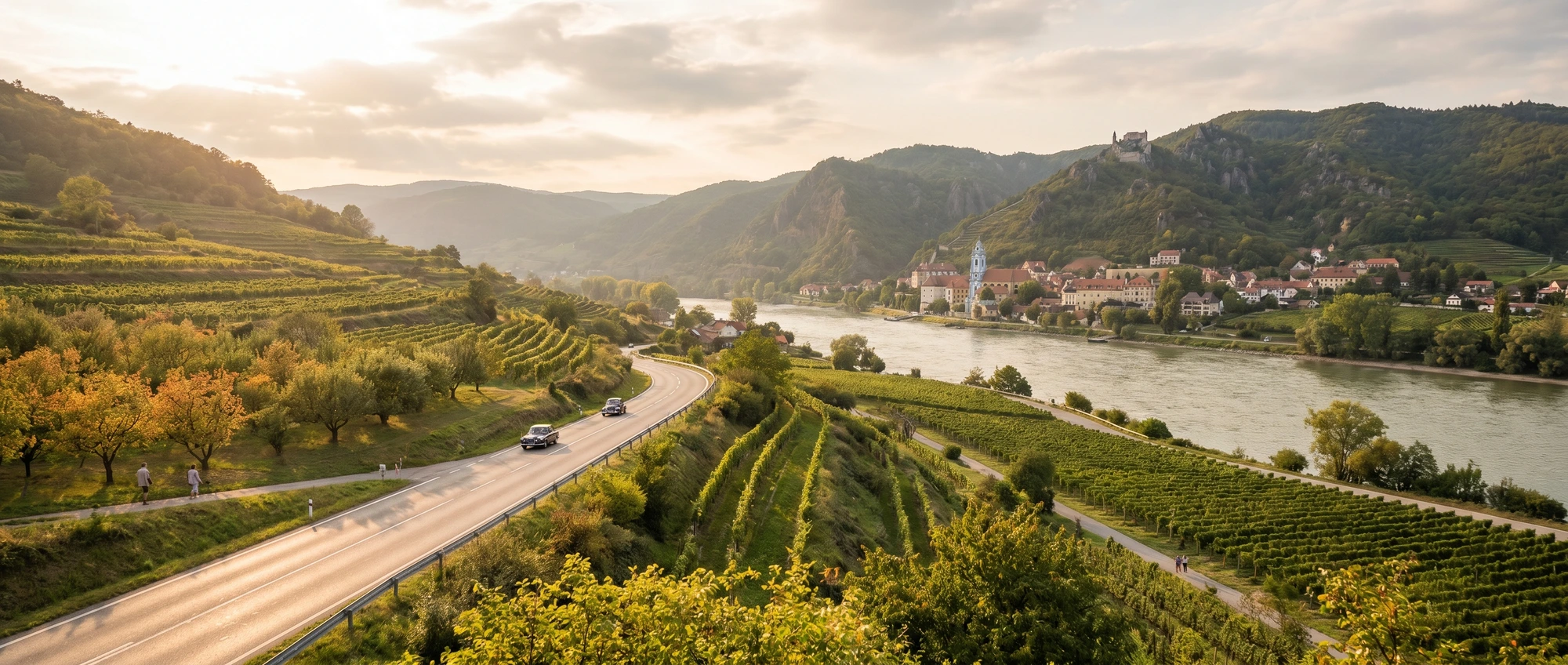
The Wachau is a 40km stretch of the Danube between Melk and Krems, an hour west of Vienna, and it does three things better than anywhere else in Austria: baroque abbeys, terraced vineyards making bone-dry Grüner Veltliner and Riesling, and apricot orchards that fill the valley with blossom in early April. The set-piece day is Melk Abbey in the morning, a downstream boat through the gorge to Dürnstein, then a wine stop in Krems before the train home. You can do it from Vienna in a day, but an overnight in Dürnstein or Weissenkirchen turns a rushed coach-stop circuit into the slow river valley it's meant to be.
The Wachau is the stretch of the Danube where Austria stops being about cities and becomes about a river — 40 winding kilometres of terraced vineyards, apricot orchards and baroque abbeys between Melk and Krems, an hour west of Vienna. The set-piece is simple and hard to improve on: Melk Abbey in the morning, the downstream boat through the gorge past Spitz and Dürnstein, a glass of Grüner Veltliner in a wine village, and the train home. Float it one way with the current and you see the whole valley without ever doubling back.
The mistake first-timers make is treating it as a box to tick on a Vienna day trip and arriving in Dürnstein at the same late-morning moment as every river-cruise ship and coach party. For a few hours the one cobbled lane under the blue church tower is shoulder-to-shoulder, and people leave thinking the Wachau is a tourist trap. It isn’t — it’s just busy on a tight schedule. Come early, or better, stay a night in Dürnstein or one of the quieter wine villages like Weissenkirchen: once the day boats leave around five, the valley empties and you get the slow, vineyard-quiet version it was always meant to be.
The route
The Wachau works as a one-way line, not a loop — float or cycle downstream with the Danube from Melk to Krems and you never backtrack. Train times are direct ÖBB services from Vienna's Westbahnhof and Franz-Josefs-Bahnhof; boat times are the DDSG Blue Danube scheduled services, which run roughly April to October only. Out of that window the boats stop and you do the valley by train, the regional bus or a hire car.
-
Morning
Melk Abbey
Take the direct ÖBB train from Vienna Westbahnhof to Melk (~1h05). The vast yellow Benedictine abbey above the town is the headline sight — the library and marble hall are the highlights — and a guided tour or the morning slot beats the cruise crowds. Allow about two hours, then walk down to the boat landing.
-
Midday
Boat Melk → Spitz → Dürnstein
Board the DDSG Blue Danube boat downstream through the gorge, passing terraced vineyards and Spitz's 'Tausendeimerberg' (Thousand-Bucket Hill). Hop off at Dürnstein (~1h15 from Melk) for the blue-towered church and the climb to the castle ruin where Richard the Lionheart was held in 1193 — about 20–30 minutes up.
-
Afternoon
Weissenkirchen & a wine stop
Either stay on to Weissenkirchen, the wine-village heart of the valley, for a Heuriger glass of Grüner Veltliner, or cycle the flat riverside Donauradweg path between villages (e-bike hire is widely available). The cellars here pour the dry whites the Wachau is known for — a tasting flight runs €10–€20.
-
Evening
Krems and the train home
End in Krems, the valley's eastern town, for the cobbled Steiner Landstrasse and the Kunsthalle. Direct trains run Krems back to Vienna's Franz-Josefs-Bahnhof in about 1 hour — or stay over in Dürnstein and have the village to yourself once the day boats leave.
Where to base yourself
Pick one or two bases rather than moving every night.
Dürnstein
£££ premiumThe prettiest base and the one worth the overnight: once the river-cruise passengers and coach groups clear out by early evening, the cobbled lane under the blue church tower empties and you get the postcard village to yourself. Rooms are limited and premium, so book ahead. Good for a romantic one- or two-night stop, not for budget travellers.
Best for: An overnight to beat the day-trip crowds, couples
Weissenkirchen & Spitz
££ mid-rangeThe working wine-village middle of the valley, quieter and better value than Dürnstein, with Heurigen (wine taverns) and guesthouses among the vineyards. Spitz sits under the terraced Tausendeimerberg. This is the base for cyclists doing the Donauradweg and for anyone whose trip is built around tastings rather than sightseeing.
Best for: Wine tastings, cycling, better value than Dürnstein
Krems an der Donau
££ mid-rangeThe largest town and the most practical base — a proper old town, more restaurants and hotels, an art quarter, and direct trains back to Vienna in about an hour. Less postcard-perfect than the wine villages but the easiest place to find a mid-range room and to arrive or leave by public transport.
Best for: Practicality, train links, a town base with restaurants
Getting around Wachau Valley
Pick the direction, not the vehicle: the Wachau is a downstream valley, so plan Melk → Krems and let the Danube do the work. Direct ÖBB trains reach Melk from Vienna in about 1h05 and return from Krems in about an hour, so you never need a car for the day trip. The DDSG Blue Danube boats run the Melk–Krems stretch roughly April–October — go downstream (about 1h40 Melk to Krems) rather than upstream, which is slower and dearer against the current. The flat Donauradweg cycle path along the river is the local's choice: hire an e-bike at Melk or Krems and ride village to village. A hire car only earns its keep out of boat season or if you're touring beyond the valley; in season it just means hunting for parking in villages built before cars. Austria drives on the right.
Book the essentials
Where to stay
Tours & tickets
Airport transfers
Car hire
Stay connected
Wachau Valley FAQs
Can you do the Wachau Valley as a day trip from Vienna?
Should you take the boat upstream or downstream in the Wachau?
What is the Wachau Valley known for?
Ready to book?
Compare car hire