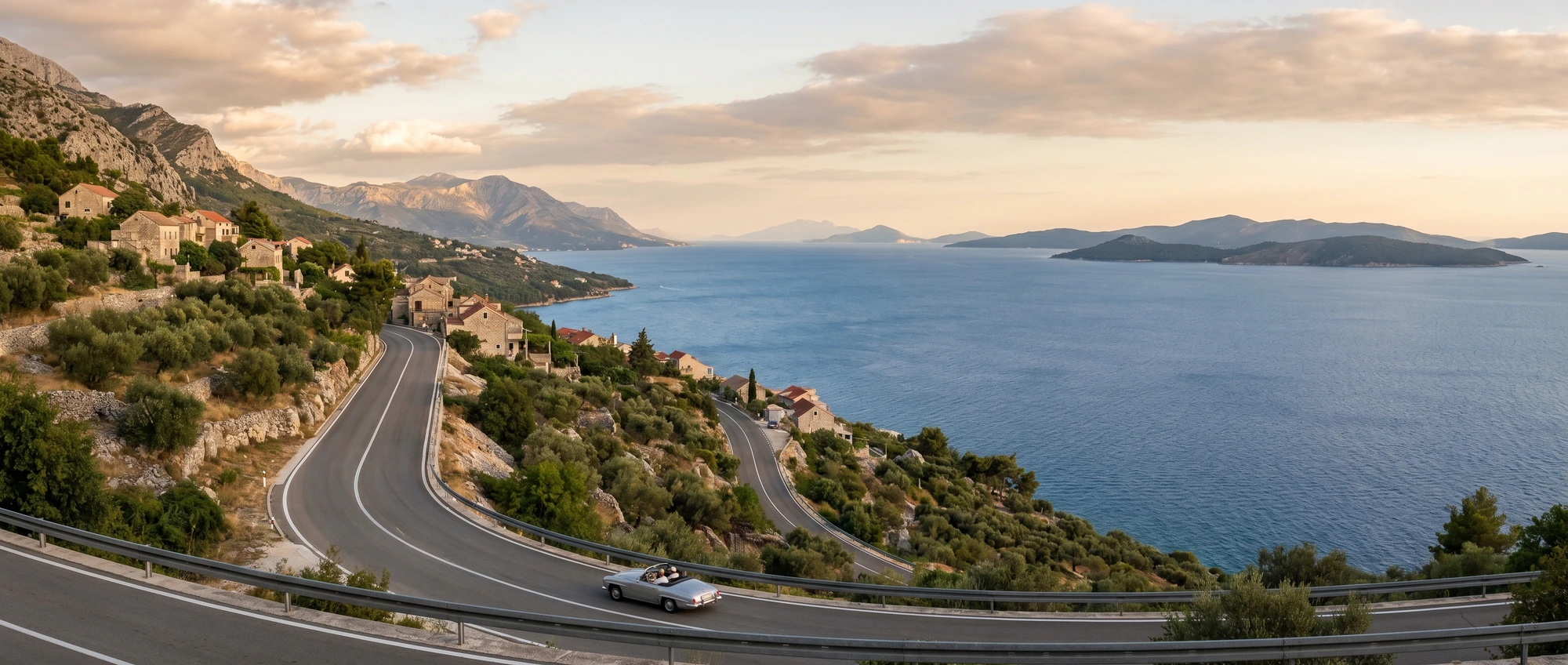
Dalmatia
Dalmatia
Croatia's Adriatic coast from Zadar to Dubrovnik for UK travellers: the coastal drive, where to base yourself, real ferry times to Hvar and Brač, and whether you actually need a car.
In short
Dalmatia at a glance
Dalmatia is the Croatian coast UK travellers picture: walled old towns, marble Roman streets and a string of islands a ferry-hop offshore. The classic trip runs north to south — Zadar, Split, then Dubrovnik — with island days to Hvar, Brač or Korčula slotted in from Split. Since the Pelješac bridge opened in 2022 you can drive the whole length without crossing into Bosnia. Allow 10 days to do the coast plus a couple of islands at a relaxed pace; a week if you base in Split and day-trip.
Dalmatia is the long, island-fringed stretch of the Croatian Adriatic that most UK travellers mean when they say “Croatia”: Zadar’s Roman forum in the north, Diocletian’s living Roman palace in Split in the middle, and Dubrovnik’s walled old town in the south, with a scatter of islands — Hvar, Brač, Korčula — sitting a short ferry hop offshore. The classic trip runs north to south so you never double back, and an open-jaw flight (in to Split or Zadar, home from Dubrovnik) saves you a day of driving the whole coast in reverse.
The thing to understand is the rhythm: you drive the mainland and you take the boats. A hire car earns its keep between towns and for the inland sights — Krka’s swimmable waterfalls, the Makarska beaches, the Pelješac wineries — but it’s a liability on the islands and in the pedestrianised old quarters, where you want to arrive on foot. The fast catamarans from Split do Hvar in under an hour, so islands are easy day trips or a couple of relaxed nights without the car. Since the Pelješac bridge opened in 2022, the Split–Dubrovnik drive no longer dips into Bosnia, so there’s no passport stop at the old Neum corridor.
One honest warning: Dubrovnik is dramatically pricier than the rest of the coast and gets genuinely packed when the cruise ships dock. Base yourself in Split for better value and shorter ferry hops, walk Dubrovnik’s walls early in the morning, and aim for May, June or September rather than the July–August peak.
The route
A relaxed 10-day run down the coast that strings together the three headline towns and two islands without backtracking. Drive times are for the A1 motorway plus the coastal D8; ferry times are peak-season Split catamarans. Book island ferries ahead in July–August, especially with a car.
-
Days 1–2
Zadar
Start in the north — it's lively without the cruise-ship crush of Dubrovnik. See the Sea Organ and Greeting to the Sun on the waterfront, walk the Roman forum, and use it as the base for a half-day at Krka National Park's swimmable waterfalls (about an hour south by car).
-
Days 3–5
Split & an island day
Drive down (about 2–2.5 hours) and base in Split: Diocletian's Palace is a living Roman quarter, not a museum. From the Riva, catamarans reach Hvar in around 55 minutes or Bol on Brač (the Zlatni Rat beach) in just over an hour — do one as a long day trip rather than dragging luggage across.
-
Days 6–7
Hvar or Korčula
Stay a couple of nights on an island to slow down. Hvar Town is the glamorous, pricier choice with the best nightlife; Korčula is quieter, walled and easier on the wallet. Both are car-optional — leave the hire car on the mainland and travel on foot.
-
Days 8–10
Pelješac to Dubrovnik
Cross the Pelješac bridge (no border, no toll), stop at Ston for the oysters and medieval walls or a Pelješac winery, then finish in Dubrovnik. Walk the city walls early before the cruise crowds land, and fly home from Dubrovnik to close the trip without driving back north.
Where to base yourself
Pick one or two bases rather than moving every night.
Split (Varoš / Veli Varoš)
££ mid-rangeThe best all-round base: the old stone quarter just west of Diocletian's Palace, walkable to the Riva and the ferry port for island days. Quieter and better value than rooms inside the palace walls, which get noisy with bar spill late at night.
Best for: Ferry hub, Roman old town, island day trips
Zadar (Poluotok / old peninsula)
££ mid-rangeStay on the walled peninsula for the Sea Organ, Roman forum and sunset on the waterfront on your doorstep. A relaxed, local-feeling start to the trip and the launch point for Krka and the northern islands.
Best for: First two nights, Krka, a calmer pace
Hvar Town
£££ premiumThe headline island base: a pretty harbour town with a hilltop fortress and the liveliest nightlife on the coast. Prices run high and the centre is car-free, so come by catamaran and travel light.
Best for: Island nights, nightlife, harbour scene
Dubrovnik (Ploče / Lapad over the old town)
£££ premiumBase just outside the walls in Ploče (steps from the old town, sea views) or leafy Lapad (cheaper, beachy, a bus ride out) rather than inside the walls, where rooms are dear and you're woken by early cruise crowds.
Best for: Walls, old town, flying home
Getting around Dalmatia
Drive the coast and take the boats — that's the Dalmatian rhythm. A hire car is genuinely useful between mainland towns (Zadar–Split is the A1 motorway, about 2–2.5 hours; Split–Dubrovnik is roughly 2h50 on the A1 or 3h45 on the slower, prettier coastal D8) and for reaching Krka, the Makarska beaches and Pelješac wineries. But cars are a liability on the islands and in the pedestrianised old towns, so leave it on the mainland and island-hop on foot: fast catamarans from Split reach Hvar in about 55 minutes and Bol on Brač in just over an hour, run by Krilo (Kapetan Luka) and Jadrolinija. The Split–Dubrovnik drive no longer crosses Bosnia thanks to the Pelješac bridge, and there's no vignette in Croatia — you pay A1 tolls by the section (Split to the last southern exit is about €7.40).
Book the essentials
Where to stay
Tours & tickets
Airport transfers
Car hire
Stay connected
Dalmatia FAQs
How many days do you need for the Dalmatian coast?
Do you need a car in Dalmatia?
How do you get from Split to Hvar?
Do you cross into Bosnia driving Split to Dubrovnik?
What is the best time to visit Dalmatia?
Ready to book?
Compare car hire