Central Dalmatia
Hvar Island
Hvar island for UK travellers, beyond the party-town headlines: lavender fields and vineyards, where to base yourself away from Hvar Town's marina prices, and how the catamarans from Split actually work.
In short
Hvar Island at a glance
Hvar is the long, sun-soaked Dalmatian island that most people only see as Hvar Town — the glossy yacht-and-cocktails harbour at the western tip. The island is far bigger and quieter than that: a spine of lavender fields and vineyards runs east from the UNESCO-listed Stari Grad Plain (one of Europe's oldest continuously farmed landscapes) to the laid-back family resorts of Jelsa and Vrboska. Get here from Split by catamaran in under an hour, but pick your base carefully — Hvar Town is the priciest and most crowded corner, and the calmer towns are a cheap bus or a hire-car drive away.
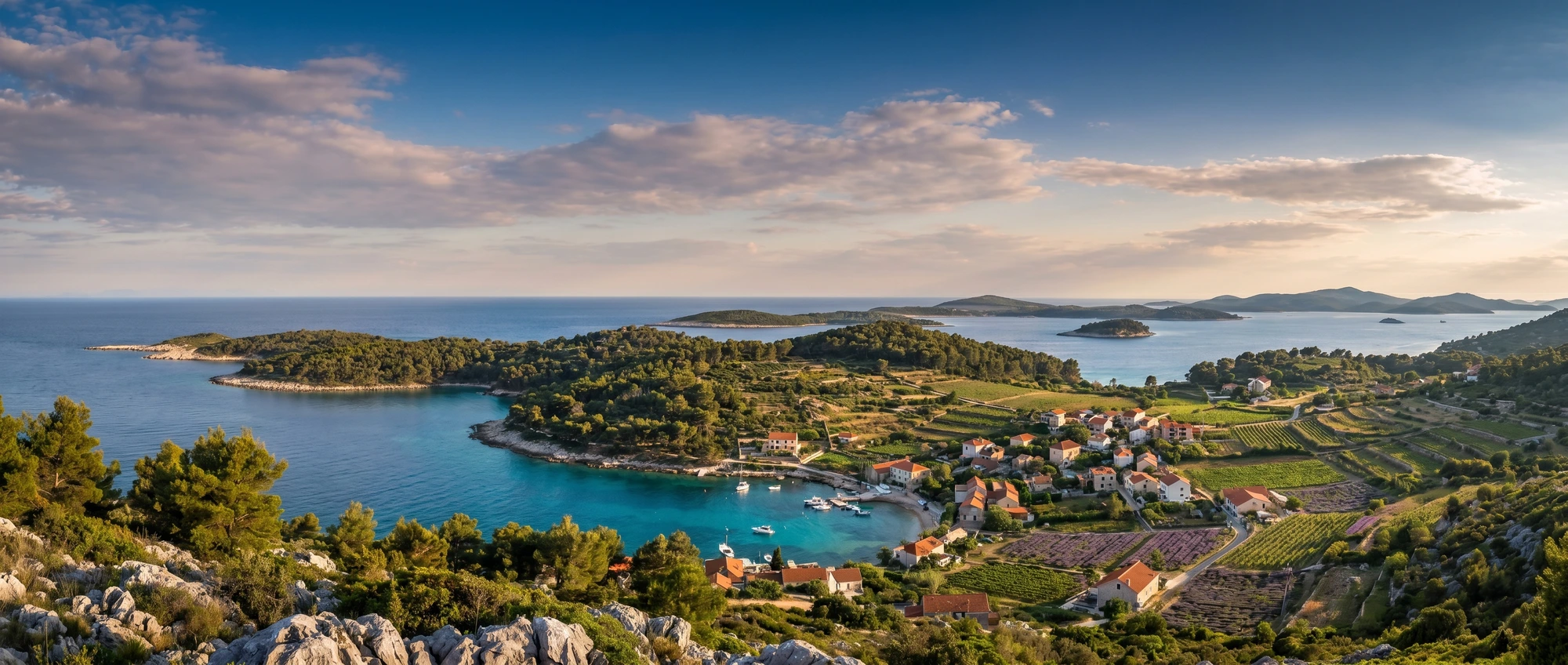
Hvar has a reputation problem: most UK travellers picture only Hvar Town, the yacht-and-cocktails harbour at the western tip, and either book straight into it or write the whole island off as a party trap. Both are mistakes. The island runs 68km east from there into something almost no one photographs — the UNESCO Stari Grad Plain, a 2,400-year-old patchwork of dry-stone walls and vineyards, the lavender that scents the ridge in June, and the calm pine-backed beaches of Jelsa and Vrboska. The party harbour is real, but it’s about a tenth of the island.
The mistake that actually costs you is at the ticket desk in Split. There are two ports and two boats: the fast passenger catamaran that everyone defaults to lands at Hvar Town, while the car ferry docks at Stari Grad, 20 minutes’ drive away over the ridge. Book the catamaran when your apartment is in Jelsa and you’ll discover the island bus network is too thin to rescue you. Decide where you’re sleeping first — buzzy and pricey in the west, calmer and cheaper in the east — then buy the crossing that lands you nearest, and hire a small car if you want the wine villages and coves the day-trippers never reach.
The route
A relaxed 4–5 day island stay that pairs Hvar Town's buzz with the quieter east, without spending the trip on buses. Crossing times are from Split's catamaran terminal; on-island drives are along the single ridge road that runs the length of the island.
-
Days 1–2
Hvar Town
Catamaran from Split lands here in about 1 hour. Climb to the Spanjola fortress for the harbour view, see the oldest municipal theatre in Europe (1612) on the main square, and take the 20-minute taxi-boat out to the Pakleni Islands for the day. Stay a street or two back from the Riva — the harbourfront charges marina prices.
-
Day 3
Stari Grad & the plain
About a 20-minute drive east over the ridge. Wander the oldest town on the island and walk or cycle a stretch of the UNESCO Stari Grad Plain, a 2,400-year-old grid of dry-stone walls, vineyards and olive groves. This is also where the car ferry from Split docks.
-
Days 4–5
Jelsa, Vrboska & the wine road
Another 20 minutes east to Jelsa, the calm family base, and tiny Vrboska, the island's prettiest harbour. Drive the inland road through Pitve, Zavala and the Plenkovic and Tomic wineries around Sveta Nedjelja on the south coast — Hvar's Plavac Mali reds are the real local product, not the cocktails.
Where to base yourself
Pick one or two bases rather than moving every night.
Hvar Town
£££ premiumThe glamorous western harbour — the buzz, the best restaurants, the yacht crowd and the nightlife, with the Pakleni Islands on the doorstep. Also the most expensive and crowded base on the island, and noisy until the small hours in July and August. Sleep up the hill behind the Riva rather than on it, and you keep the views without the marina premium.
Best for: Nightlife, restaurants, first-time buzz
Stari Grad
££ mid-rangeThe oldest town on the island and the car-ferry port — a calmer, more lived-in harbour wrapped around a deep bay, with the UNESCO plain on its edge. Better value than Hvar Town and an easy base if you arrive with a hire car. A 20-minute drive from the Hvar Town buzz when you want it.
Best for: Car arrivals, couples, a quieter old town
Jelsa & Vrboska
£ valueThe east-island family choice: Jelsa is a relaxed resort town with pine-shaded pebble beaches and shallow water, and neighbouring Vrboska is a postcard fishing inlet. Cheaper again, with self-catering apartments and a slower pace — the place to come if Hvar Town's reputation puts you off entirely.
Best for: Families, self-catering, calm and value
Getting around Hvar Island
There's no train, and the island bus network is thin — a few daily Hvar Town–Stari Grad–Jelsa runs timed loosely to the ferries, which makes connections frustrating if you're relying on them. For anything beyond your base town, hire a car or scooter (roughly €45–€60/day for a small car in season) to reach the wine villages, the south-coast coves below Sveta Nedjelja and the long quiet east end at Sucuraj. Crucially, match your crossing to your base: the fast Jadrolinija and Krilo passenger catamarans from Split (about 1 hour, from ~€10) dock at Hvar Town, while the slower car ferry (about 2 hours) lands at Stari Grad, 20 minutes' drive away — taking the catamaran when your apartment is in Jelsa means an awkward, infrequent bus or a pricey taxi. Drive on the right.
Book the essentials
Where to stay
Tours & tickets
Airport transfers
Car hire
Stay connected
Hvar Island FAQs
How do you get to Hvar from Split?
Is Hvar Town the best place to stay on Hvar?
Do you need a car on Hvar?
Ready to book?
Compare car hire