Northern Croatia (Adriatic)
Istria
Croatia's foodie north for UK travellers: Pula's Roman arena, hilltop Motovun and the truffle towns, Rovinj as your base, real drive times and whether you actually need a hire car.
In short
Istria at a glance
Istria is Croatia's Italianate north — a heart-shaped peninsula of Venetian harbour towns, hill villages and truffle-and-wine country that feels closer to Tuscany than to Dubrovnik. Fly into Pula (PUY) for the Roman amphitheatre, base yourself in pretty Rovinj on the west coast, and spend two or three days drifting inland to Motovun, Grožnjan and the Buzet truffle towns. It's compact: nowhere on the peninsula is much more than an hour's drive from anywhere else, and the food — fresh-shaved truffles, Malvazija white, Istrian olive oil — is the real reason to come, not the beaches, which are rocky rather than sandy. Allow 4–5 days; a hire car roughly doubles what you can see.
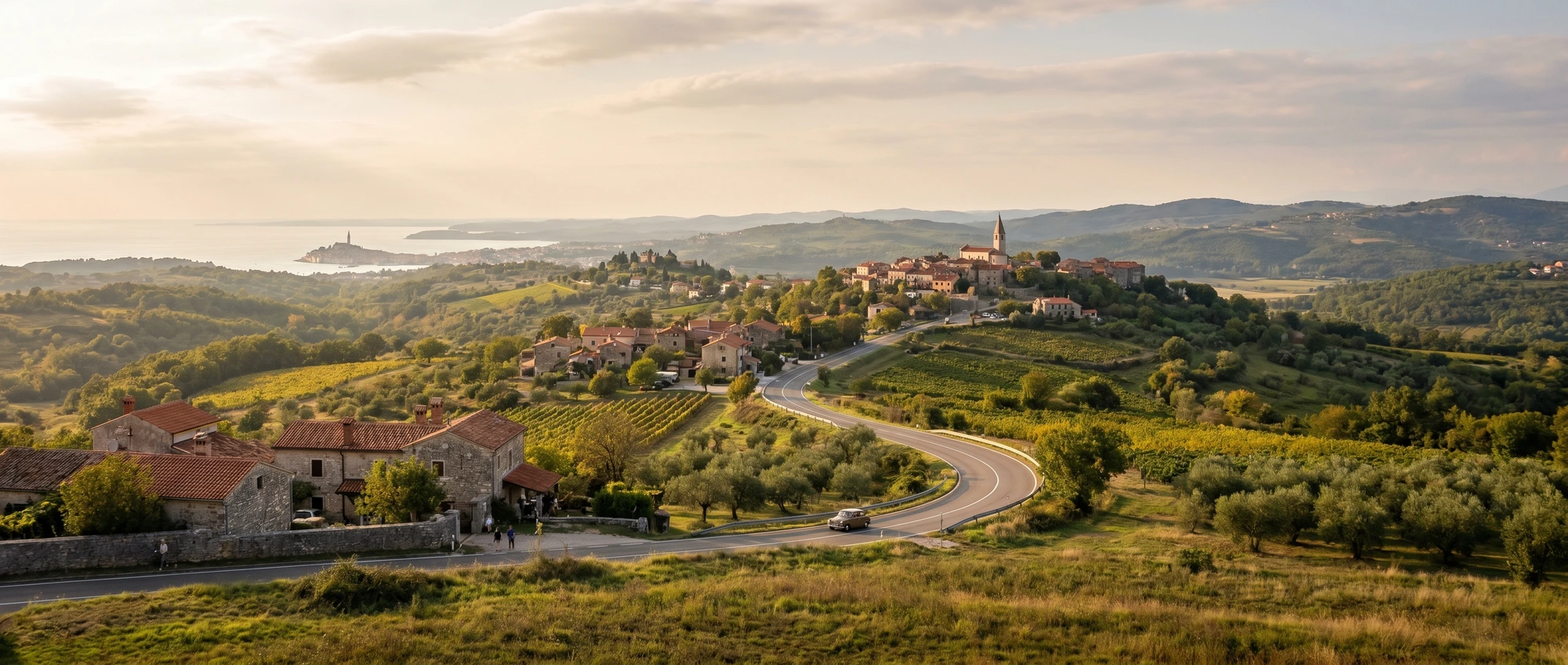
Istria is the part of Croatia that doesn’t look or taste Croatian at all. For four centuries it was Venetian, and it shows: the harbour towns have campaniles and piazzas, the menus run to truffle pasta and Malvazija rather than grilled fish and rakija, and the interior of vineyard-striped hills could pass for Tuscany if you squinted. It’s also the closest slice of Croatia to the UK and to northern Italy — you can fly into Pula in under two and a half hours, or drive down from Venice in a couple — which makes it the natural choice for a first trip if the famous Dalmatian island-hopping further south feels like a stretch.
The mistake first-timers make is treating Istria as a beach holiday and basing themselves on the coast for the whole stay. The beaches are rocky coves, not Dalmatian turquoise, and they’re not why you come — the food is. The single best day of any Istria trip is spent inland, looping the hill towns of Motovun and Grožnjan and sitting down to a long lunch of fresh-shaved truffle around Buzet or Livade, and that day needs a hire car because the buses up there barely run. Base in pretty Rovinj, give the interior a proper day or two rather than a rushed afternoon, and you’ll understand why people keep coming back to the quietest corner of the country.
Towns & places in Istria
The route
A relaxed four-to-five-day loop that pairs the two headline coastal towns with a full day in the inland truffle-and-hill-town country. Drive times are quiet-road estimates on Istria's good but narrow regional roads; almost everything sits within an hour of Rovinj, so you base once and radiate out rather than packing and repacking.
-
Days 1–2
Rovinj
Settle into the prettiest base on the coast: a Venetian old town tumbling down to the harbour under the St Euphemia bell tower, with sunset over the water from the Grisia lanes. Swim off the rocks at Lone bay or take the little boat to Crveni otok (Red Island), 15 minutes offshore. No car needed in town — park on the edge and walk.
-
Day 3
Pula
About 40 minutes south by car. The 1st-century Roman amphitheatre — one of the best-preserved in the world and still used for summer concerts — is the single reason to come; the entry fee is around €15. Add the Temple of Augustus and the Arch of the Sergii, swim at the Verudela peninsula, then drive back to Rovinj for dinner.
-
Day 4
Inland truffle towns
The best day of the trip and the one that needs a car. Loop Motovun (the hilltop wine-and-truffle town, ~45 min from Rovinj), Grožnjan (a tiny artists' village), and Livade or Buzet for a long truffle lunch — fresh-shaved truffle over fuži pasta at a tavern like Zigante. Stop at a roadside olive-oil or Malvazija tasting on the way back.
-
Day 5
Poreč or the coast road
Drive north up the coast (~40 min) to Poreč for the 6th-century Euphrasian Basilica and its gold Byzantine mosaics — a UNESCO site and worth the ticket — or spend a final slow day on Rovinj's rocks before flying home from Pula.
Where to base yourself
Pick one or two bases rather than moving every night.
Rovinj
££ mid-rangeThe best first base on the coast: a postcard Venetian old town, the liveliest evening scene in Istria and good restaurants a lane back from the harbour. Rooms inside the old town are atmospheric but cramped and steep-staired; the modern hotels and apartments just outside (around Lone and Monte Mulini bays) are easier with a car and a short walk in.
Best for: First-timers wanting looks, food and walkability in one base
Pula
£ valueThe peninsula's biggest city and only airport, more workaday than pretty but cheaper than Rovinj and built around the Roman arena. A sensible base if you're arriving late or leaving early, or want city-plus-rocky-beach at the Verudela peninsula. Less charm in the evenings than Rovinj, so most people sleep here only at the ends of a trip.
Best for: Arrival/departure nights and the Roman sights
Motovun / inland hill towns
££ mid-rangeSleep up in the truffle-and-wine country for a night to do the inland day properly and dine without driving. Motovun's old town has a handful of small hotels with valley views; the surrounding agriturismi serve their own oil, wine and truffle. Cooler, quieter and greener than the coast — you'll want the car.
Best for: Food-led trips and a slow inland night
Getting around Istria
Hire a car — it's the one decision that makes or breaks an Istria trip. The coastal towns (Pula, Rovinj, Poreč) are linked by reasonable buses, but the inland hill towns and truffle taverns that are the whole point of the peninsula have thin, awkward bus timetables, and the distances are short: Pula to Rovinj is about 40 minutes, Rovinj to Motovun about 45, and you can loop the entire interior in a day. Pick the car up at Pula airport on arrival, but leave it in the car parks on the edge of Rovinj's and Motovun's old towns — both are pedestrianised and the lanes are too tight to drive. Drive on the right. If you'd rather not drive at all, base in Rovinj or Pula, use the coastal buses, and book a guided truffle-hunt-and-tasting day-trip to cover the interior.
Book the essentials
Where to stay
Tours & tickets
Airport transfers
Car hire
Stay connected
Istria FAQs
Is Istria better than the Dalmatian coast for a first trip to Croatia?
Do you need a car in Istria?
When is the best time to visit Istria?
Ready to book?
Compare car hire