La Romana (southeast coast)
Altos de Chavón
How to visit Altos de Chavón at Casa de Campo: what the day-pass actually costs, how to get past the gate if you're not staying, when to go for the light, and an honest worth-it verdict on La Romana's replica village.
Where
La Romana, Dominican Republic
Opening hours
The village lanes are open daily, roughly 08:00 until late evening once restaurants and bars are running; the Regional Museum of Archaeology keeps shorter daytime hours, broadly 09:00–20:00. There are no turnstiles inside the village — access is controlled at the Casa de Campo estate gate, so the practical 'hours' question is when you can get a day-pass at the checkpoint. Amphitheatre concerts are ticketed separately and only on event nights.
Tickets
Walking the village is free; the cost is estate access. Non-resort day visitors buy a consumable day-pass at the Casa de Campo gate for around US$25 (~£20) that you spend back on food and drink in the village, so it's effectively a minimum spend rather than a sunk ticket. The Regional Museum of Archaeology is free. Casa de Campo guests and most organised excursions and cruise tours include access, so you pay nothing extra at the gate. US dollars are the practical currency; bring small bills.
Time needed
1.5–2.5 hours to walk the lanes, the church and the museum and take in the river view; longer if you stay for dinner or an amphitheatre show.
In short
Visiting Altos de Chavón
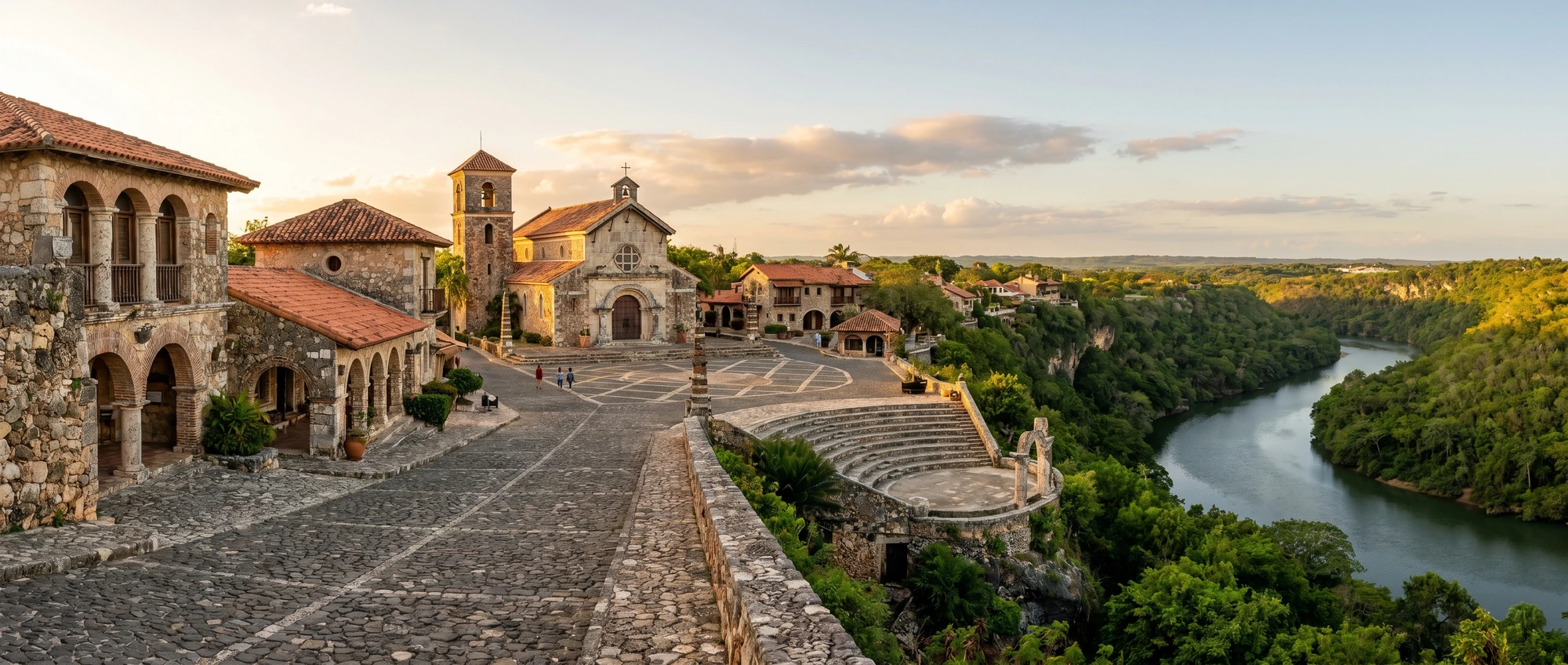
Altos de Chavón is a 1970s replica of a 16th-century Mediterranean hill village, built in carved coral block above the Chavón river inside the gated Casa de Campo estate near La Romana. The cobbled lanes themselves are free to wander, so the real planning question is getting through the resort gate, not buying an attraction ticket: non-staying day visitors pay a consumable estate day-pass at the security checkpoint (around US$25 / ~£20, redeemable against food and drink at the village). Once inside, the set pieces are the St Stanislaus church, the free Regional Museum of Archaeology with its Taíno collection, the artisan workshops, and the 5,000-seat Grecian-style amphitheatre that Frank Sinatra opened in 1982. Go late afternoon: the carved stone glows at golden hour, the river view down to the marina is the photo, and you can roll the visit into dinner at one of the village restaurants.
Getting in: the gate, not a ticket desk
The thing to understand before you go is that there’s no turnstile at Altos de Chavón itself. The cobbled lanes are free to walk and the Regional Museum of Archaeology inside is free too — the cost is getting through the security gate of the gated Casa de Campo estate that surrounds it. If you’re not a resort guest, you pay a consumable estate day-pass of around US$25 (~£20) at the checkpoint, which you then spend back on food and drink in the village. So treat it less as an admission fee and more as a minimum spend.
If you’re staying at Casa de Campo, or you’ve booked an excursion or a cruise tour, access is already included and you pay nothing extra at the gate. Independent visitors coming up from Bayahibe, La Romana town or the cruise port are easiest off in a booked taxi or a tour — agree the fare and the currency before you set off, and use a booked car rather than a street one, given the country’s high crime rate.
What’s actually here
The village is a 1970s recreation of a 16th-century Mediterranean hill town, hand-built in carved coral block above the Chavón river. The set pieces are the St Stanislaus church (Iglesia San Estanislao), the small Regional Museum of Archaeology with its Taíno collection, the artisan and ceramics workshops, and the 5,000-seat Grecian-style amphitheatre — the one Frank Sinatra opened in 1982, which still hosts concerts on event nights. The single best view is from the village edge looking down the gorge to the marina; that’s the photo.
It is, to be honest about it, a replica rather than an antiquity, and if you want genuine colonial stone you’ll get more from Santo Domingo’s Colonial Zone. But the craftsmanship is real and the river setting is the finest in the La Romana area, which is why it’s worth more than a ten-minute photo stop.
Best time to come, and is the day-pass worth it?
Aim for late afternoon into the evening. The coral block takes the golden-hour light, the heat drops off its midday peak, and the late-morning cruise-excursion groups have usually cleared out. Better still, stay on for dinner at one of the village restaurants as the lanes quieten — that’s when the place is at its best and the day-pass spend pays for itself. Allow an hour and a half to two and a half hours for the lanes, the church and the museum; longer with a meal or an amphitheatre show.
As a built attraction it won’t move history buffs, but for an evening out from a La Romana or Bayahibe beach week it’s the standout non-beach thing to do, and the river view earns the trip. Roll it into a Casa de Campo dinner rather than rushing it in the midday heat, and book your transport both ways rather than relying on flagging a taxi after dark.
Planning the rest of your trip? See the La Romana city guide.
More to see in La Romana

Book the essentials
Tours & tickets
Altos de Chavón FAQs
How much does it cost to get into Altos de Chavón?
Can you visit Altos de Chavón if you're not staying at Casa de Campo?
Is Altos de Chavón worth it?
What is the best time of day to visit Altos de Chavón?
Ready to book?
Check tickets & tours