Greater Cairo
Khan el-Khalili
How to visit Khan el-Khalili in Islamic Cairo: when to go, what's actually worth buying, the haggling and 'free tea' scripts to ignore, and how to get there.
Where
Cairo, Egypt
Opening hours
The alleys are public streets and never close. Individual shops run roughly 09:00–22:00, though hours are at each seller's discretion — some shut by 19:00, others stay open past 23:00. El-Fishawy café has been open 24/7 since 1797. Many shops are quieter or closed during Friday midday prayers.
Tickets
Free to enter and wander. Budget for what you buy: mint tea or Turkish coffee at El-Fishawy runs about 20–40 EGP (roughly 30p–60p), and a small brass or copper piece after haggling is typically a few hundred EGP (single-figure pounds).
Time needed
1.5–2 hours to browse the main lanes and stop for a tea; half a day if you pair it with the Al-Azhar and Al-Hussein mosques and a walk up Al-Muizz Street.
In short
Visiting Khan el-Khalili
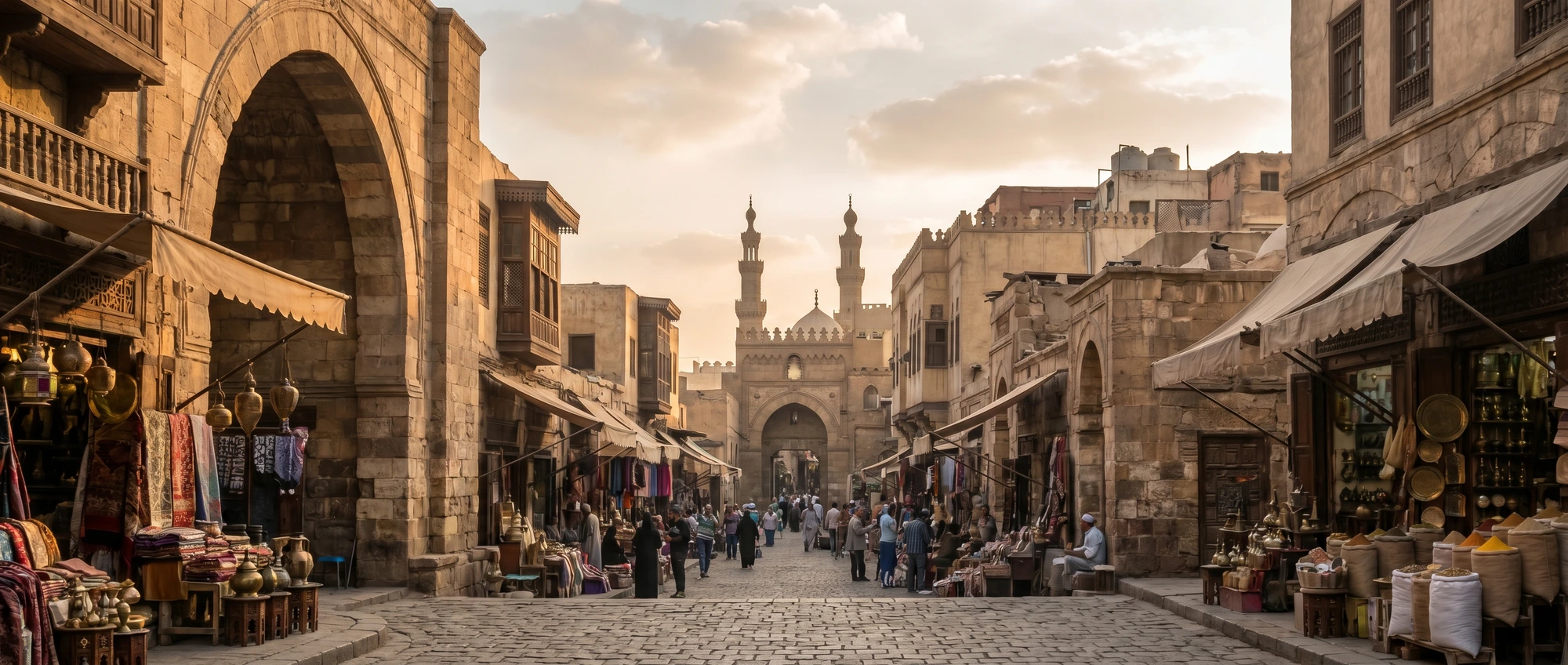
Khan el-Khalili is a free-to-enter public bazaar in Islamic Cairo, not a ticketed attraction — the cost is whatever you spend inside. Walk past the first 200 metres of plastic pyramids and machine-printed scarves and head deeper to the copper alley (Nahaseen), the gold quarter (Sagha) and the perfume sellers (Attareen), where the work is actually made on site. Go late afternoon into early evening when the lanterns are lit and the heat drops, treat every opening price as 2–3× the real one, and ignore the 'come in for tea' pitch unless you genuinely intend to buy.
How to visit without overpaying
Khan el-Khalili isn’t a ticketed sight — it’s a working bazaar in Islamic Cairo that’s been trading since the fourteenth century, and the streets never close. There’s no entry fee. The only money you spend is what you hand over inside, which is exactly where most visitors go wrong: they buy the first plastic pyramid or “papyrus” they see in the crowded lanes near the Al-Azhar Street entrance, all of which is machine-made tourist stock.
Walk past the first couple of hundred metres before spending anything. Deeper in, the trades split by alley: Nahaseen is the coppersmiths’ lane, where you can watch brass trays and coffee pots being hammered in open workshops; Sagha is the gold quarter, the place for a silver or gold cartouche with your name in hieroglyphs; and Attareen is where the perfume sellers keep the real essential oils — jasmine, sandalwood, lotus — that you can smell before you commit.
Treat every opening price as two to three times the fair one. Counter at around 40% of what’s quoted, expect to settle near 55–65%, and set your walk-away number in Egyptian pounds before you start. Walking away genuinely works here: you’ll often be called back with a better figure before you reach the next stall.
When to go, the tea pitch, and getting there
Go in the late afternoon into early evening. The midday heat is brutal for most of the year, and after dark the lanterns are lit and the lanes look their best — this is also the hour to walk north up Al-Muizz Street, one of the most intact medieval Islamic streets anywhere. Allow an hour and a half to two hours to browse and stop for a drink; make it a half-day if you fold in the Al-Azhar and Al-Hussein mosques (both free, modest dress required).
About that “come in for tea” offer: it isn’t a swindle, but it is the opening line of a long, pressured sales pitch at jewellery and perfume shops. Accept it only if you actually want to buy. For a real tea, sit at El-Fishawy, the café that’s been open round the clock since 1797, where mint tea or Turkish coffee is 20–40 EGP — about 30 to 60 pence — paid openly with no obligation to buy anything else.
Getting there is simplest by Uber or Careem: ask for Al-Azhar Street or Al-Hussein Mosque, and from Downtown or Tahrir it’s 15–20 minutes and roughly 60–100 EGP (around £1). The metro works too — Line 3 to Bab El Shaaria or Line 1 to Attaba (8–15 EGP), then a 10–25 minute walk. Don’t try to drive yourself; the traffic and parking around Islamic Cairo aren’t worth it.
Skip Khan el-Khalili if you only want to shop, because most of what’s on display is tat and the hard sell tires people out fast. Go for the atmosphere — the call to prayer over the lanterns, a coffee at El-Fishawy, the coppersmiths still working by hand — and buy one well-made thing rather than an armful of souvenirs.
Planning the rest of your trip? See the Cairo city guide.