Mecklenburg-Vorpommern, north-east Germany
Rügen Island
A first Rügen trip for UK travellers: the white chalk cliffs of the Königsstuhl, the white-villa resorts of Binz and Sellin, and the giant Prora block — with real train times from Berlin, euro prices and a car yes/no verdict.
In short
Rügen Island at a glance
Rügen is Germany's largest island, sitting in the Baltic off the north-east coast and joined to the mainland city of Stralsund by the Rügenbrücke road bridge. It's a domestic summer-holiday classic rather than a UK package destination: the draws are the white chalk cliffs of Jasmund National Park (the famous Königsstuhl viewpoint), the grand white-villa seaside resorts of Binz and Sellin with their long piers, the 4.5km Nazi-era Prora block now half-converted to flats and hostels, and the lighthouses of Kap Arkona at the northern tip. There are no UK flights to the island; the natural route is to fly to Berlin and take the direct InterCity train to Binz, around three and a half hours. Allow three to four days for the cliffs and a couple of resorts, a week to slow down and add Hiddensee or Kap Arkona.
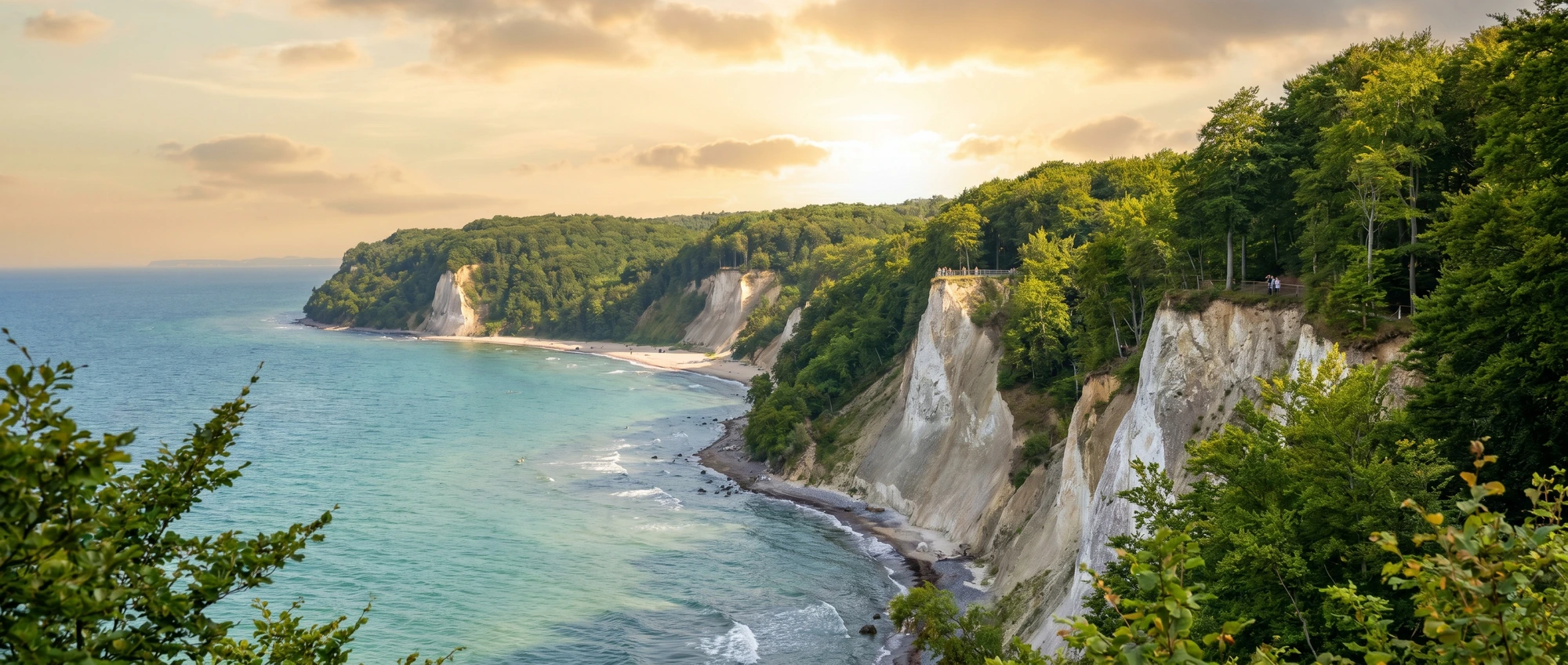
Rügen is the seaside Germany comes home to — its largest island, a short bridge from Stralsund, and for generations the place the country has taken its summer holiday rather than a name UK travellers know. The pull is a specific set of sights: the white chalk cliffs of the Königsstuhl in Jasmund National Park, the white-villa “Bäderarchitektur” resorts of Binz and Sellin with their long piers, the half-finished 4.5km Prora block the Nazis built and abandoned, and the lighthouses and Slavic temple ruins out at Kap Arkona. Come for those and the beech-forest cliff walks, and treat the beach as a bonus, because the Baltic is only really swimmable in July and August.
The first-timer’s mistake is assuming you need a car and a long drive across Germany to make it work. You don’t. Binz has the only direct InterCity from Berlin — about three and a half hours — and from there the ‘Rasender Roland’ steam railway, the regional trains to Sassnitz and the summer buses reach the cliffs, the resorts and the cape, where cars have to stop short anyway. The other thing to know before you book the headline view: the Königsstuhl rock itself is now fenced off and seen from a ticketed skywalk for around €12, while the Victoria-Sicht viewpoint a few minutes’ walk along the Hochuferweg gives you the same cliff side-on for free. Base in Binz, ride the steam train to Sellin for the pier, and save the hire car for Kap Arkona and the back lanes.
The route
A relaxed four-day trip that pairs the chalk-cliff national park with the two headline white-villa resorts, then adds the northern cape, with no long backtracking. Times are estimates by car and by the island's trains and buses — the Rügenbrücke from Stralsund and the Rasender Roland steam line do most of the linking. You can run almost all of this car-free if you base in Binz on the InterCity line.
-
Day 1
Binz & Prora
Arrive into Binz on the direct InterCity from Berlin (~3h30) and settle into the island's grandest resort: the white Bäderarchitektur villas, the 370m pier and a long blue-flag beach. Walk or cycle the 4km north along the shore to Prora — the unfinished 4.5km Nazi 'Colossus' block, now part flats and youth hostel — and its documentation centre for the history. An easy first half-day on foot.
-
Day 2
Jasmund & the Königsstuhl cliffs
Head to Jasmund National Park for the white chalk cliffs. Park at the Königsstuhl visitor centre or take the shuttle bus from Sassnitz, then walk the cliff-top Hochuferweg path for the classic Victoria-Sicht view of the Königsstuhl (the rock itself is now viewed from a ticketed skywalk, around €12). The beech forest behind is UNESCO-listed. Allow a full day with the walk.
-
Day 3
Sellin, Putbus & the Rasender Roland
Ride the 'Rasender Roland' narrow-gauge steam railway from Binz to Sellin — the island's prettiest resort, with its restored 1920s Seebrücke pier and the grand cliff-top Wilhelmstraße promenade. Carry on to classical Putbus, the planned 'white town' with its circular Circus and rose gardens. A slower, prettier day with little driving.
-
Day 4
Kap Arkona & Vitt
Drive or take the bus to the island's northern tip at Kap Arkona: the two lighthouses (including Schinkel's 1827 tower), the Slavic temple ruins of the Jaromarsburg on the cliff edge, and a walk down to the tiny thatched fishing hamlet of Vitt. Cars stop at Putgarten and you finish on foot, by the Arkona-Bahn road train or by bike. Head back to Binz for the train home.
Where to base yourself
Pick one or two bases rather than moving every night.
Binz
££ mid-rangeThe largest and grandest of Rügen's Ostseebäder and the obvious first base: a long sweep of white Bäderarchitektur villas, a 370m pier, a blue-flag beach and the island's only direct InterCity station from Berlin. The widest choice of hotels and restaurants, busiest in July–August, and the easiest place to be car-free. Prora and Jasmund are both a short hop away.
Best for: First-timers, car-free trips, the chalk cliffs and the grandest resort scene
Sellin
££ mid-rangeThe most photogenic resort, built along a low cliff with the restored 1920s Seebrücke pier reached by a lift or the steps down from the Wilhelmstraße promenade. Smaller and prettier than Binz, on the Rasender Roland steam line, and a touch quieter — a good base if the postcard pier is what drew you to the island.
Best for: Couples, the famous pier, photography and a quieter resort
Sassnitz
£ valueA working ferry-and-fishing town rather than a resort, but the closest base to the Königsstuhl and the Jasmund cliffs, with the shuttle bus to the national park leaving from here. Plainer and cheaper than Binz or Sellin, with the harbour, the Ozeaneum's smaller sibling and the U-boat museum — better value if hiking the cliffs is your priority over the beach.
Best for: Hikers, the Jasmund cliffs on a budget, harbour walks
Getting around Rügen Island
You can do Rügen without a car if you base in Binz, which has the only direct InterCity from Berlin, but a hire car makes the island's quieter corners — Kap Arkona, the back-road villages, Hiddensee's ferry at Schaprode — far easier. Drive on the right, and note the Rügenbrücke road bridge from Stralsund can queue badly on summer weekends; the older Rügendamm causeway alongside it is the alternative. Car-free, the island is better connected than most German islands: the 'Rasender Roland' narrow-gauge steam railway links Putbus, Binz, Sellin and Göhren, regional trains run Stralsund–Bergen–Sassnitz and Stralsund–Binz, and a dense summer bus network reaches Jasmund and Kap Arkona, where cars stop short and you finish on foot or by road-train anyway. A Rügen guest card (Kurkarte), added to most overnight stays, discounts some buses and attractions — ask your hotel. Pick a hire car up at Stralsund station or Rostock–Laage airport rather than paying island-resort rates.
Book the essentials
Where to stay
Tours & tickets
Airport transfers
Car hire
Stay connected
Rügen Island FAQs
How do you get to Rügen from the UK?
Do you need a car on Rügen?
Can you still stand on the Königsstuhl chalk cliff?
When is the best time to visit Rügen?
Ready to book?
Compare car hire