South Iceland
Reynisfjara Black Sand Beach
How to visit Reynisfjara safely: the colour-coded wave warning that decides your day, where to park and what it costs, the best hour to beat the coaches, and an honest worth-it verdict.
Where
Vík, Iceland
Opening hours
Open 24 hours, year-round, with no gate or entrance fee — but visit in daylight, and treat the warning light as the real opening sign. When the red light flashes, access to the basalt columns and the Hálsanefshellir cave is closed off; in rough seas the whole beach can be restricted on a safety call. Check the light at the car park before you walk down.
Tickets
Free to enter. Parking only: ISK 1,000 (about £6) in the lower car park nearer the beach, or ISK 750 (about £4.50) in the upper one — both a flat fee for up to three hours, paid by card or app, with no overnight parking.
Time needed
About an hour: 45 minutes to an hour to walk the sand, see the basalt columns and the Reynisdrangar sea stacks, and grab a coffee at the café by the lower car park. Allow longer if you're waiting out a coach crowd or a red light.
In short
Visiting Reynisfjara Black Sand Beach
Reynisfjara is the jet-black, basalt-column beach 5 minutes' drive west of Vík, and the single thing that decides your visit isn't the photos — it's the sea. Check the colour-coded warning light at the car park before you set foot on the sand: green means stay alert, and orange or red means keep well back from the water, because 'sneaker waves' here surge tens of metres up the beach without warning and have killed several visitors, including a nine-year-old in August 2025. Go at opening or near dusk to dodge the tour coaches that clog the place from late morning, give it about an hour, and never turn your back on the waves to take a photo. Entry is free; you only pay to park.
The one thing that matters: the sea
Most beaches you just walk onto. Reynisfjara you read first. Before you step onto the black sand, look at the colour-coded warning light at the car park — green means stay alert, yellow and orange mean the surf is dangerous and you should keep well back, and red means the basalt columns and the Hálsanefshellir cave are closed off entirely. This isn’t theatre. The seabed drops away sharply right at the shoreline, so waves break only once or twice and then surge tens of metres up the beach with no warning — Icelanders call them sneaker waves — and the Atlantic here is cold enough to disable a strong swimmer in minutes. Several visitors have drowned at Reynisfjara, including a nine-year-old girl swept from a cave in August 2025, after which the operators began flashing the red light earlier and sealing the cave when it shows. GOV.UK lists going too close to the sea as a common cause of accidents in Iceland, and this is the beach it’s thinking of.
The practical rules are simple and non-negotiable: keep a long way back from the water’s edge, never turn your back on the waves to pose for a photo, and keep children well up the sand near the dunes. If a wave reaches your feet, you’re already too close.
Getting there, parking and how long to give it
Reynisfjara sits about five minutes’ drive west of Vík on a paved side road off the Ring Road — a 2WD hire car handles it fine, no 4x4 needed — and roughly 2.5 hours (187 km) from Reykjavík if you’re coming straight through. There’s no entrance fee; you only pay to park. The lower car park nearer the beach is ISK 1,000 (about £6) and the upper one is ISK 750 (about £4.50), each a flat fee for up to three hours, paid by card or app. Toilets and a café (the Black Beach Restaurant) sit by the lower lot, so you can warm up with a coffee after the wind has had its way with you.
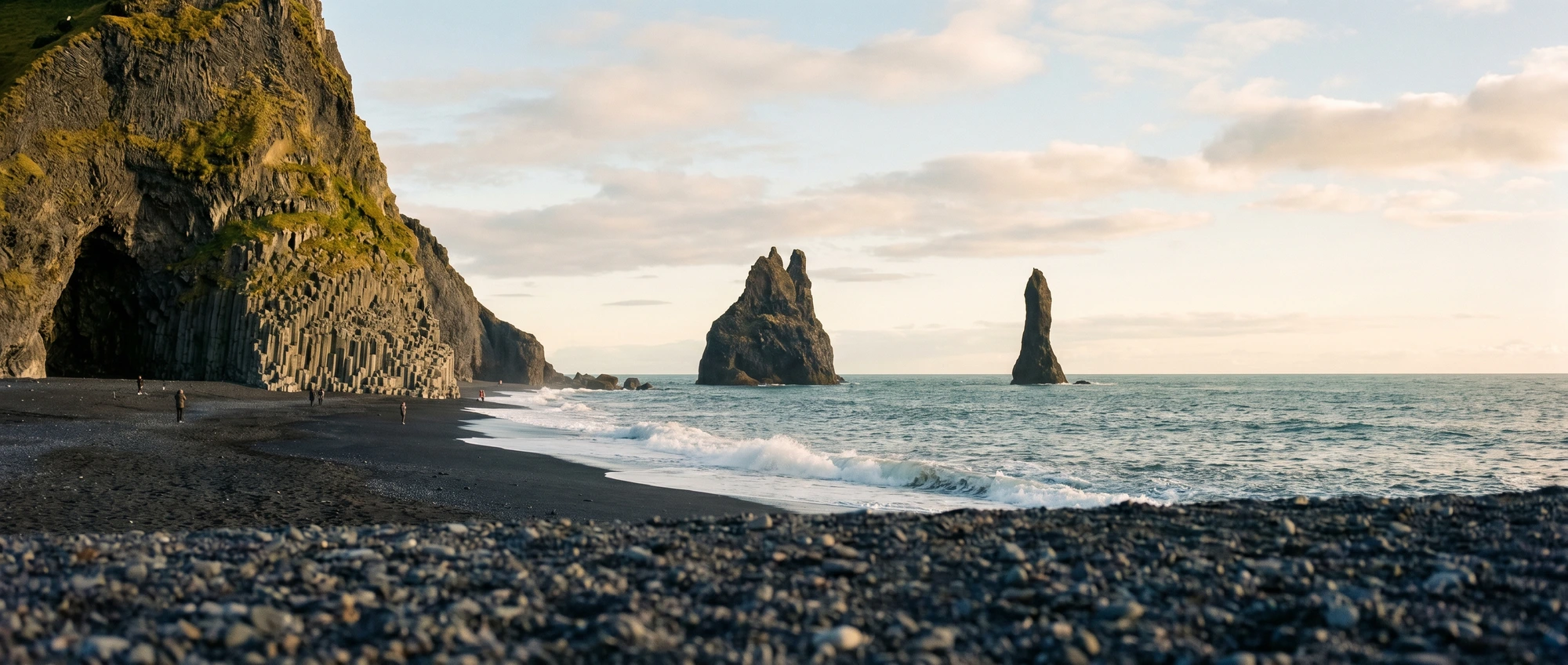
Give the beach about an hour — enough to walk the sand, see the hexagonal basalt columns and the Reynisdrangar sea stacks offshore, and duck out of the gale. The catch is timing: tour coaches from Reykjavík pack the car park from mid-morning to mid-afternoon, so the place is busiest exactly when most day-trippers arrive. Come at opening or near dusk and you can have the sand close to yourself, which is the single best argument for sleeping over in Vík rather than day-tripping the South Coast in one exhausting loop.
Is it worth it?
Yes — Reynisfjara is the South Coast sight that lives up to its photographs, and the basalt columns and brooding sea stacks are genuinely strange to stand beneath. Our honest steer: treat it as a 45-minute-to-an-hour stop, not a destination in itself, and pair it with Dyrhólaey (puffins in June and July) and the waterfalls back towards Reykjavík rather than lingering. If the light is on red, don’t sulk — walk Víkurfjara, the calmer black-sand beach by Vík village, which frames the Reynisdrangar stacks just as well without the lethal surf. And after February 2026’s storms reshaped the sand and exposed boulders here, conditions can change week to week, so check the forecast and the light before you commit the drive.
Planning the rest of your trip? See the Vík city guide.