Punjab
Golden Temple (Sri Harmandir Sahib)
How to visit Amritsar's Golden Temple: it's free and open round the clock, why dawn and after-dark beat midday, how the head-covering and shoe routine works, and eating in the langar that feeds tens of thousands a day.
Where
Amritsar, India
Opening hours
Open 24 hours, every day. The Guru Granth Sahib is carried in (prakash) before dawn — around 02:30–05:00 depending on the season — and taken to the Akal Takht at night (sukhasan), roughly 21:30–23:00; the floodlit night view is best in the hours before that. The complex never closes, but the inner sanctum causeway queue is shortest very early morning and late evening.
Tickets
Free. There is no entry ticket and no charge to eat in the langar; donations are voluntary. Budget only for a small auto or Ola from your hotel if you are not within walking distance, and for the optional shoe-deposit tip if you use a porter.
Time needed
Allow 2–3 hours for a proper visit — circuit the parikrama, queue across the causeway to Sri Harmandir Sahib, and sit for langar. A quick floodlit-at-night look is 45 minutes; combine with Jallianwala Bagh next door for a half-day.
In short
Visiting Golden Temple (Sri Harmandir Sahib)
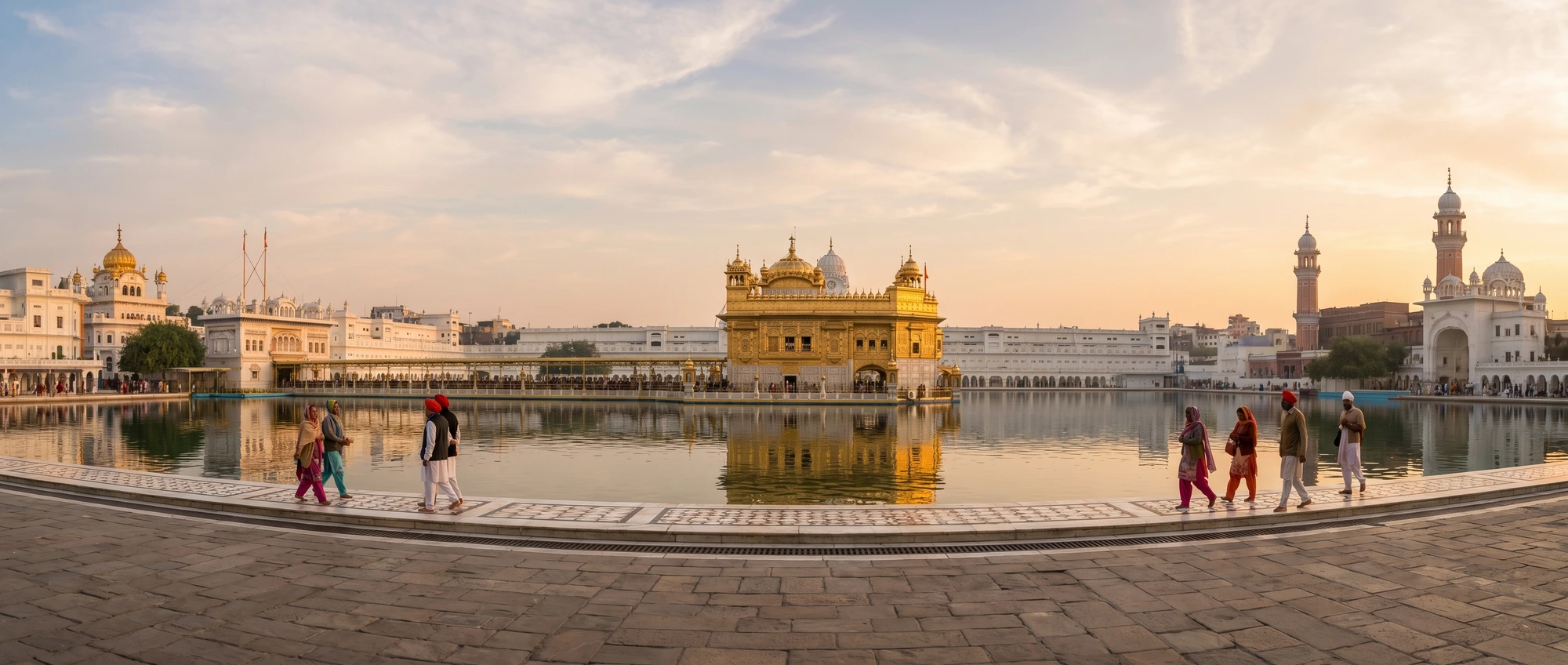
The Golden Temple — Sri Harmandir Sahib, Sikhism's holiest shrine — is free to enter and open around the clock, so the decisions are about timing and etiquette, not tickets. Go twice: at first light when the marble parikrama is cool and the prakash (opening of the Guru Granth Sahib) happens before dawn, and again after dark when the gold sanctum is floodlit and mirrored in the Amrit Sarovar pool. Cover your head, leave shoes and socks at the free counter, wash your feet through the shallow trough at the entrance, and eat at least once in the langar, the free community kitchen that serves on the order of 50,000–100,000 meals a day. Allow two to three hours, more if you queue across the causeway to the inner sanctum.
How to do it right: free, round the clock, twice in a day
The first thing to know is that there is no ticket. Sri Harmandir Sahib — the Golden Temple, Sikhism’s holiest shrine — is free to enter and open 24 hours a day, so the planning is about timing and etiquette rather than booking. The routine at the entrance is the same for everyone: cover your head (free scarves are handed out if you don’t have one), leave shoes and socks at the free deposit counter, and wash your feet through the shallow water trough before you step onto the marble. Don’t bring alcohol or tobacco, dress modestly, and you’re in.
Plan to come twice in the same day. Before dawn — the prakash, when the Guru Granth Sahib is carried in, happens roughly 02:30–05:00 depending on the season — the marble parikrama is cool underfoot, the morning Asa di Var prayers drift across the water, and the crowds are thin. Then return after dark, when the gold sanctum is floodlit and mirrored in the Amrit Sarovar, the sacred pool that rings it. That night reflection is the photograph everyone comes for, and it’s a completely different place from the harsh midday version.
Inside the complex: the causeway, the pool and the langar
From the parikrama, a marble causeway crosses the water to the gilded inner sanctum itself, where ragis sing kirtan continuously. The queue for the causeway is the one wait worth planning around — it’s shortest very early morning and late evening, and can stretch to an hour or more at busy times and on weekends. Photography is fine around the pool but not inside the inner sanctum.
Don’t skip the langar. The Golden Temple’s community kitchen serves a free vegetarian meal — dal, sabzi and chapati — to anyone who sits, on the order of tens of thousands of plates a day, every job done by volunteers. You take a steel plate, sit cross-legged in long rows on the floor, and eat alongside everyone else; there’s no charge and donations are voluntary. Allow 2–3 hours for the full circuit, less if you only come for the night view.
When to go, and what to pair it with
Time your trip for October to March, when Punjab is dry and cool and the open marble is comfortable barefoot. Avoid April to June, when temperatures pass 40°C and the stone is too hot to walk on by late morning — early and late visits become essential rather than optional then. The autumn Bandi Chhor Divas illuminations (around Diwali) are spectacular but bring big crowds.
The Golden Temple sits a short walk from Jallianwala Bagh, the 1919 massacre memorial, and the Partition Museum in the old Town Hall, so a half-day covers all three on foot. The one thing that needs a vehicle is the late-afternoon Wagah border ceremony about 30km west — book a car or a guided afternoon trip for that. Our honest take: the Golden Temple is the rare icon that lives up to itself, and because it costs nothing and never closes, the only way to get it wrong is to come once, at midday, in a rush.
Planning the rest of your trip? See the Amritsar city guide.