Tuscany
Tuscany
A first Tuscany road trip for UK travellers: the Florence–Chianti–Siena–Val d'Orcia loop, where to base yourself, the ZTL fines that catch everyone, and whether you actually need a car.
In short
Tuscany at a glance
Tuscany is the road trip Italy is built for: fly into Pisa or Florence, then loop the Chianti wine roads, the medieval skyline of San Gimignano, Siena's shell-shaped Piazza del Campo and the cypress-lined hills of the Val d'Orcia. The whole circuit is only about 250–300 km, so you're never driving more than 90 minutes between stops. You do want a car here — public transport reaches Florence, Siena and Pisa, but not the vineyards, agriturismi and hill villages that are the whole point. Allow 7 days for a relaxed loop, 5 if you skip the deep south.
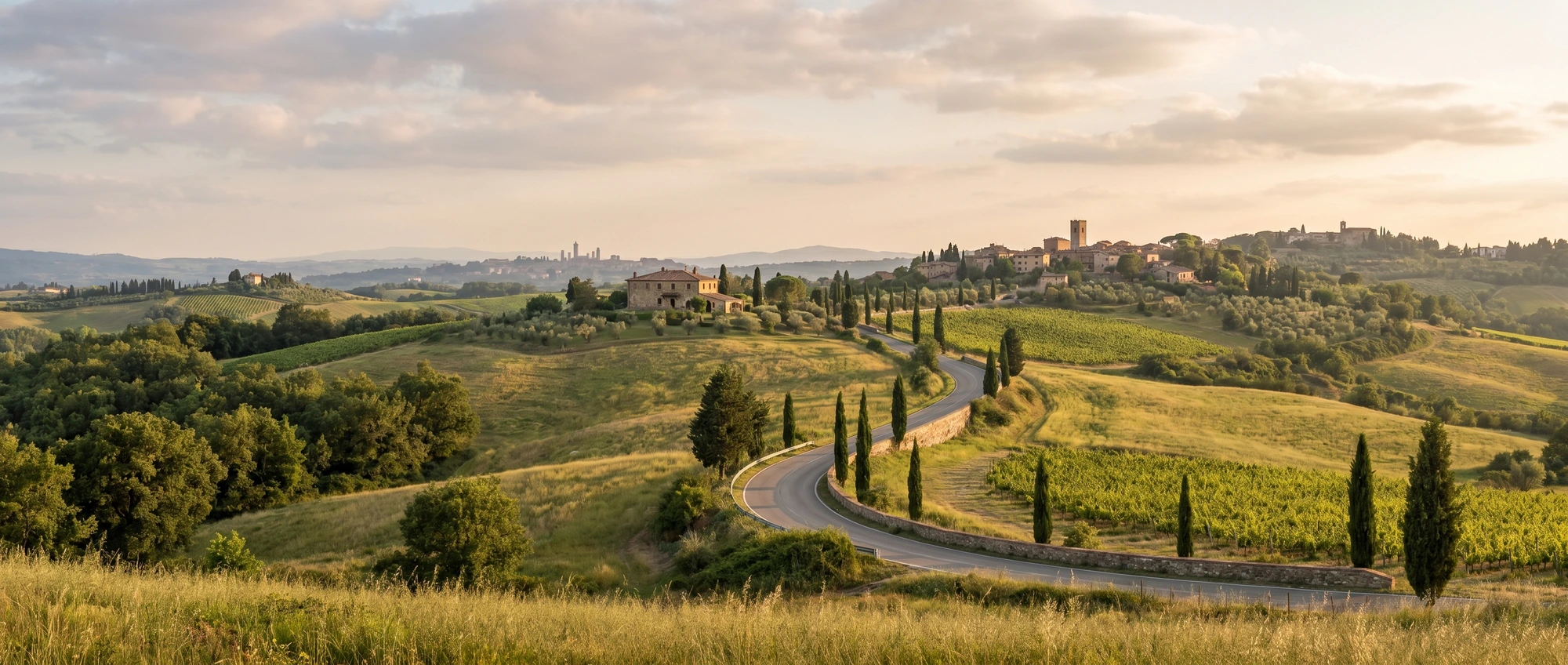
Tuscany is the road trip Italy seems designed for: a compact loop of about 250–300 km that takes in Florence’s Renaissance heavyweights, the vineyard lanes of Chianti, San Gimignano’s medieval towers, Siena’s shell-shaped Piazza del Campo, and the cypress-lined hills of the Val d’Orcia that launched a thousand screensavers. You’re rarely behind the wheel for more than 90 minutes between stops, which leaves the days free for long lunches and cellar visits rather than motorway slog.
The honest verdict on the car: here, unlike most of Italy, you want one. Trains will get you to Florence, Pisa and Siena, but they won’t reach the family wineries near Greve, the agriturismi with the pool and the view, or the back roads of the Val d’Orcia — and those are the whole reason to come. The one thing every UK driver should learn before they set off is the ZTL: the camera-enforced restricted zones in the centres of Florence, Siena, Lucca and others. Drive in by accident and the fine of roughly €80–100, plus an admin fee from the hire company, can land months after you’re home. The rule is simple — never drive into a walled old town. Park at the edge and walk.
The loop below assumes the relaxed week, basing in the cities first on foot, then swapping to a countryside agriturismo once you’ve collected the car. Drop the Val d’Orcia and it compresses neatly to five days; come in the September harvest and book the good rural stays well ahead, because they fill months out.
The route
A relaxed one-week loop that strings together the cities, the wine and the iconic hills without backtracking. Drive times are real-road estimates on the SR2, SS222 'Chiantigiana' and the autostrade; keep the car out of the city ZTLs and park at the edge.
-
Days 1–2
Florence
Start here on foot, before you collect the car. The Uffizi and the Accademia (David) both need timed tickets booked weeks ahead, and the Duomo dome climb sells out by mid-morning. Don't drive into the centre — Florence's ZTL is one of Italy's strictest. Pick the hire car up at the airport or a peripheral depot as you leave on day 3.
-
Day 3
Chianti wine roads
Drive the SS222 'Chiantigiana' south — about an hour to Greve in Chianti, the heart of it. Stop at a family estate near Greve, Panzano or Radda for a tasting (typically €15–35 a head, often free at small cellars). Sleep at an agriturismo here so you can actually drink at lunch and walk back to your room.
-
Days 4–5
Siena & San Gimignano
San Gimignano's medieval towers are a 45-minute drive on; climb the Torre Grossa (€10) for the rooftop view, then push to Siena (about an hour). Park at Santa Caterina or Il Campo car parks — never inside the walls. The shell-shaped Piazza del Campo and the striped Duomo (cathedral from €5) are the highlights; two nights lets you slow down.
-
Days 6–7
Val d'Orcia
The postcard Tuscany — cypress avenues, Pienza's pecorino, and the Brunello cellars around Montalcino and the Vino Nobile of Montepulciano. About 70 minutes south of Siena. Base near Montalcino or Pienza, do one cellar tour, and drive the SP146 between Pienza and Montepulciano at golden hour before looping back to fly home.
Where to base yourself
Pick one or two bases rather than moving every night.
Florence (Oltrarno / Santa Croce edge)
££ mid-rangeThe best first base before you have the car: walkable, packed with the headline sights and the most direct UK flights into nearby Pisa. The Oltrarno (south bank) is calmer and better value than the cathedral core. Stay outside the ZTL line or pick a hotel with a ZTL permit for your plate.
Best for: First two nights, museums, walkability
Chianti countryside (near Greve or Panzano)
££ mid-rangeOnce you have the car, swap the city hotel for a vineyard agriturismo. You get a pool, a cellar door on the doorstep and dinner with a view for less than a Florence room. The trade-off is you'll drive everywhere — but that's the whole point of the trip.
Best for: Wine, slow days, agriturismo life
Val d'Orcia (near Montalcino or Pienza)
££ mid-rangeThe quietest, prettiest base for the southern loop — cypress hills, Brunello cellars and Pienza's cheese shops within a short drive. Book ahead in harvest season; the good agriturismi here fill months out for September and October.
Best for: Brunello, scenery, harvest, two nights
Getting around Tuscany
Hire a car — Tuscany is the rare Italian region where you genuinely need one. Trains link Florence, Pisa and Siena, but the vineyards, agriturismi and hill villages that make the trip have no buses. The catch is the ZTL: camera-enforced restricted zones in the centres of Florence, Siena, Lucca and others, where a wrong turn means an €80–100 fine plus an admin charge from the rental company months later. Park at the edge of every town (signed park-and-ride or the big peripheral car parks) and walk in. Pick the car up as you leave Florence rather than keeping it parked in the city.
Book the essentials
Where to stay
Tours & tickets
Airport transfers
Car hire
Stay connected
Tuscany FAQs
How many days do you need for Tuscany?
Do you need a car in Tuscany?
What are the ZTL zones and how do I avoid a fine?
What is the best time to visit Tuscany?
Ready to book?
Compare car hire