Chubu / Kanto
Mount Fuji and Hakone
How to see Mount Fuji from Tokyo for UK travellers: Hakone's hot-spring loop versus the close-up lake views at Kawaguchiko, real train and bus costs in pounds, and which one to pick.
In short
Mount Fuji and Hakone at a glance
There are two ways to do Mount Fuji from Tokyo, and people muddle them up. Hakone is a hot-spring resort south-west of the city where you ride a famous loop of trains, a cable car, a ropeway over steaming volcanic vents and a pirate-ship cruise across Lake Ashi — Fuji is the backdrop, not the point. Kawaguchiko, at the foot of the mountain, is where Fuji fills the sky: the Chureito Pagoda shot, the lakeside reflection, the close-up. Hakone is the easy day trip (about 80 minutes from Shinjuku); Kawaguchiko is the better mountain (about 2 hours by bus) and worth an overnight. Both are doable as a day trip, but the magic is staying over.
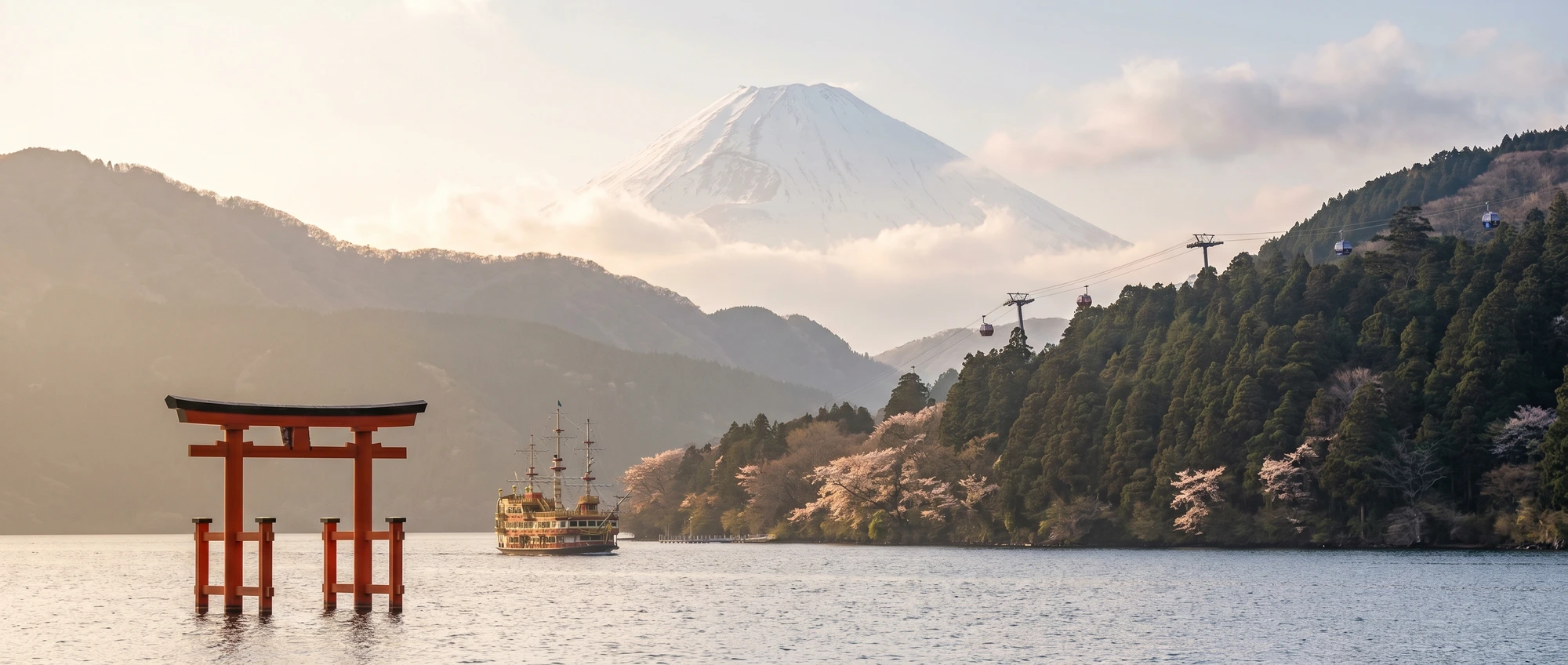
The confusion to clear up first: Hakone and Mount Fuji are not the same place. Hakone is a hot-spring valley south-west of Tokyo where the attraction is the journey itself — a chain of little mountain trains, a cable car, a ropeway gliding over the steaming sulphur vents of Owakudani, and a mock pirate ship that cruises Lake Ashi to the red torii gate of Hakone Shrine standing in the water. Fuji shows up over the ridge on a clear day, but it’s the supporting act. You come to Hakone to ride the loop and soak in an onsen.
If the mountain itself is what you’re after — the one that fills the frame, snow-capped and enormous — that’s Kawaguchiko, on the far side of Fuji at the lakes. From Oishi Park the mountain reflects in the water; from the Chureito Pagoda it rises behind a five-storey pagoda in the single most photographed view in Japan. Hakone is the slicker day trip (about 80 minutes on the Romancecar from Shinjuku); Kawaguchiko is the better mountain (about two hours by bus) and rewards an overnight.
The honest catch with Fuji is that it hides. Cloud builds through the day and the peak often vanishes by early afternoon, worst of all in the summer humidity. The clearest skies come on cold winter mornings from November to February, and you want to be looking before 8am. That single fact is the argument for staying a night near the lake rather than rolling in at midday on a coach: you trade one early start for a real chance of seeing the thing you came for.
The route
Two self-contained plans rather than one loop, because Hakone and Kawaguchiko sit on opposite sides of the mountain and most people pick one. Times are from Shinjuku; the Hakone Freepass and the Fuji-area bus pass both pay off if you do the full circuit.
-
Option A — Day 1
Hakone hot-spring loop
Romancecar from Shinjuku to Hakone-Yumoto (about 80 min, ~£11). Ride the loop anticlockwise: Hakone Tozan switchback railway up to the Open-Air Museum, then the ropeway over the Owakudani sulphur vents (eat a black egg, boiled in the volcanic spring), the pirate ship across Lake Ashi to Moto-Hakone and the red torii gate of Hakone Shrine standing in the water. The 2-day Hakone Freepass (¥7,100, ~£37 from Shinjuku) covers every leg.
-
Option A — Night
Onsen ryokan in Hakone
This is the reason to stay: a traditional inn with a hot-spring bath, a kaiseki dinner and yukata robes. Decent ryokan start around ¥12,000–15,000pp (~£62–78) with dinner and breakfast; a private in-room onsen pushes you past ¥25,000 (~£130). Gora and Sengokuhara are the best onsen bases.
-
Option B — Day 1
Kawaguchiko & the close-up Fuji
Highway bus from Shinjuku Bus Terminal to Kawaguchiko (about 2 hours, ~£11–12, cheaper online). Get the ¥1,500 (~£8) two-day local bus pass and ride the Red Line to Oishi Park for the lavender-and-Fuji lakeside view, then the Chureito Pagoda (five-storey pagoda framing the mountain — the single most photographed Fuji shot). Aim to be at the viewpoints early; cloud builds through the afternoon.
-
Option B — Night
Lakeside stay for the dawn mountain
Overnight on Lake Kawaguchiko's north shore so you can walk to the water for the 5–8am window, statistically the clearest of the day. A lake-view room with Fuji in the glass is the whole trip; book autumn-foliage weekends (late October–mid-November) months ahead, as the best dates sell out first.
Where to base yourself
Pick one or two bases rather than moving every night.
Hakone — Gora & Sengokuhara
££ mid-rangeThe onsen heartland: hillside ryokan with hot-spring baths, the Open-Air Museum and the Pola art museum within reach. Gora sits on the loop's cable-car line so you're not coach-dependent; Sengokuhara is quieter and good for the pampas-grass field. This is where you stay to soak, not to stare at Fuji.
Best for: Onsen ryokan, the scenic loop, a relaxed overnight
Kawaguchiko — north shore (Oishi/Lake Kawaguchi)
££ mid-rangeThe Fuji-view base. North-shore hotels look straight across the lake at the mountain, so you can catch the dawn-clear window without travelling. Walkable to Oishi Park and on the Red Line bus loop. Plainer than a Hakone ryokan, but the room view is the point.
Best for: Close-up Mount Fuji, lake-view rooms, photographers
Fujiyoshida / Shimoyoshida
£ valueThe town below the Chureito Pagoda, with retro shopping streets that frame Fuji at the end of the road. Cheaper than the lakeshore and handy if the pagoda sunrise is your priority, but you're a short hop from the lake views rather than on them.
Best for: Chureito Pagoda sunrise, budget stays, the photogenic street shots
Getting around Mount Fuji and Hakone
These are two different journeys, not a loop. For Hakone, take the Odakyu Romancecar from Shinjuku to Hakone-Yumoto (about 80 minutes, roughly £11 one-way; ¥50 cheaper booked ticketless online) — slower local trains via Odawara cost about ¥1,270 (~£7) if you'd rather save. Inside Hakone, the 2-day Hakone Freepass (¥7,100, ~£37 from Shinjuku) covers the switchback train, cable car, ropeway, pirate ship and buses, and pays for itself if you ride the full loop. For Kawaguchiko, the Fujikyu/Keio highway bus from Shinjuku Bus Terminal is the easy option (about 2 hours, ~£11–12, ¥200 cheaper online); the train via Otsuki and the Fujikyu line is slower and pricier. Around the lakes, the ¥1,500 (~£8) two-day Fuji-area bus pass covers the Red, Green and Blue sightseeing lines. A Japan Rail Pass does not cover the private Odakyu, Fujikyu or Hakone lines, so don't bank on it here.
Book the essentials
Where to stay
Tours & tickets
Airport transfers
Stay connected
Trains & rail passes
Mount Fuji and Hakone FAQs
Hakone or Kawaguchiko — which is better for Mount Fuji?
Can you see Mount Fuji on a day trip from Tokyo?
Is the Hakone Freepass worth it?
Can you climb Mount Fuji, and do you need a permit?
Ready to book?
Book experiences