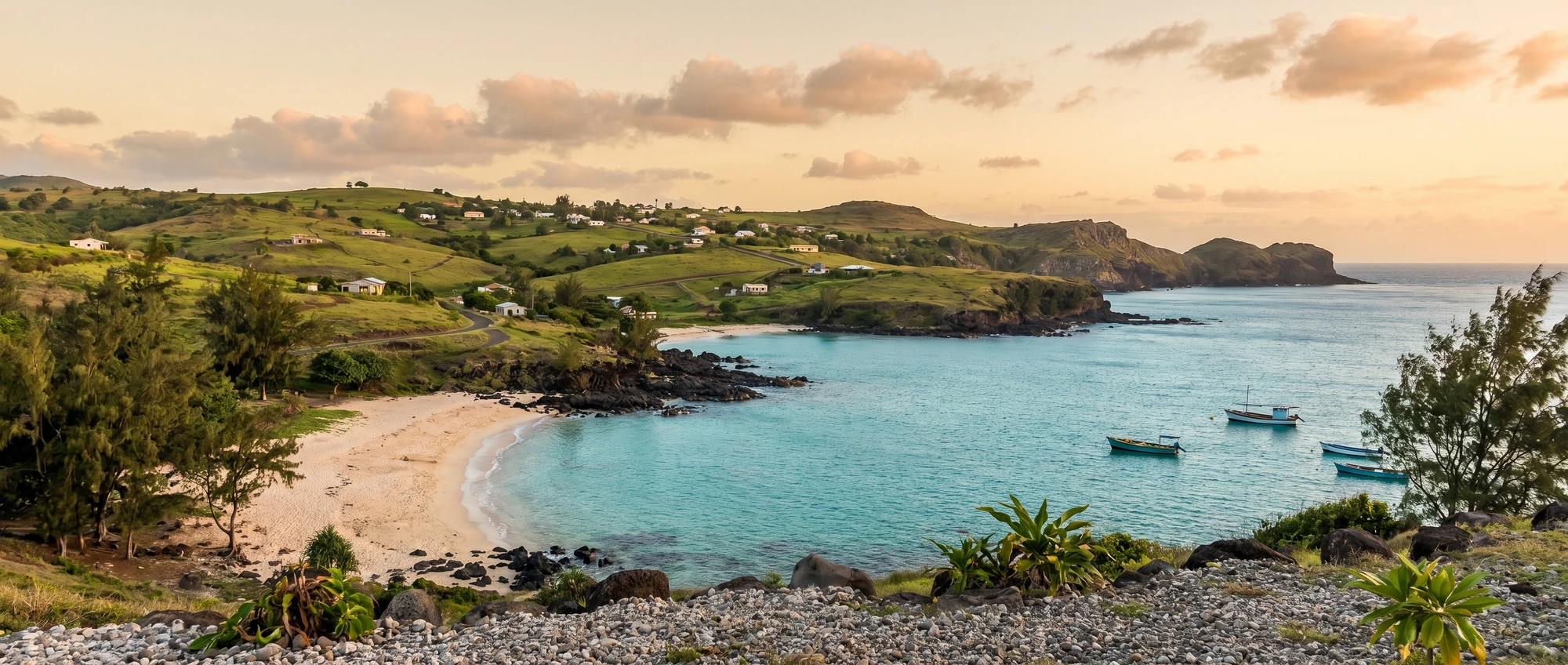
Outer islands, Mauritius
Rodrigues
How to add Rodrigues to a Mauritius trip: the 1h30 Air Mauritius hop to RRG, the Île aux Cocos bird boat, octopus-and-Creole eating in Port Mathurin, and why it's the rustic opposite of the resort coasts.
In short
Rodrigues at a glance
Rodrigues is the small Mauritian island 560km east of the main one — a 1h30 Air Mauritius or Airlink hop from SSR airport (MRU) to tiny Sir Gaëtan Duval airport (RRG) at Plaine Corail. It is the rustic opposite of the Belle Mare and Grand Baie resort coasts: a hilly, volcanic island ringed by a lagoon twice the size of the land, with Creole fishing villages, no high-rise hotels and almost no chain anything. Most UK visitors add it as a three-to-five-night second leg after a week on the main island, not as a standalone long-haul trip. The draws are specific: a boat day to Île aux Cocos, a protected sandy islet with nesting terns and noddies inside the lagoon; the François Leguat reserve at Anse Quitor, where you walk among free-roaming giant tortoises and into a limestone cave; the Saturday-morning Port Mathurin market for chilli paste, honey and limes; and a walk down to Trou d'Argent, the postcard cove on the wild east coast reached on foot from Graviers. Eating is the other reason to come — octopus curry (ourite) is the island dish, grilled or curried at simple tables in Port Mathurin and Port Sud-Est. Two honest caveats: it is genuinely remote and basic, with limited nightlife, slow roads and small guesthouses rather than spas, so it suits walkers, snorkellers and people who want quiet over polish; and the same southeast trade winds that make Pointe Coton a kitesurf spot make July and August breezy. Bring rupees and a card — it is the same currency, left-hand driving and UK Type G plugs as the main island, so no travel adapter is needed for a Rodrigues stay.
Rodrigues is the small, hilly island 560km east of the main island, and it is the rustic opposite of the Belle Mare and Grand Baie resort coasts. There are no high-rise hotels and almost no chains — instead Creole fishing villages, family guesthouses, octopus drying on lines and a lagoon roughly twice the size of the land itself. You reach it on the 1h30 Air Mauritius or Airlink hop from SSR airport (MRU) over to tiny Sir Gaëtan Duval airport (RRG) at Plaine Corail in the south, with several flights most days and return fares around ₨7,000–11,000 (~£110–170). Most UK visitors come for three to five nights as a second leg after a week on the main island, not as a standalone long-haul trip.
The set-pieces are specific and easy to string together. The island-classic day is a permitted boat out to Île aux Cocos, a protected sand islet inside the lagoon thick with nesting terns and noddies, usually with a Creole barbecue lunch and a price around ₨1,500–2,500 (~£23–39) a head; numbers are capped to protect the colony, so book a day or two ahead. Near the airport at Anse Quitor, the François Leguat reserve (entry ~₨400–500 / £6–8) lets you walk among free-roaming giant tortoises and into the Caverne Patate limestone cave. On the wild east, you park at Graviers and walk the 20–30 minute coastal path down to Trou d’Argent, the cliff-backed cove, then on to Saint François beach. And on a Saturday morning the market in Port Mathurin, the small capital, fills with chilli paste, honey and limes — go by about 9am before it thins.
Two honest caveats decide whether Rodrigues suits you. It is genuinely remote and basic: limited nightlife, slow and hilly roads, guesthouses and tables d’hôte rather than spas, so it rewards walkers, snorkellers and people who want quiet over polish. And it sits full in the southeast trade winds, so July and August are breezy and a few degrees cooler — perfect for the Pointe Coton kitesurfers, less so for lazy lagoon swimming, which is calmest in the May–June and September–November shoulder months. Practically it is the same as the main island — Mauritian rupees, driving on the left like home and UK Type G plugs at 230V — but far more cash-led, so carry ₨2,000–4,000 (~£30–60) for the market, the buses and the octopus stalls. Check the GOV.UK Mauritius page for the latest safety and health advice, as it covers Rodrigues too.
The route
Rodrigues is a small island you slow right down on, not a touring blitz, so this is a relaxed three-to-four-day skeleton for a second leg after the main island, built around Port Mathurin or a southeast guesthouse with a hire car or a guesthouse driver. There is no train and the buses are sparse and slow, so factor a hire car or fixed-price driver into the boat-day and beach legs.
-
Day 1
Fly in and settle in the southeast
Take the morning Air Mauritius or Airlink flight from MRU — about 1h30 over open ocean — into Sir Gaëtan Duval airport (RRG) at Plaine Corail in the south. Pick up a small hire car or a pre-arranged guesthouse driver and settle near Port Sud-Est or Rivière Cocos. Ease in with a first octopus curry at a beach table and a swim; the lagoon here is shallow and warm.
-
Day 2
Île aux Cocos bird boat
The island-classic day out: a permitted boat trip across the lagoon to Île aux Cocos, a protected sand islet thick with nesting terns and noddies, usually with a Creole barbecue lunch on the beach — around ₨1,500–2,500 (~£23–39) per person. Numbers are capped to protect the colony, so book a day or two ahead through your guesthouse and pick an operator with a reserve permit; check the boat carries enough life jackets (GOV.UK).
-
Day 3
Tortoises, the cave and the east-coast walk
Drive to the François Leguat reserve at Anse Quitor near the airport (entry ~₨400–500 / £6–8) to walk among free-roaming giant tortoises and into the Caverne Patate limestone cave, then cross to the wild east. Park at Graviers and walk the 20–30 minute coastal path down to Trou d'Argent, the photogenic cliff-backed cove, then on to Saint François beach for the afternoon.
-
Day 4
Port Mathurin market and a slow finish
If your day here is a Saturday, start in the capital, Port Mathurin, for the morning market — go by about 9am for chilli paste, honey, limes and crafts before it thins out. Otherwise stroll the small town, climb or drive towards Mont Limon (the 398m high point) for the island view, and keep the rest light before the flight back to MRU. Leave a clear buffer: there are only a handful of daily flights and they fill in peak season.
Where to base yourself
Pick one or two bases rather than moving every night.
Port Mathurin and around
££ mid-rangeThe small capital on the north coast and the island's only real town, with the Saturday market, the ferry quay, a cluster of guesthouses and small hotels, banks and the best choice of Creole tables. It is the most convenient base if you want to walk to dinner and shops and don't mind that it isn't on a swimming beach — the nicest sand is a short drive east. A practical, central base for a first Rodrigues stay.
Best for: First-timers wanting shops, banks, the market and an easy walk to dinner
The southeast: Port Sud-Est, Rivière Cocos and Pointe Coton
££ mid-rangeThe lagoon-and-kitesurf side of the island, closest to the airport and to the Île aux Cocos boats, with a run of small beach guesthouses and a couple of larger hotels at Pointe Coton. This is the spot for shallow warm swimming, the long Pointe Coton sand and kitesurfing in the trade-wind season; quiet, with little beyond your guesthouse table for dinner, so plan transport.
Best for: Beach and lagoon days, kitesurfers and being near the boat trips
Graviers and the east coast
£ valueThe wild, cliff-backed east, the trailhead end for the walk to Trou d'Argent and Saint François. Accommodation is sparse and simple — a few family guesthouses and self-catering rooms — and it is the quietest, most remote corner, with the best walking straight from the door. Choose it only if you want isolation and don't mind driving to most meals and shops.
Best for: Walkers and people wanting the quietest, most remote base
Getting around Rodrigues
Rodrigues is small — about 18km end to end — but the roads are hilly, narrow and slow, so don't plan by the map's short distances. There's no train and the public buses, run from the Port Mathurin terminal, are cheap (₨20–40 / ~£0.30–0.65) but infrequent and stop in the early evening, so they're a budget tool rather than a way to keep to a boat-trip schedule. The thing that unlocks the island is a small hire car — roughly ₨1,400–2,000 (~£22–31) a day, and you drive on the left like home — booked ahead through your guesthouse or a local agency, as the airport desks are tiny and sell out in peak season. If you'd rather not drive the steep lanes, most guesthouses arrange a fixed-price driver for a half-day or a beach run; agree the fare before you set off, as taxis aren't metered. The airport, Sir Gaëtan Duval (RRG) at Plaine Corail, is in the south, about 20 minutes from Port Mathurin and 10–20 minutes from the southeast beaches — arrange the transfer with your guesthouse rather than expecting a rank of waiting taxis.
Book the essentials
Where to stay
Tours & tickets
Airport transfers
Car hire
Stay connected
Rodrigues FAQs
How do you get to Rodrigues, and how long does it take?
Is Rodrigues worth visiting if I'm already going to Mauritius?
What is there to do on Rodrigues?
When is the best time to visit Rodrigues?
Rodrigues or the main island — and do I need to bring cash?
Ready to book?
Compare car hire