Southern Mexico
Yucatán Peninsula
The inland Yucatán by hire car for UK travellers: Mérida as a base, Chichén Itzá before the coaches arrive, the cenotes worth the detour, and how to loop it from Cancún without backtracking.
In short
Yucatán Peninsula at a glance
The Yucatán is the inland half of Mexico's Caribbean corner — the bit most UK travellers fly over on the way to a Cancún resort and never see. Pick up a hire car at Cancún or Mérida airport and you can loop colonial Mérida, the Maya cities of Chichén Itzá and Uxmal, the pretty pueblo of Valladolid and a string of swimmable cenotes in a week without doubling back. Distances are real — Cancún to Mérida is about 300km — but the toll road is fast and flat, and a car is the only sensible way to reach the quieter ruins and cenotes before the day-trip coaches arrive. Allow 6–7 days for the full loop, or 3–4 if you base in Mérida and treat it as side trips.
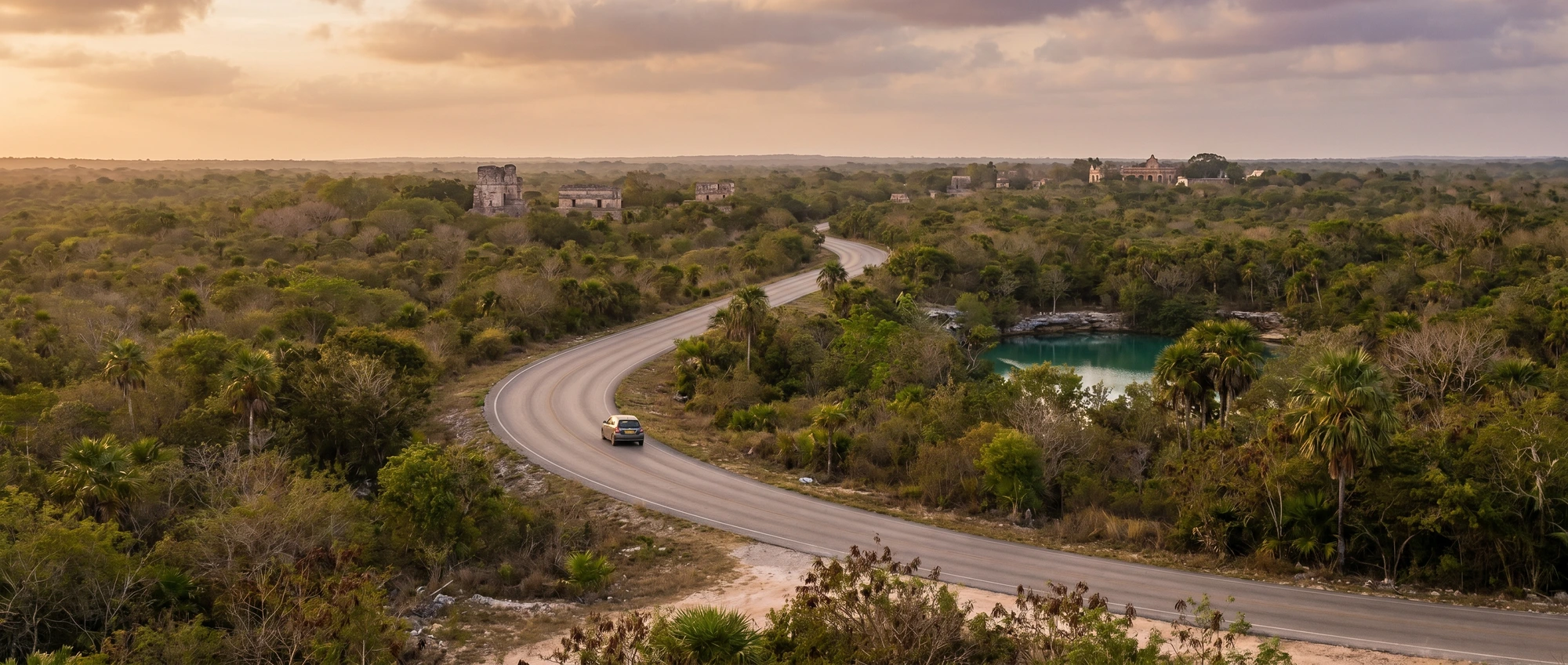
The Yucatán is the Mexico that the Cancún beach crowd flies over and never lands in: flat scrubland studded with sinkhole cenotes, Maya cities older than anything in Europe, and a string of unhurried colonial towns where the food is better and the prices are a third of the resort strip. The classic first trip is a one-way arc by hire car — Cancún airport to Valladolid, on through Izamal to Mérida, then home — which lets you reach Chichén Itzá and Uxmal under your own steam instead of on a coach’s timetable.
The mistake almost everyone makes is treating Chichén Itzá as a day trip from a Cancún resort. Do that and you arrive at eleven, when the car parks fill with coaches and the temperature tips past thirty; the photos are of crowds and the experience is of queuing in the heat. Base yourself 45 minutes away in Valladolid instead, be at the gate for the eight o’clock opening, and you’ll have the great pyramid almost to yourself before the first bus pulls in. The same logic runs through the whole peninsula — the car, the early start, and a colonial base beat the resort-and-day-trip version every time.
The route
A relaxed six-day loop that strings together the headline Maya cities, a couple of cenotes and a colonial base without a single day of backtracking. Drive times are toll-road estimates; the free road is cheaper but much slower and rougher, so factor the toll into the budget.
-
Days 1–2
Valladolid & Chichén Itzá
Drive straight from Cancún airport to Valladolid (about 2 hours, 160km on the 180D toll road) and skip the coast entirely. Use Valladolid as a base: it's 45 minutes from Chichén Itzá, so you can be at the gate for the 8am opening before the Cancún coaches roll in. Cool off afterwards in Cenote Suytun or Cenote Ik Kil nearby.
-
Day 3
Izamal, then on to Mérida
Break the Valladolid–Mérida run (about 2 hours, 160km) at Izamal, the 'Yellow City', where the whole colonial centre is painted ochre. Continue to Mérida and settle in for the rest of the trip — it's the safest, most walkable base on the peninsula and the food capital of the region.
-
Days 4–5
Mérida & Uxmal
Use Mérida as a hub. Day-trip to Uxmal (about 1h15, 80km south), the finest Maya site after Chichén Itzá and far quieter, with no coach crowds. Keep an evening for Mérida itself: the Paseo de Montejo, the Sunday street closure and a meal of cochinita pibil at the central market.
-
Day 6
Celestún flamingos, then back to Cancún
Take an early boat trip from Celestún (about 1h30 west of Mérida) to see the flamingos in the biosphere lagoon, then either fly home from Mérida (MID) or drive the toll road back to Cancún (about 3h30, 300km) to close the loop.
Where to base yourself
Pick one or two bases rather than moving every night.
Mérida (Centro)
££ mid-rangeThe best all-round base on the peninsula: a grand colonial centre, the Paseo de Montejo, the region's best food and prices a fraction of the Riviera Maya. Safe to walk day and night and well placed for Uxmal, Celestún and the cenote country south of the city.
Best for: First-timers, food, a walkable colonial base
Valladolid
£ valueA small, pretty pueblo mágico that beats Cancún as a Chichén Itzá base — 45 minutes from the ruins, with Cenote Suytun and Cenote Zaci on the doorstep and a fraction of the resort-zone cost. Quieter at night; choose this over a long day trip from the coast.
Best for: Chichén Itzá at dawn, cenotes, a quiet first night
Izamal
£ valueA tiny ochre-painted colonial town that works as a calm one-night stop between Valladolid and Mérida — convent, pyramids and very little tourist crowd. Limited choice of hotels, so book ahead; better as a stopover than a multi-night base.
Best for: A slow midpoint stop, photographers
Getting around Yucatán Peninsula
A hire car is the right call for the Yucatán — it's the only practical way to reach Chichén Itzá before the coaches, the quieter ruins like Uxmal, and the cenotes that aren't on a tour itinerary. Pick the car up at Cancún or Mérida airport, decline the pushy 'extra insurance' upsell at the desk if your travel policy already covers car hire (it often catches UK drivers out), and stick to the 180D toll road (the 'cuota') between Cancún and Mérida — it's flat, fast and avoids the potholes, topes (speed bumps) and slow village crawls of the free road. Watch for topes on every approach to a town and don't drive after dark, which GOV.UK advises against on Mexican rural roads. If you'd rather not drive, the ADO first-class bus network links Cancún, Valladolid, Chichén Itzá and Mérida comfortably, but it ties you to the coach timings and you'll lose the dawn-arrival advantage at the ruins.
Book the essentials
Where to stay
Tours & tickets
Airport transfers
Car hire
Stay connected
Yucatán Peninsula FAQs
How many days do you need for the Yucatán?
Is it better to do Chichén Itzá as a day trip from Cancún or stay in the Yucatán?
Do you need a hire car for the Yucatán?
Ready to book?
Compare car hire