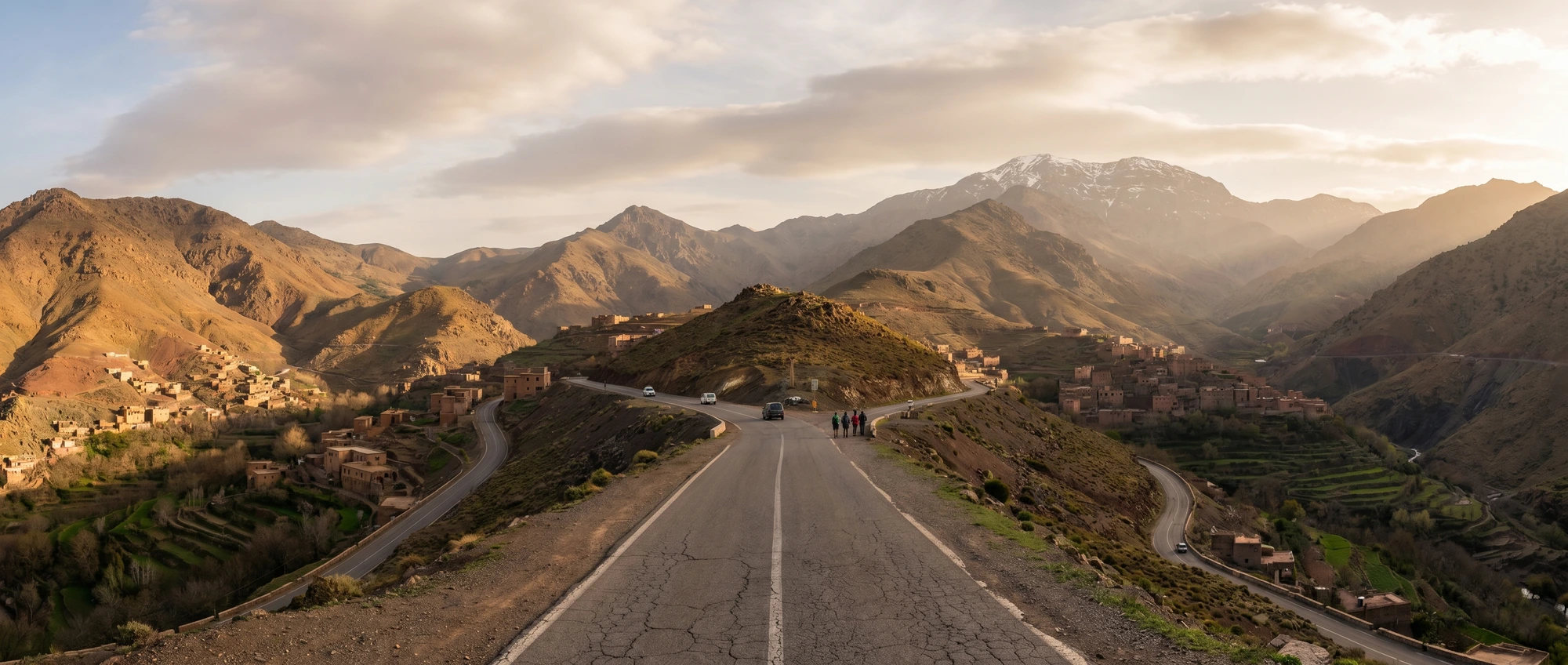
High Atlas, Morocco
Atlas Mountains
The High Atlas from Marrakech: which day trip is worth it (Imlil, not the Ourika coach), what it takes to climb Toubkal, the Tizi n'Tichka road to the desert, and the honest post-earthquake picture.
In short
Atlas Mountains at a glance
The High Atlas is the wall of 4,000m peaks an hour south of Marrakech, and it's where most first-timers' best day of the trip happens — or where they waste one. The honest split: Imlil (about 1h30 from the city) is the proper trailhead for a Berber-village walk and the launch point for Mount Toubkal, North Africa's highest at 4,167m; the Ourika Valley to Setti Fatma is the closer, cheaper coach day-trip, prettier on paper than in a crowd. The Tizi n'Tichka pass (2,260m) is the road, not a stop — it's how you cross the range to Aït Benhaddou and the Sahara. One thing every guide skirts: the September 2023 earthquake hit these villages hard and recovery is uneven, so spending your money up here genuinely matters.
The High Atlas is the wall of 4,000m peaks an hour south of Marrakech, and it sorts travellers into two camps: those who pick the right day and have the best one of their trip, and those who take the wrong coach and waste it. The right day is Imlil — about 1h30 and 65km from the city, at 1,740m, where the road runs out and the trailheads begin. You walk up through the Berber villages of the Aït Mizane valley, lunch in a guesthouse, and stand at the foot of Mount Toubkal, North Africa’s highest at 4,167m. The wrong day is the Ourika Valley to the Setti Fatma waterfalls: closer, cheaper and genuinely pretty, but a busy coach circuit where self-appointed guides latch on at the falls. Fine for a green half-day; not the mountains proper.
Toubkal itself is a two-day commitment from Imlil, not a day trip — about 5–6 hours up to the refuge, then a long 10–12 hour summit-and-return — and the season matters more than the fitness. Autumn (September–October) is the snow-free window where no technical gear is needed; from November to April you want crampons, an ice axe and a qualified guide. If your real target is the Sahara, the Atlas is the drive rather than the destination: the N9 climbs to the Tizi n’Tichka pass at 2,260m, 800-plus bends of it, then drops to the kasbah of Aït Benhaddou and on to Ouarzazate, which is why it’s day one of every Merzouga tour-loop.
One thing most guides skate over: the September 2023 earthquake hit these villages hard, and recovery has been uneven — some trekking hamlets are still quiet more than two years on, even as Marrakech books out. Imlil came through largely intact and is open, and staying in a village gîte or hiring a local guide is the most direct way to put your money where it’s needed. There’s no railway up here, so it’s a private driver, a small-group tour, or the grand-taxi-to-Asni-then-shared-4x4 route — and once you’re in the valleys, it’s all on foot or by mule, in cash.
The route
The Atlas isn't really a do-it-all-in-one-go region — it's three different trips depending on how much time and effort you want. Pick the line that fits: a half-day taster, a proper day in the mountains, a two-day Toubkal push, or the cross-range drive to the desert. Drive times are from Marrakech; there's no train, so everything below is by road.
-
Half day
Ourika Valley & Setti Fatma
The easy taster: ~1h–1h15 south to the Ourika Valley, lunch by the river, and a scramble up to the Setti Fatma waterfalls. It's the standard Marrakech coach trip (shared from ~£20–25pp, a private driver ~£55–80 for the car), green and cooler than the city — but it gets crowded and touty at the falls, with self-appointed 'guides' attaching themselves to you. Fine for a morning; not the mountains proper.
-
Full day
Imlil & the Aït Mizane valley
The day worth doing: ~1h30 (65km) to Imlil at 1,740m, then a 2–3 hour guided walk up through the Berber villages of Aroumd and the Mizane valley with real High Atlas views, lunch in a village guesthouse. Hire a local Imlil guide rather than booking the cheapest Marrakech package — the money stays in the valley and the walking is better. Mules can carry bags or tired legs.
-
2 days
Mount Toubkal ascent
Toubkal (4,167m) is North Africa's highest and a two-day minimum from Imlil — about 5–6 hours up to the refuge at ~3,200m on day one, then a 10–12 hour summit-and-return on day two. No technical skill needed in autumn, but it is a long, high, hard walk; altitude bites above 3,500m. From November to April you need crampons, an ice axe and a qualified guide. Always go with a guide and book the refuge ahead.
-
Cross-range
Tizi n'Tichka to Aït Benhaddou & the desert
If your real goal is the Sahara, the Atlas is the drive to get there. The N9 climbs to the Tizi n'Tichka pass (2,260m) — 800-plus bends, dramatic, and queasy if you're prone to car sickness — then drops to the mud-brick kasbah of Aït Benhaddou (~2h30–3h, 190km) and on to Ouarzazate. This is the standard first day of a Merzouga desert tour-loop; do it as part of the 3-day desert trip rather than a there-and-back day.
Where to base yourself
Pick one or two bases rather than moving every night.
Imlil (Aït Mizane valley)
£ valueThe base if the mountains are the point: the Toubkal trailhead at 1,740m, a cluster of gîtes and guesthouses, and walks straight from the door. Imlil itself came through the 2023 earthquake largely intact and has tourism income, so a night here is both the best launchpad and a useful place to spend. Cool evenings even in summer — pack a layer.
Best for: Trekkers, Toubkal, village walks
Ouirgane & Asni
££ mid-rangeLower, greener and gentler than Imlil, in the Azzaden and Asni valleys on the road up from Marrakech. Better for a relaxed mountain stay than a hard trek — lodges, a reservoir lake, easy walks — and Asni is the Saturday-market town and the road junction for Imlil. Less dramatic scenery, easier driving, often better-value rooms.
Best for: Relaxed mountain stays, families, gentle walking
A Berber gîte (village guesthouse)
£ valueFamily-run converted village homes across the High Atlas — Berber rugs, a panoramic terrace, and a tagine or couscous cooked by your hosts. The point is local life rather than hotel polish: simple, warm, and the most direct way to put your money into communities still rebuilding after the quake. Book through a trekking outfit or your guide.
Best for: Immersion, trekkers, supporting recovery
Ouarzazate (over the pass)
££ mid-rangeNot the mountains but the obvious overnight if you've crossed the Tizi n'Tichka heading for the desert: the film-studio town where the road splits for the Drâa Valley and Merzouga. Functional rather than charming, with normal hotels and a kasbah of its own. Most people sleep here on night one of a Sahara tour-loop rather than basing here.
Best for: Desert-bound travellers, a night beyond the pass
Getting around Atlas Mountains
There is no railway in the Atlas, so it's all road and all from Marrakech. The cleanest options are a private driver for the day (~£55–90 for the car to Imlil or Ourika and back) or an organised small-group tour; the cheap-and-local route is a grand taxi to Asni, then a shared 4x4 or minibus up the rough last stretch to Imlil. Self-driving the lower valleys is fine, but the Tizi n'Tichka pass — 800-plus bends and winter snow closures roughly January to April — isn't most people's idea of a holiday, so for the cross-range desert run, take a driver or a tour-loop. Once you're in Imlil, everything is on foot or by mule; bring cash, as cards don't work in the villages.
Book the essentials
Where to stay
Tours & tickets
Airport transfers
Stay connected
Atlas Mountains FAQs
Is the Atlas Mountains day trip from Marrakech worth it?
Can you climb Mount Toubkal in a day from Marrakech?
When is the best time to trek the Atlas Mountains?
How do you get from Marrakech to the Atlas Mountains?
Is it OK to visit the Atlas Mountains after the 2023 earthquake?
Ready to book?
Book experiences