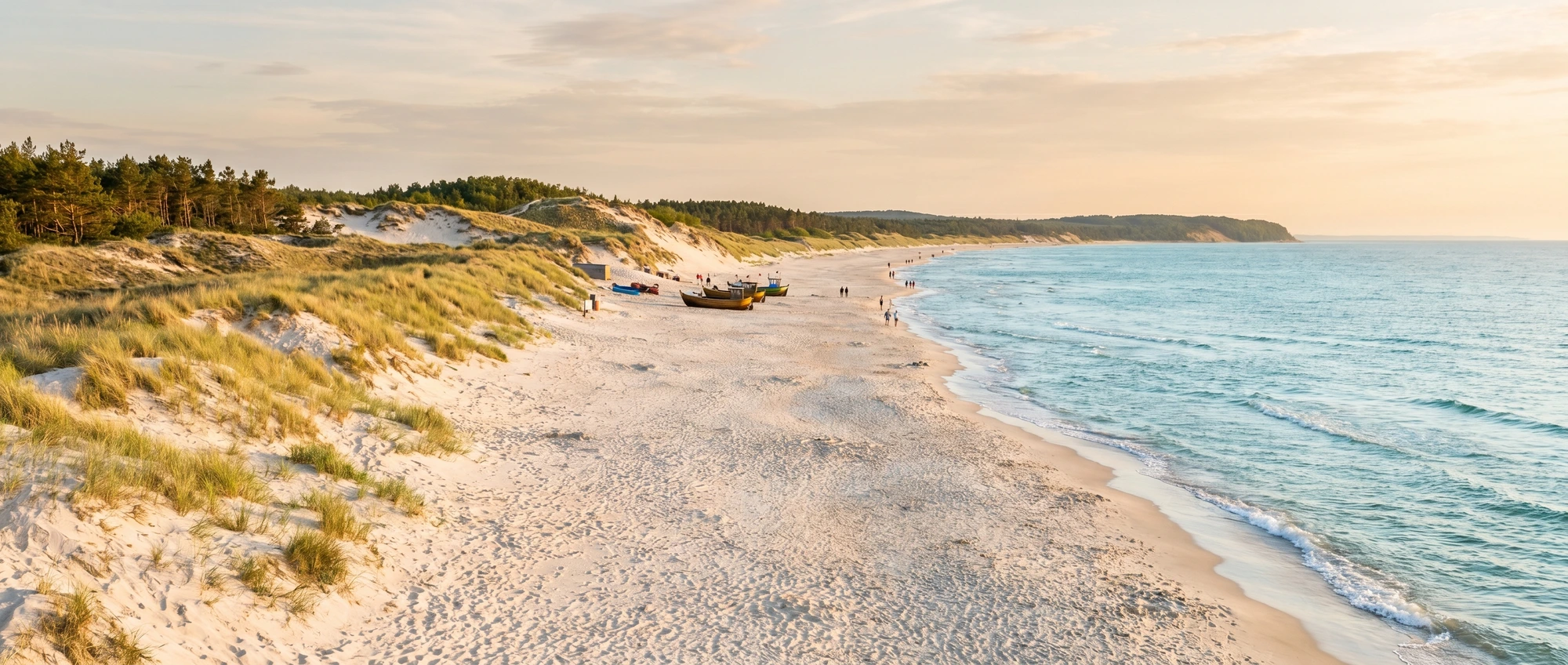
Northern Poland
Polish Baltic Coast
Poland's summer-holiday seaboard for UK travellers: the Gdańsk–Sopot–Gdynia Tri-City, white-sand dunes at Łeba and the Hel peninsula — what's worth the trip north and when the Baltic is actually warm enough to swim.
In short
Polish Baltic Coast at a glance
The Polish Baltic coast is the country's domestic summer-holiday strip, and for UK travellers it's really a Gdańsk add-on: fly into GDN, base in the Tri-City (Gdańsk, Sopot, Gdynia), and the beaches, the pier and the dunes are all a cheap SKM commuter train away. Sopot is the resort heart — Europe's longest wooden pier, a proper sandy beach and a busy spa-town strip — while Łeba's shifting dunes and the slim Hel peninsula are the day trips worth making. The honest catch is the water: the Baltic is cold, swimmable mainly in July and August, so come for the sand, the seafood and the air rather than a Mediterranean swim.
For UK travellers the Polish Baltic coast is best understood not as a standalone beach holiday but as the seaward half of a Gdańsk trip. Fly into GDN, base yourself anywhere in the Tri-City, and the SKM commuter train threads Gdańsk, Sopot and Gdynia together every ten minutes for the price of a coffee — which means you can spend a morning in a Hanseatic old town and an afternoon on a wide sandy beach without ever touching a car. Sopot is the resort heart, with Europe’s longest wooden pier and the busiest strip on the coast; Gdańsk is the cultural anchor; Gdynia is the cheaper, quieter port end and the launch point for the Hel peninsula.
The thing first-timers get wrong is the water. People arrive picturing a Mediterranean swim and find the Baltic genuinely cold — realistically swimmable only in July and August, and bracing the rest of the year. Come for the sand, the sea air, the smoked fish and the dunes, and you’ll love it; come expecting warm water in May and you’ll be disappointed. The one excursion that earns leaving the Tri-City is Łeba, where the shifting dunes of Słowiński National Park look improbably Saharan — go by hire car or a guided day tour, because public transport west of Gdynia is slow.
The route
A long-weekend-plus base in the Tri-City that mixes Gdańsk's old town with real beach days, using the cheap SKM commuter train rather than a car. Times are door-to-door estimates from a Sopot or central Gdańsk base; the SKM runs every ~10 minutes so you flex these freely.
-
Days 1–2
Gdańsk old town
Base first in the Hanseatic core: the Long Market, the Crane on the Motława, St Mary's and the European Solidarity Centre. From central Gdańsk, Sopot is ~15 minutes on the SKM and Gdynia ~35 — so you can settle here and still beach-hop.
-
Day 3
Sopot beach & pier
About 15 minutes by SKM from Gdańsk. Walk the 511m wooden pier (entry ~9 zł / £1.80 in peak season), spend the afternoon on the wide sandy beach, and stroll the Monte Cassino 'Crooked House' strip. This is the resort heart of the coast.
-
Day 4
Hel peninsula
The slim sand spit off Gdynia: take the SKM to Gdynia then a seasonal ferry (~1h) or train (~1.5h) to Hel town. Beaches on both the calmer bay side and the open-sea side, plus the seal sanctuary. A full, relaxed day out.
-
Day 5
Łeba dunes (optional)
The standout natural sight: the shifting Saharan-looking dunes of Słowiński National Park, ~1h45 west of Gdańsk by car or a longer bus/train. Best as a guided day tour if you're not driving — it's the one trip that genuinely justifies leaving the Tri-City.
Where to base yourself
Pick one or two bases rather than moving every night.
Sopot
££ mid-rangeThe resort base and the obvious beach pick: a wide sandy beach, the wooden pier and the liveliest strip on the coast around Monte Cassino. Prices spike in July–August and it gets loud at night near the centre — book a street back from the main drag for sleep. The SKM puts Gdańsk 15 minutes away.
Best for: Beach days and nightlife
Gdańsk old town
££ mid-rangeThe cultural base and the best value of the three: a near-intact Hanseatic core, the Solidarity and WWII museums, and far more to do on a rainy day than the resort towns. You're 15–35 minutes by SKM from the beaches, so it works even as a beach-trip base. Best for a first visit that wants more than sand.
Best for: First-timers and culture
Gdynia
£ valueThe modern, working-port end of the Tri-City — less pretty than Gdańsk, quieter than Sopot, and usually the cheapest beds. It's the jumping-off point for Hel-peninsula ferries and a good shout if you want a calmer base with quick sea access and lower prices.
Best for: Budget stays and Hel ferries
Getting around Polish Baltic Coast
You don't need a car on the Polish Baltic coast — the SKM (Szybka Kolej Miejska) commuter train is the spine of the Tri-City, running every ~10 minutes between Gdańsk, Sopot and Gdynia for roughly 4–7 zł (£0.80–£1.40) a single, bought from platform machines or the Jakdojade app. Gdańsk airport links in by the PKM rail line or bus 210 to the centre in about 30–35 minutes. For the day trips, Hel is reachable by a seasonal passenger ferry from Gdynia or Sopot (~1h) or by train (~1.5h), while Łeba's dunes are the one place a hire car or a guided tour really helps, since public transport west of Gdynia is slow and infrequent. Poland drives on the right.
Book the essentials
Where to stay
Tours & tickets
Airport transfers
Car hire
Stay connected
Polish Baltic Coast FAQs
Can you swim in the Polish Baltic Sea?
How do you get around the Tri-City?
Is the Polish Baltic coast worth visiting from the UK?
Ready to book?
Compare car hire