Alentejo
Roman Temple of Évora
How to visit the Roman Temple of Évora: it's free and open-air, takes ten minutes, and works best paired with the Chapel of Bones on a day from Lisbon.
Where
Evora, Portugal
Opening hours
Always open. It's an open-air ruin behind low railings in a public square, so you can see it 24 hours a day, floodlit after dark. There are no opening hours and no closed days.
Tickets
Free. There is no entrance fee and no ticket — you view it from the surrounding square and the adjacent Jardim de Diana, not from inside the railings.
Time needed
10–15 minutes to see the temple itself; 20–30 if you sit in the garden behind it for the view over the Alentejo plain.
In short
Visiting Roman Temple of Évora
The Roman Temple of Évora is free, fenced but fully visible, and open day and night — there is no ticket, no queue and nothing to book. It's the best-preserved Roman temple in Iberia, but you'll have seen it in ten minutes, so treat it as the centrepiece of a wider Évora wander rather than a destination in itself. Pair it with the Chapel of Bones (a 12-minute walk and €5 entry) and the cathedral, ideally on a day trip from Lisbon.
How to visit, and what to expect
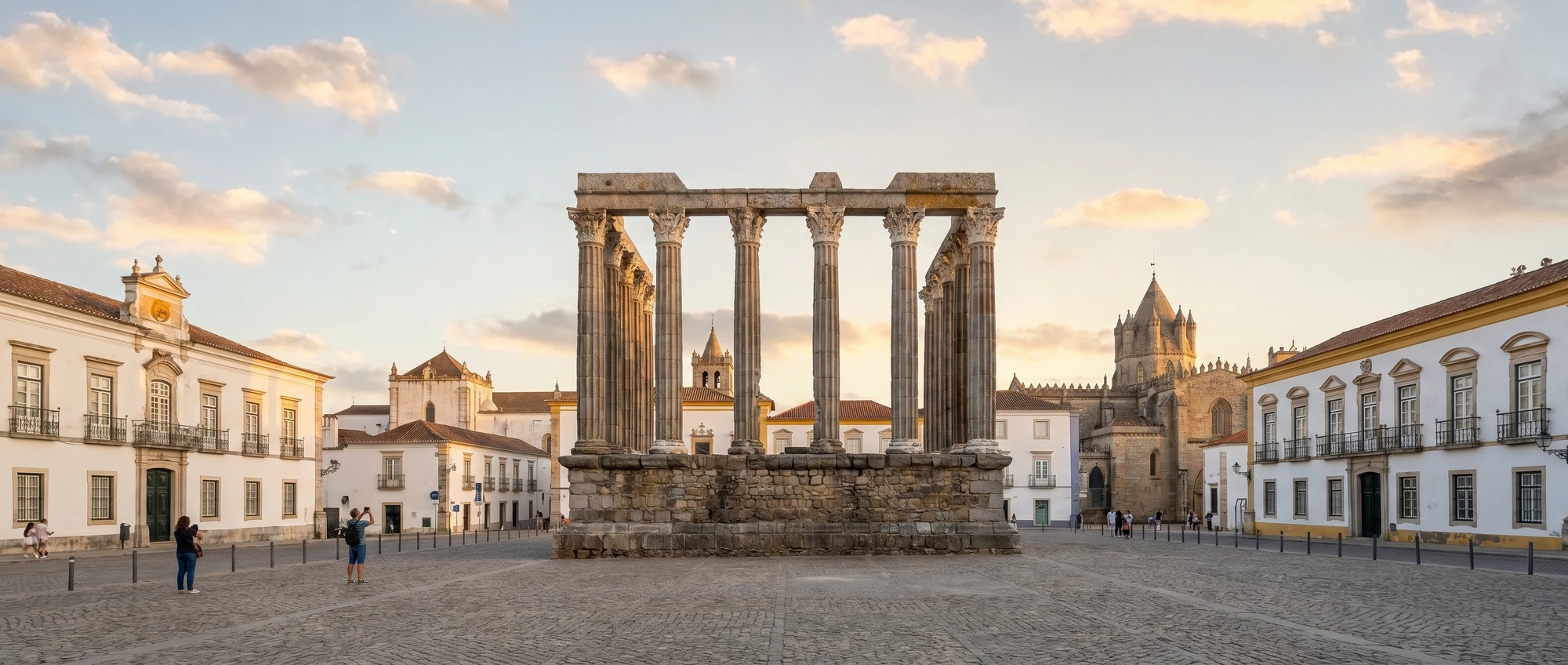
There is nothing to book and nothing to pay. The Roman Temple of Évora stands behind low iron railings on the Largo do Conde de Vila Flor, the town’s highest point, and you take it in from the surrounding square and the garden behind it rather than walking among the columns. It’s lit at night, so an after-dinner loop past it is one of the better free things you can do in Évora. Allow ten or fifteen minutes for the temple itself, a little longer if you carry a drink up to the Jardim de Diana beside it for the view over the red-tiled town and the Alentejo plain rolling out beyond.
What survives is genuinely the real thing: 14 Corinthian columns from the 1st century, their fluted granite shafts topped with capitals and bases of white Estremoz marble, the tallest standing over six metres. It outlasted the centuries partly by accident — it was walled up and used as a butcher’s shop and store through the Middle Ages, which protected the columns until the 19th century stripped the later walls away. The popular name, Temple of Diana, is a 17th-century invention by a local priest and has no archaeological basis; it was almost certainly dedicated to the imperial cult of Augustus.
Is it worth it, and what to pair it with?
Yes, but keep it in proportion. This is the best-preserved Roman temple in Iberia and it’s free, so there’s no reason to skip it — but you will have seen everything in a quarter of an hour, and it doesn’t justify a journey on its own. Treat it as the anchor of a half-day in Évora’s walled old town rather than the main event.
The natural pairing is the Chapel of Bones (Capela dos Ossos), a 12-minute walk south through the centre, where the walls are lined with the bones of some 5,000 people — that one does cost about €5, and it’s the more memorable stop of the two. Add the Gothic Sé cathedral a couple of minutes from the temple and you have a compact, walkable morning. Most UK visitors come on a day trip from Lisbon: the intercity train from Oriente takes about an hour and a half, and a guided walking tour is worth it here if you’d rather have the Roman, medieval and macabre layers explained than read the plaques yourself.
Planning the rest of your trip? See the Evora city guide.