Mpumalanga & Limpopo lowveld, South Africa
Kruger National Park
How to actually plan a Kruger safari from the UK: self-drive the SANParks side or pay for a guided private reserve, which gate to use, and the malaria call you make before you book.
In short
Kruger National Park at a glance
The Kruger is two different safaris wearing one name. The SANParks national park is the self-drive option: you hire a car, pay R535 a day to enter, sleep in a fenced rest camp like Skukuza or Lower Sabie, and do your own spotting on tarred and gravel roads — cheap, flexible, and genuinely rewarding if you're patient. The private reserves on the unfenced western boundary — Sabi Sand, Timbavati, Thornybush — are all-inclusive lodges where a ranger and tracker drive you off-road at dawn and dusk and put you on leopard the SANParks visitor never sees. You can't drive into those reserves yourself. Most UK first-timers fly in to Skukuza, Hoedspruit or Nelspruit rather than driving the five-plus hours from Johannesburg, and the single biggest decision — made before you book anything — is malaria: the Kruger is a low-risk malaria zone, highest in the wet summer (GOV.UK / TravelHealthPro).
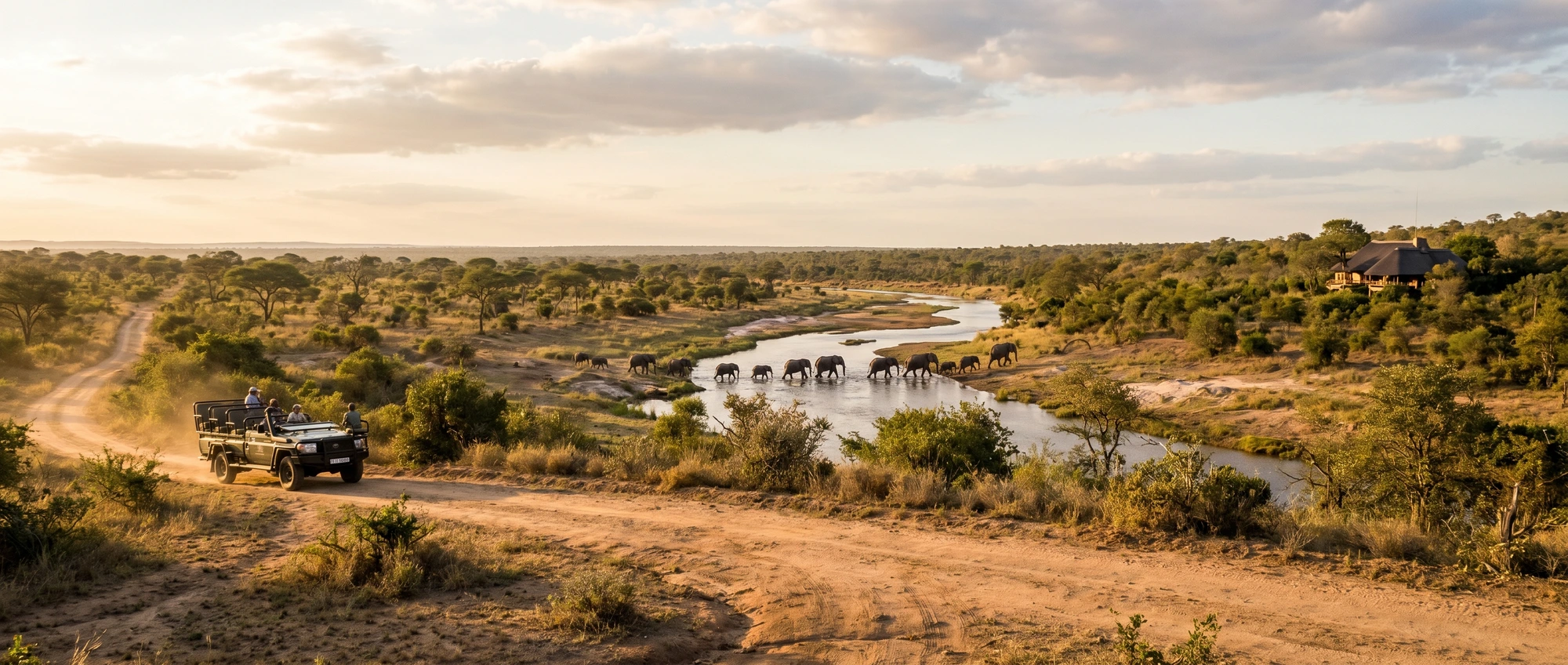
The thing nobody tells first-timers is that “the Kruger” is two completely different holidays sold under one name, and choosing between them is the whole game. On the SANParks side you are the driver: you hire a normal car, pay your daily conservation fee at the gate, sleep behind a fence at a camp like Skukuza or Lower Sabie, and crawl the tarred roads at 50km/h hoping the next bend holds something. On the private reserves along the unfenced western edge — Sabi Sand, Timbavati — you are a passenger, and a ranger with a tracker reads spoor, goes off-road and finds you the leopard the self-driver spends a week missing. One is cheap and patient; the other is expensive and almost guaranteed. Decide which trip you actually want before you book a single night.
The two mistakes that spoil it are both made at the planning stage. The first is driving in from Johannesburg to save money — it’s five hours-plus each way on roads you don’t need to be on, when a regional flight into Skukuza, Hoedspruit or Nelspruit drops you at the gate in an hour. The second is treating malaria as an afterthought: the Kruger is a malaria zone, worst in the wet summer, so you sort tablets with a travel clinic well before you fly, or you pick a malaria-free Eastern Cape reserve instead and skip the question entirely. Get those two calls right, give it three nights rather than one, and even the budget self-drive version delivers.
The route
A four-night safari that does both halves of the Kruger: a couple of self-drive nights in the SANParks rest camps, then a splurge in a private reserve for the guided off-road game drives. Distances inside the park are short but slow — the park speed limit is 50km/h on tar and 40km/h on gravel, so an hour covers maybe 40km of looking, not motorway miles.
-
Day 1
Fly in and enter the park
Fly from Johannesburg to Skukuza (about 1h05) or Nelspruit/Mbombela, collect a hire car and enter via the nearest gate — Paul Kruger Gate for Skukuza, Numbi or Phabeni for the southern camps. Get to camp before the gate-closing time (around 18:00 in winter); driving inside the park after dark is not allowed.
-
Days 2–3
Self-drive the southern circuit
Base at Skukuza or Lower Sabie — the southern Kruger has the densest game and the best surfaced roads. Be at the camp gate when it opens at first light (about 06:00 in winter), drive the Sabie River loop slowly, and break at a picnic site like Nkuhlu. This is the cheap, patient, do-it-yourself half of the trip.
-
Day 4
Transfer to a private reserve
Drop the hire car and move to a Sabi Sand or Timbavati lodge on the unfenced western edge — about a 1h30–2h drive or a short charter hop. From here you swap your own spotting for a ranger and tracker, off-road access and a far higher leopard hit-rate.
-
Day 5
Dawn drive, then fly home
Take the pre-dawn game drive (the best light and the most active predators), then transfer back to Skukuza or Hoedspruit for the regional flight to Johannesburg and your evening connection to the UK. Arrange the airport leg as a booked transfer, not a hailed taxi (GOV.UK).
Where to base yourself
Pick one or two bases rather than moving every night.
SANParks rest camps (Skukuza, Lower Sabie, Satara)
£ valueThe self-drive option inside the national park: fenced camps with rondavels, chalets and campsites, a shop and a restaurant, from roughly R1,500–R3,500 a night for a unit. Skukuza is the big southern hub on the Sabie River; Lower Sabie has the best riverside game viewing; Satara sits in lion country further north. You drive yourself and do your own spotting.
Best for: Self-drive, flexibility and value
Private reserves (Sabi Sand, Timbavati, Thornybush)
£££ premiumAll-inclusive lodges on the unfenced western boundary where a ranger and tracker run twice-daily off-road game drives. Roughly £350–£900+ per person per night including meals, drinks and drives, with Sabi Sand the best-known for leopard. You can't self-drive here — the game viewing is done for you, and it shows.
Best for: Guided drives and high game density
Hoedspruit & the R40 lodges
££ mid-rangeThe town of Hoedspruit, with its own airport, is the access town for the central and northern reserves and a cluster of mid-range lodges and guesthouses on the R40 corridor. A practical, lower-cost base for guided drives without the top private-reserve price, and handy if you're combining Kruger with the nearby Blyde River Canyon.
Best for: Mid-range guided safaris and the Panorama Route
Getting around Kruger National Park
Inside the SANParks side you get around in your own hire car — a normal saloon is fine on the tar and main gravel roads, and the park enforces a 50km/h limit, so progress is deliberately slow. Camp gates and entrance gates open around 06:00 and close around 18:00 in winter (earlier sunsets mean earlier closing), and you must be inside a camp by closing — driving after dark is banned. Fuel and shops exist at the main camps but fill up when you can. For the long approach from Johannesburg, fly: Skukuza (inside the park), Hoedspruit and Nelspruit/Mbombela all take regional flights, saving five-plus hours of driving each way. In the private reserves you don't drive at all — the lodge ranger handles every game drive and airport transfer, which is part of what you're paying for.
Book the essentials
Where to stay
Tours & tickets
Airport transfers
Car hire
Stay connected
Trains & rail passes
Kruger National Park FAQs
Should I self-drive the Kruger or book a private reserve?
When is the best time to visit the Kruger?
Do I need malaria tablets for the Kruger?
Ready to book?
Compare car hire