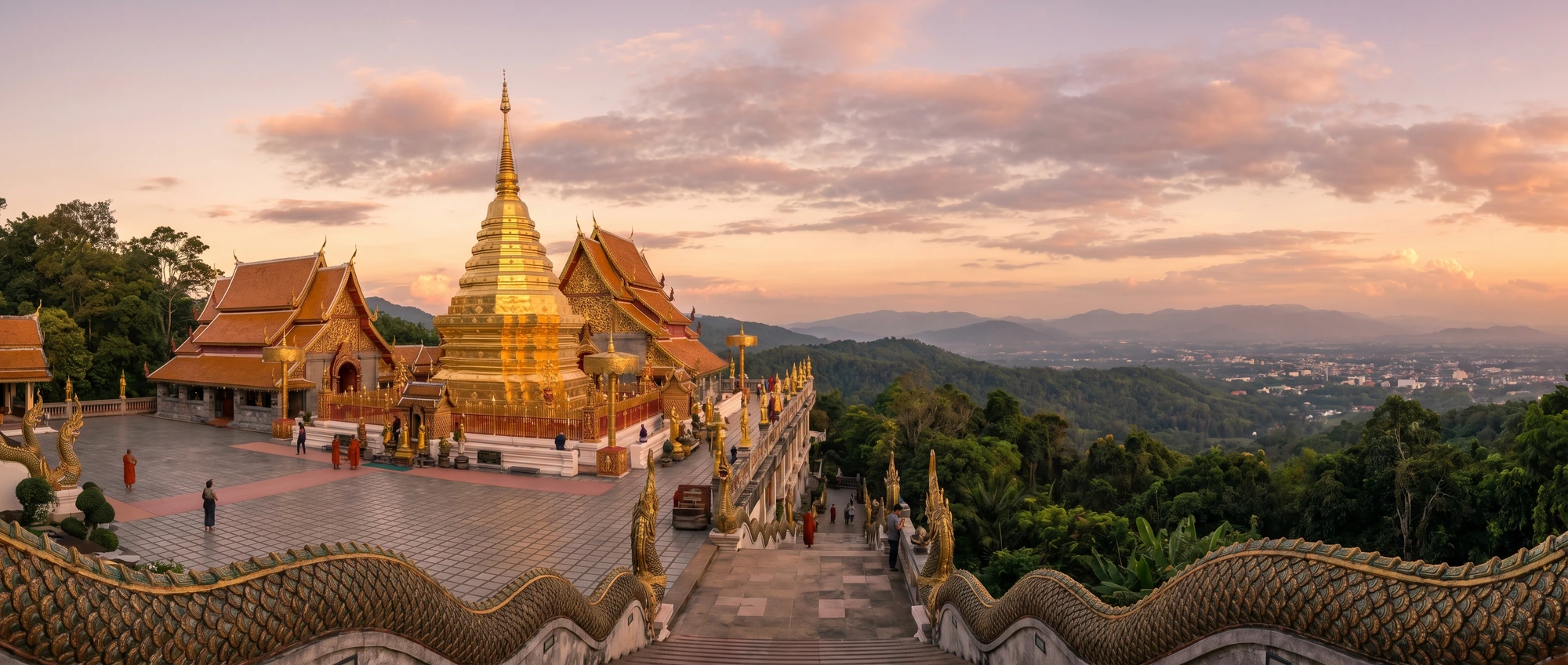
Northern Thailand
Wat Phra That Doi Suthep
How to do Chiang Mai's mountain temple: book a half-day tour or take a shared songthaew, the small foreigner fee at the gate, the 306-step climb versus the funicular, and the hour that beats the coach crowds.
Where
Chiang Mai, Thailand
Opening hours
06:00–20:00 daily; the chedi terrace is floodlit after dark, so a late-afternoon arrival catches both the city view and the lit gold stupa. The funicular runs roughly 06:00–18:00 — outside those hours the 306 steps are the only way up.
Tickets
฿30 foreigner temple entry (about £0.70). The optional funicular is ฿50 for foreigners and ฿20 for Thais (about £1.15); the 306-step Naga staircase is free. A booked half-day tour from Chiang Mai runs roughly ฿600–900 (about £14–20) including transport and a guide, with the ฿30 gate fee sometimes extra. Bring small baht notes — the temple takes cash only.
Time needed
About 1.5 hours at the temple, plus 45–60 minutes each way for the drive and (on a songthaew) the wait to fill up. Half a day all in; a tour that adds Bhubing Palace runs closer to five hours.
In short
Visiting Wat Phra That Doi Suthep
The decision that shapes a Doi Suthep visit isn't the ticket — entry is a trivial ฿30 (about £0.70) at the gate — it's how you get up the 15 km of switchbacks. A half-day group tour (roughly ฿600–900 / £14–20) bundles the transport, a guide and usually a second stop such as Bhubing Palace; a shared red songthaew from near Chiang Mai Zoo is the cheap DIY option at about ฿40–60 each way but only leaves once full. From the car park you climb the 306-step Naga staircase or pay the ฿50 foreigner funicular fare to the terrace. Cover shoulders and knees, take your shoes off on the upper platform, and aim for the 06:00 opening or the last hour of daylight to beat the coach groups and the spring haze that hides the city view.
How to get up there without the faff
There’s no timed ticket and the gate fee is a token ฿30 (~£0.70) for foreigners — the only real decision is how you climb the 15 km of switchbacks. The cheap local way is a shared red songthaew from near Chiang Mai Zoo on Huay Kaew Road: about ฿40–60 (£1–1.40) each way, but the truck only leaves once it fills and may not run back late afternoon, so agree a return or use Grab for the trip down. The easier way, especially with an early start in mind, is a half-day guided tour (about ฿600–900 / £14–20) that handles the hotel pickup, the climb timing and usually a second stop like Bhubing Palace — book it the day before in high season, as morning slots go first. At the top you either take the 306-step Naga staircase or pay the ฿50 (~£1.15) funicular; pay if stairs are a problem, otherwise the climb is part of it.
Best time for the mountain temple
Go for the 06:00 opening or the last hour of daylight — the terrace is floodlit after dark, so a late slot gives you both the city view and the lit gold chedi. By mid-morning the coach groups fill the platform, and from late February into April the crop-burning haze hides the valley that’s half the reason to come up; in a bad March week the famous view simply isn’t there. Allow about an hour and a half at the temple and a half day in total with the journey, cover your shoulders and knees and slip your shoes off at the inner terrace as at any wat — and if you do one temple in the north, make it this one, gone up early and clear rather than tacked onto a busy afternoon.
Planning the rest of your trip? See the Chiang Mai city guide.
More to see in Chiang Mai

Book the essentials
Tours & tickets
Wat Phra That Doi Suthep FAQs
Should you book a Doi Suthep tour or do it independently?
What is the best time of day to visit Doi Suthep?
Is Doi Suthep worth it?
Ready to book?
Check tickets & tours