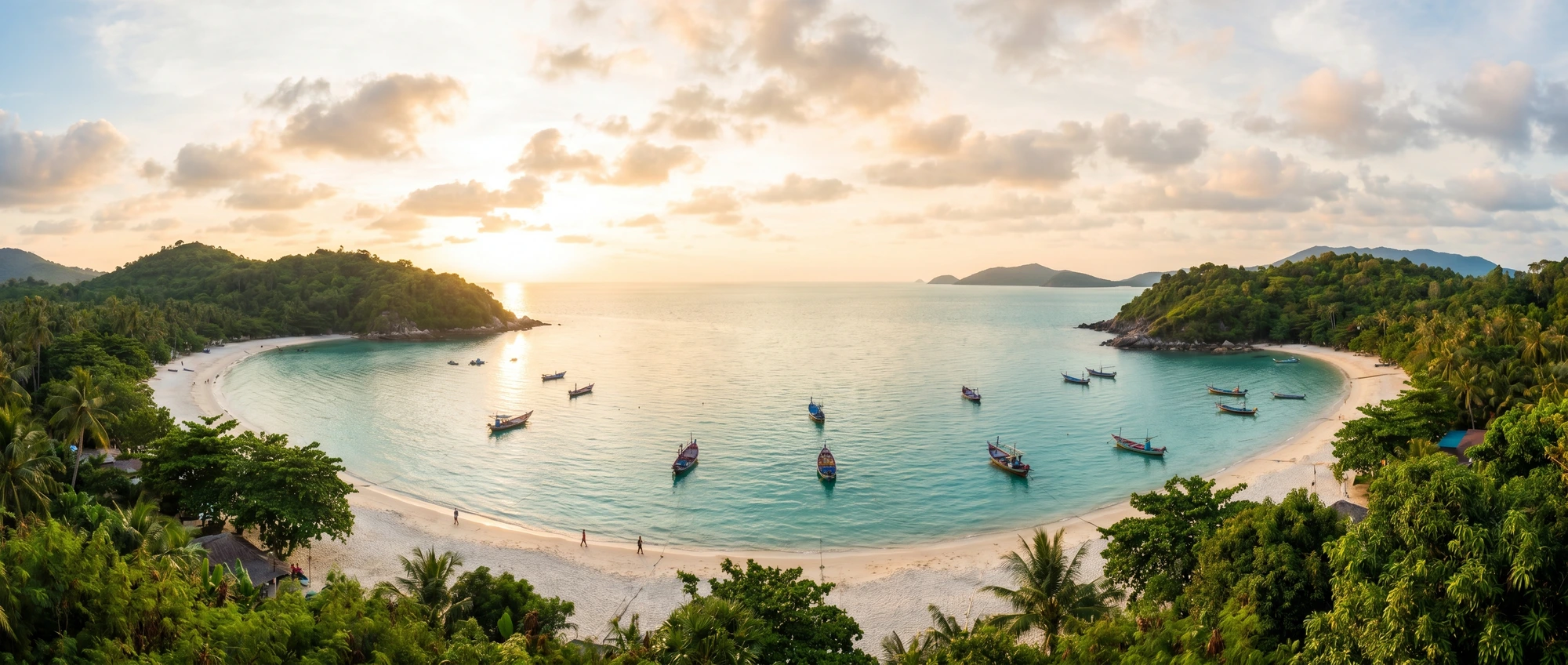
Gulf of Thailand (Surat Thani)
Koh Samui
Koh Samui for UK travellers, with the season the right way round: why you book it February–August when the Andaman side is wet, which beach actually suits you, and why flying in costs more than the rest of the trip combined.
In short
Koh Samui at a glance
Koh Samui is Thailand's most resort-ready island: a 25km-wide ring road around a palm-and-jungle interior, its own airport, and a beach for every mood. The catch is the calendar — the Gulf runs the opposite monsoon to the Andaman side, so Samui is at its driest and sunniest roughly February to August, while the wettest weeks come in October–December when Phuket and Krabi are perfect. The other catch is the flight: a Bangkok–Samui hop on Bangkok Airways, which owns the airport, is short but pricey, so most cost-conscious travellers fly to Surat Thani and take the ferry instead. Pick your beach to match your trip and the rest of the island looks after itself.
Koh Samui is the Thai island that does the least to scare a first-timer: an airport on the island itself, a ring road you can loop in an afternoon, and resorts pitched at every budget from backpacker huts to private-pool villas. The mistake people make is treating it like Phuket or Krabi and booking it for the Christmas-and-New-Year sun trip — Samui sits on the Gulf coast, which runs the opposite monsoon, so it’s at its wettest exactly when the Andaman side is at its driest. Get the calendar right and aim for February to August, and you’ve found the island that’s reliably sunny through the British summer holidays.
The other thing first-timers underestimate is how much the flight dominates the maths. The day-to-day on Samui is cheap, but the short Bangkok–Samui hop is one of the priciest internal flights in Thailand because a single airline owns the airport; flying to Surat Thani and taking the ferry instead can halve that leg for the sake of a couple of extra hours. Once you’re here, the only real decision is which beach: buzzy Chaweng if you want everything to hand, calmer Bophut or Maenam for dinners and value, or family-friendly Choeng Mon by the airport. Don’t try to stay on all of them — the island is small enough to visit the others on a songthaew or a day-boat to Phangan and Tao.
The route
A relaxed 5–6 day island stay that pairs Samui's own beaches and waterfalls with a day-boat to the neighbouring islands, without packing every night. Drive times are around the 51km ring road; crossing times are from Samui's two piers, Nathon (west) and Big Buddha/Bang Rak (north-east).
-
Days 1–2
Settle on the north-east beaches
Land at Samui airport (or arrive by ferry at Nathon, about 40 minutes' drive from the east-coast beaches). Base around Bophut, Choeng Mon or Chaweng and do nothing strenuous on day one after the long-haul. See the 12-metre golden Big Buddha at Wat Phra Yai, then eat dinner in Bophut's Fisherman's Village, the island's most walkable old quarter.
-
Day 3
Round the ring road
Hire a car or take a songthaew to loop the 51km coastal road. Stop at Na Muang waterfalls in the jungle interior, the Hin Ta and Hin Yai 'grandfather and grandmother' rock formations near Lamai, and a viewpoint or two. Half a day of driving covers the island; leave the afternoon for a beach.
-
Day 4
Day-boat to Koh Phangan or Koh Tao
Catch a fast ferry from Bang Rak or Big Buddha pier (about 30–45 minutes to Phangan, around 1h30–2h to Tao). Phangan's quiet north-coast beaches are a calmer day than the Full Moon Party headlines; Koh Tao is the cheapest place in the world to learn to dive. Back the same evening or stay over.
-
Days 5–6
Slow beach days
Spend the last stretch on one beach rather than chasing more. Snorkel, do a half-day longtail trip to the Ang Thong Marine Park (a 42-island archipelago an hour west by boat), or simply alternate pool and sea. Fly or ferry out from the side of the island nearest your base to avoid a cross-island dash.
Where to base yourself
Pick one or two bases rather than moving every night.
Chaweng
££ mid-rangeThe island's main event: a 6km curve of white sand backed by the densest run of hotels, bars, malls and restaurants, with the liveliest nightlife on Samui. Central Chaweng is loud and walkable; the quieter northern and southern ends keep the beach without the bass. The natural first-timer base if you want everything on the doorstep — and the priciest for it.
Best for: Nightlife, shopping, first-timers who want it all to hand
Bophut & Maenam
££ mid-rangeThe north-coast calm-and-character choice. Bophut's Fisherman's Village is the most charming dinner-and-stroll quarter on the island, with a Friday walking street; Maenam next door is quieter still, with a long shallow beach and the best value on Samui. Both look across to Koh Phangan and are handy for the ferry piers.
Best for: Couples, good dinners, value, ferry day-trips
Choeng Mon & the north-east
£££ premiumThe family corner: a sheltered, gentle bay near the airport with calm water and a cluster of higher-end resorts, a short hop from both Chaweng's restaurants and the Big Buddha pier. Quieter and more polished than Chaweng, with easy beach swimming for children. The premium end of the island for a reason.
Best for: Families, calm swimming, an upmarket base
Getting around Koh Samui
There's no public bus network on Samui — getting around means a hire car, a metered-by-haggle songthaew (the red pickup-trucks that run loosely along the ring road for about £1.10–2.30 / ฿50–100 a hop), or the Grab and Bolt apps, which give a fixed fare and are the easiest doors-to-door option. A small hire car is roughly £20–34 / ฿900–1,500 a day and the simplest way to loop the 51km ring road and reach the waterfalls and viewpoints in the interior. Resist the scooter unless you genuinely know what you're doing: Samui's hilly, fast-moving ring road and resort traffic make it one of Thailand's riskier islands to ride, and most UK travel policies exclude scooter injuries unless you hold a full UK motorbike licence. Drive on the left. For the neighbouring islands, the Lomprayah and Seatran fast catamarans leave from Bang Rak, Big Buddha and Nathon piers — about 30–45 minutes to Koh Phangan and 1h30–2h to Koh Tao.
Book the essentials
Where to stay
Tours & tickets
Airport transfers
Car hire
Stay connected
Koh Samui FAQs
When is the best time to visit Koh Samui?
How do you get to Koh Samui from the UK?
Which beach should you stay on in Koh Samui?
Ready to book?
Compare car hire