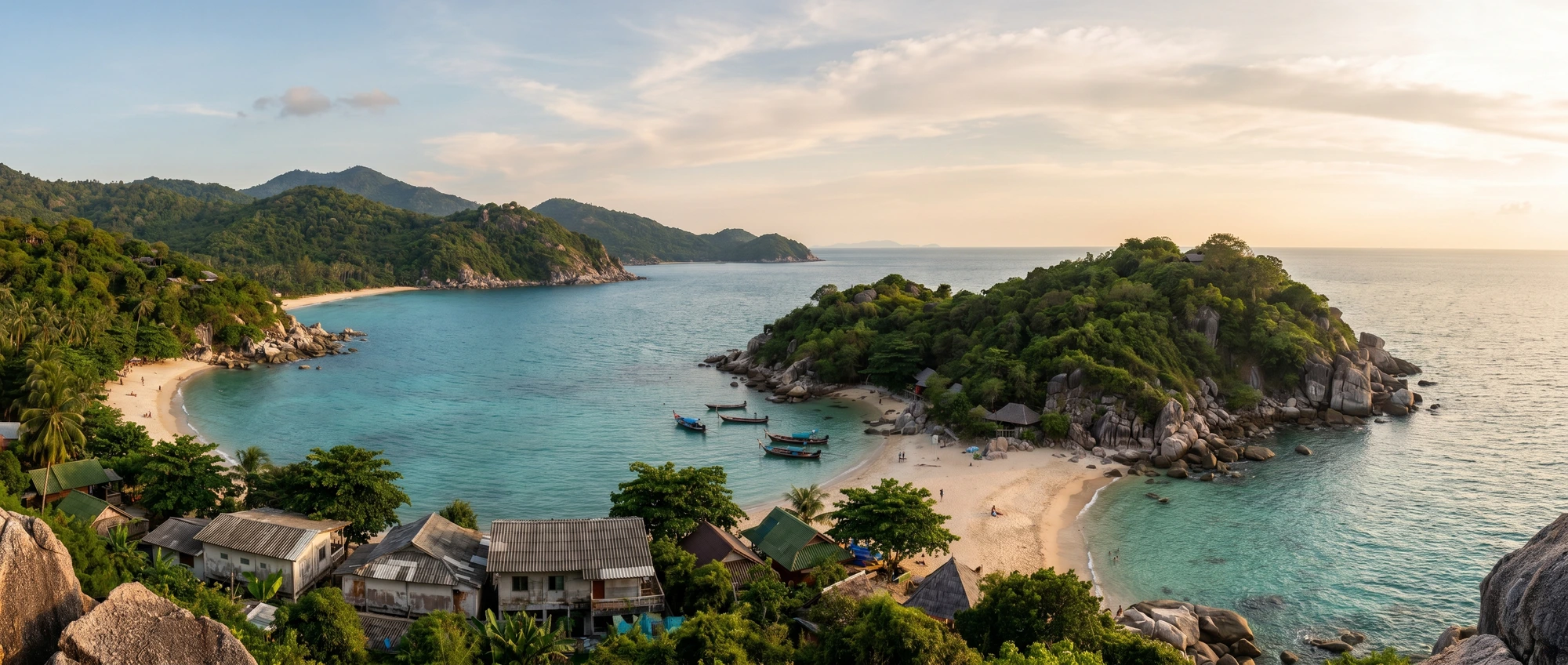
Gulf of Thailand (Chumphon Archipelago)
Koh Tao
The Gulf island where most UK travellers learn to dive: how to actually get there with no airport, what a PADI Open Water course really costs, and why you book the island by the calendar — not the photo.
In short
Koh Tao at a glance
Koh Tao is the small Gulf island where a huge share of the world's new scuba divers get certified, mostly because it is one of the cheapest and most sociable places on earth to do a PADI Open Water course — roughly ฿9,000–11,000 (~£200–260) for the three-to-four-day qualification, sleeping accommodation often thrown in. There is no airport, so getting here is a flight-plus-ferry exercise: most people fly to Koh Samui or Surat Thani, or take the overnight train and bus to Chumphon, then a high-speed catamaran across. The island runs on the Gulf calendar, opposite the Andaman side — February to August is the dry, calm, good-visibility window, while October to December brings the heaviest rain and the roughest crossings. Most visitors stay two to four nights; divers stay a week.
Koh Tao is barely 21 square kilometres of granite, jungle and beach, but it punches far above its size because it is, by a distance, the place most new divers in the world get their first qualification. The reason is simple economics: dozens of dive schools packed onto one small island compete on price, so a PADI Open Water course costs a fraction of what you’d pay in the Red Sea or the Caribbean, and there’s a built-in crowd of people doing exactly the same thing. That gives the island its character — young, sociable, scuffed-up and cheap — which is the thing to get straight before you book. If you’re picturing the manicured resort version of Thailand, you want Koh Samui next door; Koh Tao is the scrappier, more fun one.
The mistake first-timers make is logistical. There is no airport, and the island runs on the Gulf’s weather, not the Andaman’s — so people who book a flawless October beach week off a photo arrive to grey seas, cancelled ferries and poor underwater visibility, while the same week is glorious on Phuket. Get those two things right — a through-ticketed flight-and-ferry route, and a February-to-August visit — and the rest looks after itself. Don’t over-schedule it either: the island rewards a slow few days of diving, one boat trip to Koh Nang Yuan and a viewpoint hike, not a packed itinerary.
The route
The first-timer's mistake is treating Koh Tao as a quick beach stop the way you'd do Koh Samui — it isn't, because half the point is the diving and the other half is the boat day to Koh Nang Yuan. This is a relaxed three-to-four-night skeleton built around a learn-to-dive course or a couple of fun dives; ferry times are the published high-speed catamaran schedules, which run to the Gulf calendar and thin out in the October–December monsoon.
-
Day 1
Arrive and settle on Sairee
Most arrivals come in by ferry to Mae Haad pier — about 1h45 by Lomprayah catamaran from Chumphon, or roughly 1h30–2h from Koh Samui. Walk or take a songthaew (~฿100–200) the short hop to Sairee Beach, sign up with a dive school if you're learning, and watch the sunset from the long beach bar strip.
-
Days 2–3
Learn to dive (or fun-dive)
The PADI Open Water course runs over three to four days for ~฿9,000–11,000 (~£200–260), with classroom, pool and four open-water dives; certified divers do two-tank fun dives at sites like Chumphon Pinnacle or Shark Bay for ~฿1,800–2,500 a trip. Non-divers can swap this for snorkelling and the island's viewpoints.
-
Day 4
Koh Nang Yuan and the viewpoints
Take a longtail or join a snorkel boat to Koh Nang Yuan, the linked-sandbar islet off the northwest coast — there's a ฿100 landing fee and a short, steep climb to its famous viewpoint. Back on Koh Tao, hike or scooter up to the John-Suwan viewpoint above Chalok before catching an afternoon ferry out.
Where to base yourself
Pick one or two bases rather than moving every night.
Sairee Beach
£ valueThe island's main hub: a long sweep of sand backed by dive schools, hostels, bars and beach restaurants. Liveliest and most convenient for first-timers and learner divers, but the northern bar strip is loud at night — pick a set-back guesthouse if you want sleep.
Best for: First-timers, learning to dive, nightlife
Chalok Baan Kao
££ mid-rangeA quieter southern bay with a more laid-back, less party-led feel and easy access to the John-Suwan viewpoint and Shark Bay snorkelling. A short scooter or songthaew ride from Sairee's bars, so it's the calmer base that's still close to everything.
Best for: Quiet, couples, snorkelling
Mae Haad
£ valueThe pier village where the ferries land, with banks, the 7-Elevens, dive shops and cheap eats. Handy if you're arriving late or leaving early and want to be steps from the boat, though it's a working port rather than a beach base.
Best for: Early ferries, convenience, dive-shop access
Getting around Koh Tao
Koh Tao is small and there's no public bus, so getting around is on foot, by songthaew shared truck-taxi or by scooter. Songthaews from Mae Haad pier to Sairee or Chalok are about ฿100–200 a person (more at night or for one passenger), and dive schools usually run free pick-ups for course students. Scooter hire is cheap at around ฿200–300 a day, but the island's hills are steep, the roads are rough and unsealed in places, and rental scams over 'pre-existing' scratches are a known problem — photograph the bike before you ride and be aware that Thailand's road-accident rate is one of the world's highest, so think hard before renting. To reach Koh Nang Yuan or the offshore dive and snorkel sites you take a longtail or a dive-school boat; there is no road link to it.
Book the essentials
Where to stay
Tours & tickets
Airport transfers
Car hire
Stay connected
Koh Tao FAQs
How do you get to Koh Tao from the UK?
How much does it cost to learn to dive on Koh Tao?
When is the best time to visit Koh Tao?
Ready to book?
Compare car hire