Antalya Province
Hadrian's Gate
How to visit Hadrian's Gate (Üçkapılar) in Antalya's old town: it's free and open day and night, so this is about when to go, what to actually look at, and whether it's worth a detour.
Where
Antalya, Turkey
Opening hours
Open 24 hours, every day. It's an open street monument with no gate, ticket desk or closing time — it spans Atatürk Caddesi at the edge of Kaleiçi.
Tickets
Free. There is no entry charge and no ticket to book; you walk straight through it.
Time needed
10–15 minutes to look at the gate itself; combine it with a couple of hours wandering Kaleiçi rather than visiting it on its own.
In short
Visiting Hadrian's Gate
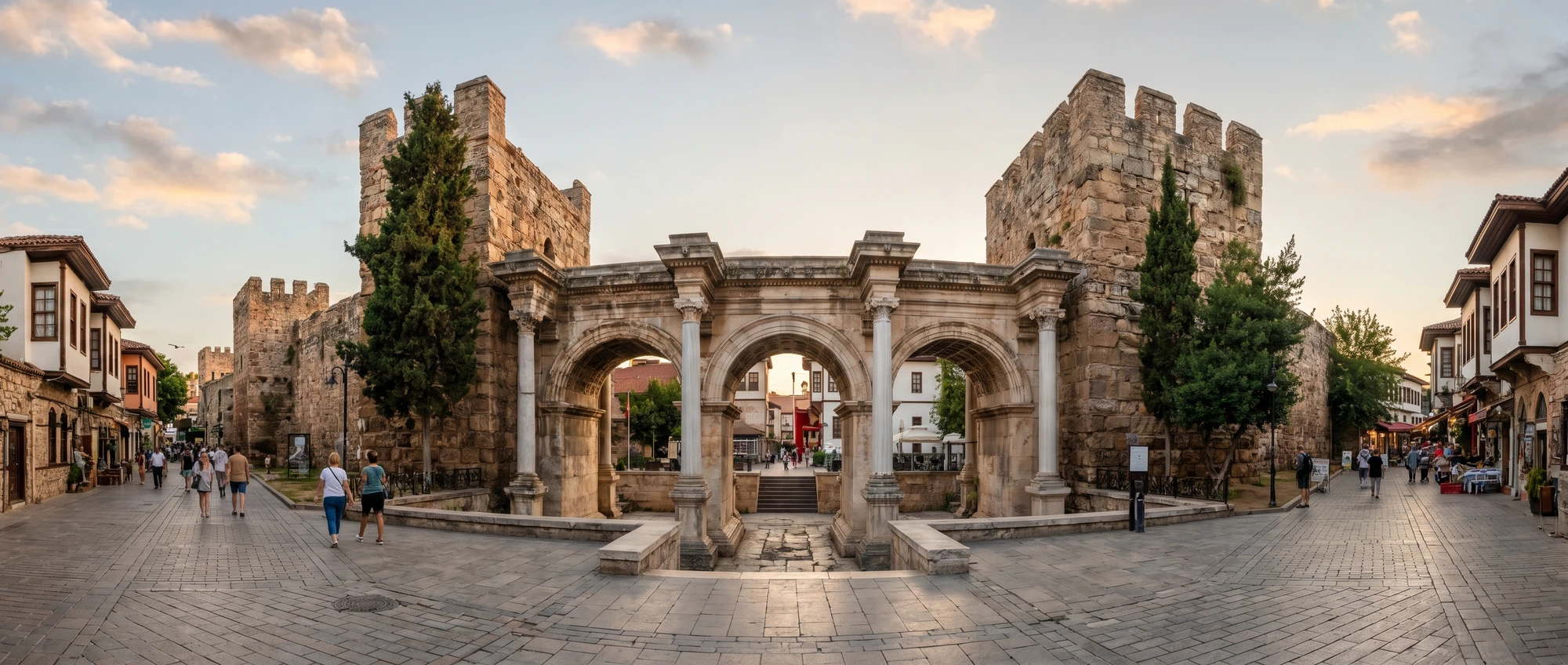
Hadrian's Gate is free and never closes, so there's no ticket to plan around — the only real decision is timing. Built in white marble around 130 CE to mark Emperor Hadrian's visit to the city that year, it's a three-arched triumphal gateway you walk straight through to enter Kaleiçi old town. Come at dusk when it's floodlit and the cart-rut grooves in the original paving under the glass walkway catch the light, look up at the carved coffered ceilings, then keep walking into the old town rather than treating the gate as a standalone stop.
How to visit (and what to actually look at)
There’s nothing to book here and nothing to pay. Hadrian’s Gate — Üç Kapılar, “the three gates” in Turkish — is a triumphal Roman arch that spans Atatürk Caddesi, so you walk straight through it to cross from the modern shopping streets into Kaleiçi old town. It was raised in white marble around 130 CE to mark Emperor Hadrian’s visit to the city that year, then built into the later defensive walls and largely hidden until those walls came down, which is why the marble survives in such crisp condition.
The detail most people miss is underfoot. Look down as you pass through the central arch and you’ll see deep grooves worn into the original Roman paving by centuries of cart wheels, now protected under a glass walkway. Then look up at the carved coffered ceilings inside each of the three arches, and at the two flanking towers — the southern Julia Sancta tower keeps its Roman lower stonework, while the upper half of the northern tower was rebuilt in the Seljuk period, so the join in styles is visible if you know to look. It’s a 10-to-15-minute stop, not an attraction you queue for.
Is the gate worth a special trip?
Because it never closes and costs nothing, timing is the only thing to get right. Go at dusk: the gate is floodlit after dark, the marble warms up, the daytime crowds funnelling between the shops and the old town have thinned, and the grooves under the glass catch the low light. Midday is the worst slot — harsh overhead sun and a steady stream of people walking through your photo.
It’s worth it as part of a Kaleiçi walk, not as a special trip across town. Treat it as the front door — pass through, then carry on down Hesapçı Sokak into the lanes of the old town, or detour to nearby Karaalıoğlu Park for the sea view. If you’re staying out at a Lara or Konyaaltı beach hotel, don’t make a dedicated journey for the gate alone; fold it into a half-day in the old town, where it earns its place as the most genuinely ancient thing you’ll walk through.
Planning the rest of your trip? See the Antalya city guide.