Louisiana
French Quarter
How to do New Orleans' French Quarter: where to actually hear jazz, why Royal Street beats Bourbon Street by day, and what to book versus walk up to.
Where
New Orleans, United States
Opening hours
The district never closes — streets are walkable 24/7. Anchor sights have set hours: St Louis Cathedral 09:30–16:00 daily (last entry 15:45), the original Café du Monde on Decatur Street open 24 hours (it shuts only on Christmas Day), and Preservation Hall shows at 17:00, 18:00, 20:00, 21:00 and 22:00. Confirm dates on each venue's site.
Tickets
Walking the Quarter is free. Preservation Hall general admission is about $15–$25 at the door (≈ £12–£20); a guaranteed-seat 'Big Shot' ticket is ~$35–$50 (≈ £28–£40) online. St Louis Cathedral is free (≈ £0.80/$1 for the self-guided leaflet). Three beignets at Café du Monde are about $4.50 (≈ £3.60).
Time needed
Half a day to wander the streets and Jackson Square; a full day if you add a sit-down meal, a jazz set and the riverfront. A jazz set itself runs about 45–60 minutes.
In short
Visiting French Quarter
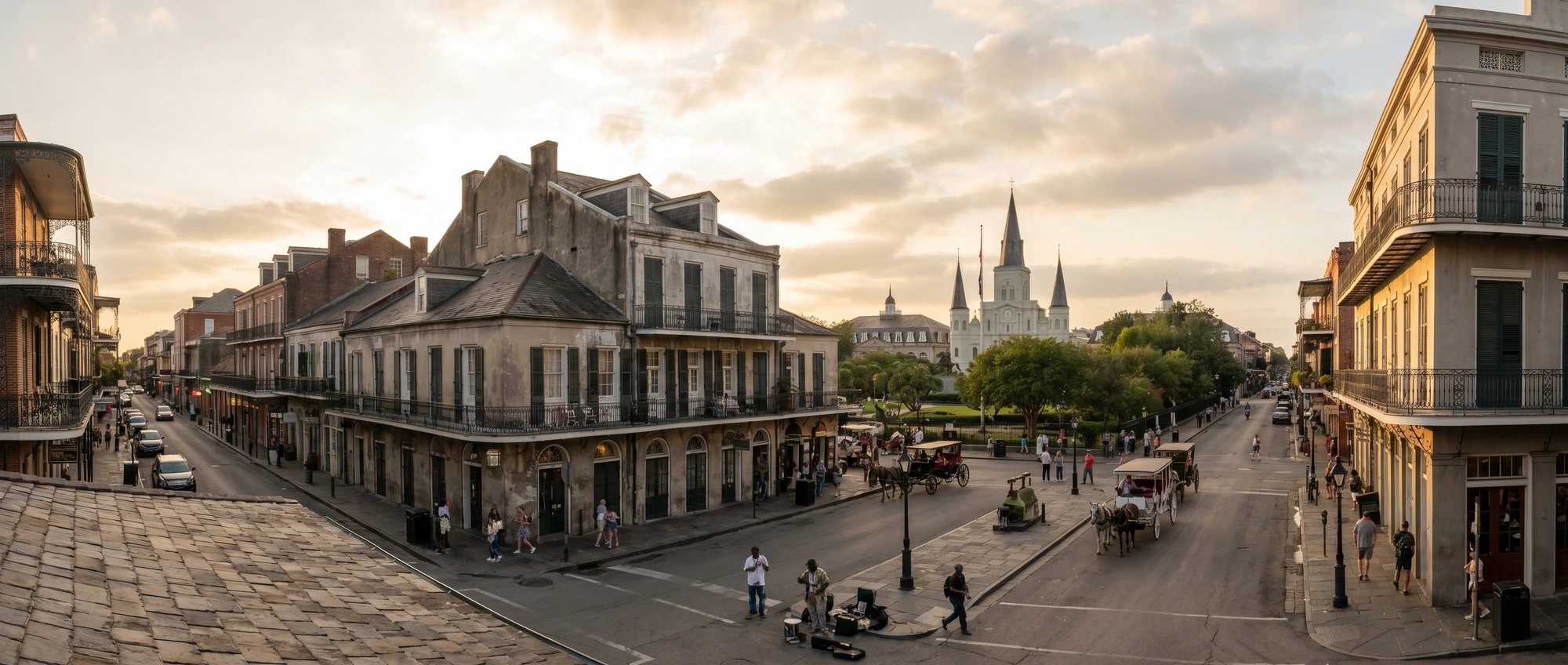
The French Quarter is free to walk and that is most of the point — the grid of Spanish-built balconied streets, Jackson Square and the riverfront cost nothing. Spend the day on Royal Street (galleries, antiques, street musicians) and Decatur, save Bourbon Street for a quick after-dark look, and book one real jazz set: Preservation Hall on St Peter Street is the one to prioritise. Allow most of a day, and treat beignets at Café du Monde as a stop, not a destination.
What you’re actually paying for
The French Quarter is a neighbourhood, not a ticketed attraction, and that catches people out. The grid of Spanish-built, balconied streets — Royal, Decatur, St Peter, Chartres — plus Jackson Square, the riverfront Moonwalk and the outside of St Louis Cathedral all cost nothing and are open at any hour. You pay only for what you step into: a jazz set, a meal, a museum, a guided walk. So the planning question isn’t “which ticket” but “which two or three things do I book, and what do I just walk past?”.
Do your daytime wandering on Royal Street rather than Bourbon. Royal is the calmer, prettier side — antique shops, art galleries and street musicians playing in the open — and it photographs far better than Bourbon’s shuttered bars do in daylight. Drop into the free St Louis Cathedral (09:30–16:00 daily, last entry 15:45; a $1 leaflet is the self-guided tour) and have three beignets and a chicory café au lait at Café du Monde on Decatur for about $4.50. Treat that as a stop, not the highlight — the queue can be long and it’s powdered sugar and coffee, not a meal.
The one thing to book: real jazz
For actual New Orleans jazz, skip the Bourbon Street bars and go to Preservation Hall on St Peter Street. Sets are short — about 45 minutes — and run through the evening (typically 17:00, 18:00, 20:00, 21:00 and 22:00). General admission is roughly $15–$25 at the door (≈ £12–£20), first-come, so there’s often a queue; if you want a guaranteed seat near the band, buy a “Big Shot” ticket online ahead for ~$35–$50 (≈ £28–£40). They go on sale about a month before and sell out for the popular nights. There’s no bar and no toilet inside, so sort both beforehand. Frenchmen Street, a five-minute walk past Esplanade Avenue out of the Quarter, is the locals’ alternative — a row of clubs with cover charges in the $5–$10 range.
Give the streets half a day, or a full day if you add a sit-down meal and a set. A guided walking tour (history, architecture or live-music focused) is worth it if you want context rather than just atmosphere.
Is Bourbon Street worth it — and our verdict
For a 20-minute after-dark look, yes: Bourbon Street is loud, neon, frozen-cocktail-in-a-plastic-cup chaos, and it’s a sight in its own right. For anything beyond that — quiet, food, real music — it isn’t where you want to be. It’s also the part of the Quarter where the GOV.UK advice on US street crime and keeping valuables out of sight is most worth heeding late at night; stick to the busy blocks and don’t wander dark side streets alone.
The French Quarter rewards walking it slowly and paying for one or two specific things rather than trying to “do” it. Book a Preservation Hall set, walk Royal Street and the riverfront by day, glance at Bourbon at night, and you’ve got the place. Pair it with the Garden District streetcar ride or a wander through the French Market rather than packing the whole day into these few blocks.
Planning the rest of your trip? See the New Orleans city guide.
More to see in New Orleans
Book the essentials
Tours & tickets
French Quarter FAQs
Do you need tickets for the French Quarter?
Do you need to book Preservation Hall in advance?
Is Bourbon Street worth it?
Ready to book?
Check tickets & tours