Red River Delta (Northern Vietnam)
Temple of Literature
How to visit the Temple of Literature in Hanoi: the ₫70,000 ticket, when to go to dodge the school groups, and what the stelae and five courtyards actually are.
Where
Hanoi, Vietnam
Opening hours
Open daily, roughly 08:00-17:00 (the gate often closes around 16:30-17:00 in the cooler winter months); last entry is shortly before closing. It opens late on some public holidays and around Tet (Vietnamese New Year, around mid-February 2026), when local students flock here before exams — check on the day if your visit lands on a holiday.
Tickets
Adult entry is ₫70,000 (about £2). Students with ID and over-60s pay a reduced ₫35,000 (about £1), and under-15s go free. Buy at the gate window with cash or the QR-code mobile payment; there is no skip-the-line ticket because queues are short — the crowds are inside, not at the booth.
Time needed
Allow 45-60 minutes to walk the five courtyards properly, longer if a ceremony or calligraphy demonstration is on. It's a flat, easy stroll with no climbing, so it slots into a morning alongside the Ho Chi Minh Mausoleum complex a 15-minute Grab to the north.
In short
Visiting Temple of Literature
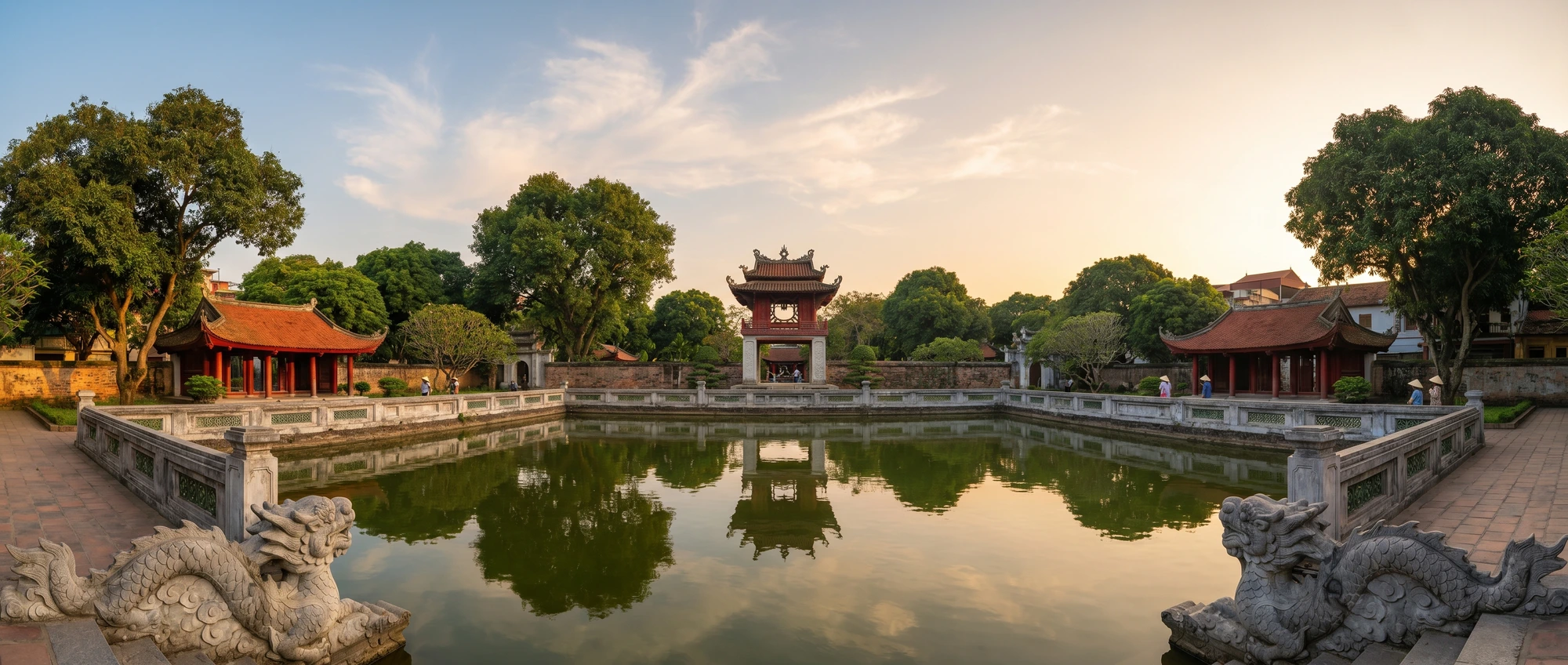
The Temple of Literature (Van Mieu) is Hanoi's calmest big sight: a walled Confucian temple founded in 1070 that became the country's first national university in 1076, laid out as five linked courtyards you walk through front to back. The highlights are the Khue Van Cac pavilion gate — the one on the ₫100,000 note — and the 82 doctors' stelae mounted on stone turtles around two square ponds. It's a flat, 45-60 minute walk-through rather than a half-day, best done early before the school and tour groups arrive, and it pairs naturally with the Ho Chi Minh complex 15 minutes north in one morning.
What it is, and what you’re actually seeing
The Temple of Literature — Van Mieu — was founded in 1070 as a Confucian temple and became Vietnam’s first national university (the Quoc Tu Giam) in 1076, training the country’s mandarin class for over 700 years. It’s laid out as five walled courtyards you walk through front to back, each separated by a gate, so the visit is a straight processional line rather than a maze. The set-piece is the Khue Van Cac, the wooden pavilion gate between the second and third courtyards — the same building printed on the ₫100,000 banknote, so it’s worth pulling a note out and matching it up.
The third courtyard is the reason to come: 82 doctors’ stelae, stone tablets carved with the names of exam graduates from 1442 onwards, each one mounted on the back of a carved stone turtle and arranged in two rows around square ponds. They’re on UNESCO’s Memory of the World register, and students still rub the turtles’ heads for luck before exams (you’re asked not to now, to protect them). The rear courtyard holds the altar to Confucius and the rebuilt Thai Hoc ceremonial hall. This is a temple to learning, not a working pagoda, so come for calm and architecture rather than incense and spectacle.
Tickets, timing, and whether it earns a slot
Entry is ₫70,000 (about £2) for adults, dropping to ₫35,000 (£1) for students with ID and over-60s, and free for under-15s. Buy at the gate window with cash or by scanning the QR code — there’s no skip-the-line ticket because the booth queue is rarely more than a few minutes. The crowds are inside: school groups and tour coaches pack the courtyards from mid-morning, so go right at the 08:00 opening or in the last hour before the gate closes (around 16:30-17:00 in winter, 17:00 in summer). Dress modestly — shoulders and knees covered, as at any Vietnamese temple.
Give it 45 to 60 minutes. It’s a flat, easy walk with no climbing, which makes it the natural pairing with the Ho Chi Minh Mausoleum complex a 15-minute Grab to the north — do both in one morning rather than building a half-day around the temple alone. Our honest take: it’s not a jaw-dropper, and on a packed mid-morning it can feel like queuing behind a hundred school blazers for a photo of the turtles. But arrive early, when the courtyards are empty and the light is low, and it’s the one central Hanoi sight where the city genuinely goes quiet — well worth the ₫70,000 and the unhurried 45 minutes.
Planning the rest of your trip? See the Hanoi city guide.
More to see in Hanoi

Book the essentials
Tours & tickets
Temple of Literature FAQs
How much is a ticket to the Temple of Literature, and do you need to book ahead?
What is there to see at the Temple of Literature?
When is the best time to visit, and is it worth it?
Ready to book?
Check tickets & tours