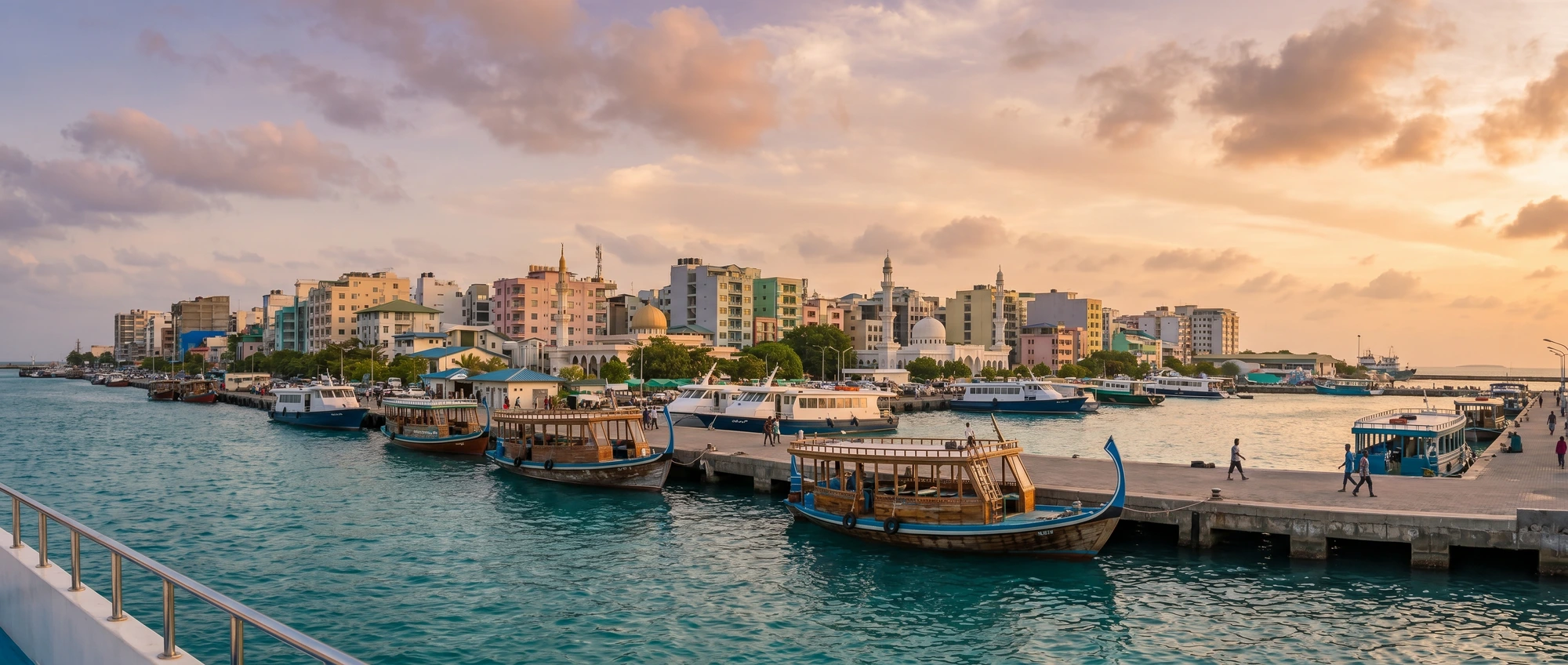
Kaafu Atoll
Malé
Almost everyone transits Malé and almost nobody stays: sleep in Hulhumalé near the airport, and keep a half-day plan in your pocket only if a missed transfer strands you.
Best length
Half a day, or one overnight in transit
Airport
Velana International (MLE), on Hulhulé island next door
Airport to centre
Public ferry ~10 min (~£1.50 / Rf25); or taxi via the bridge ~15 min
Best base
Hulhumalé for a transfer overnight, not Malé city itself
In short
Malé at a glance
Malé is the Maldives capital and the one place every UK traveller passes through, but it is a transit point rather than a holiday base: one of the most densely packed cities on earth, crammed onto a 6km² island with no beach worth the name. You don't book a Maldives trip to stay here — you fly into Velana International (MLE), then transfer straight on to your resort or local island. The only reasons to set foot in Malé proper are a late-landing flight that strands you overnight, a deliberate half-day of culture between transfers, or a budget stopover. If you do, the historic core around the Hukuru Miskiy coral-stone mosque and the fish market is a genuinely interesting two-hour walk; everything else is dense, hot and built for residents, not tourists.
The short version
- Malé is a transit hub, not a beach base — there's no swimming beach on the island, and almost everyone transfers straight on from the airport.
- Velana airport (MLE) sits on its own island a 10-minute public ferry from Malé city (~£1.50 / Rf25) — they are not the same island.
- For an overnight near the airport, sleep in Hulhumalé (bridge-linked to MLE), not Malé city — it's closer and has a real public beach.
- A half-day in old Malé covers the coral-stone Hukuru Miskiy, the fish market and the Sultan Park — about two hours on foot.
- Alcohol is illegal in Malé city; the modest-dress and no-bikini rules of an inhabited local island apply here too (GOV.UK).
Malé is the city every Maldives trip routes through and almost none are about. It’s the capital, the country’s only real urban centre, and one of the most densely packed islands on earth — more than a third of the population crammed onto six square kilometres of concrete with no beach you’d swim from. The mistake first-timers make is treating “fly to the Maldives” as “fly to a beach”; you actually land at Velana airport on a separate island, and the holiday only begins once you’ve transferred on by speedboat or seaplane. Malé itself is a logistics stop, not a destination, and planning a night here by default usually means you’ve misread the map.
That said, it earns a few hours if your transfer strands you, or if you’re the kind of traveller who wants to see how the country actually lives rather than only its postcard version. The old core — the carved coral-stone Friday Mosque, the late-afternoon fish market, Sultan Park — is a genuinely good two-hour walk and costs almost nothing. For an overnight, though, sleep in Hulhumalé by the airport rather than the city: it’s closer to your morning seaplane and has a real public beach. The structured facts below — the airport ferry, the half-day sights, and a realistic budget in pounds — pick up from here.
Plan your Malé trip
Keep a first trip focused: book the big timed sights, then leave room for neighbourhoods and food.
Top things to do in Malé
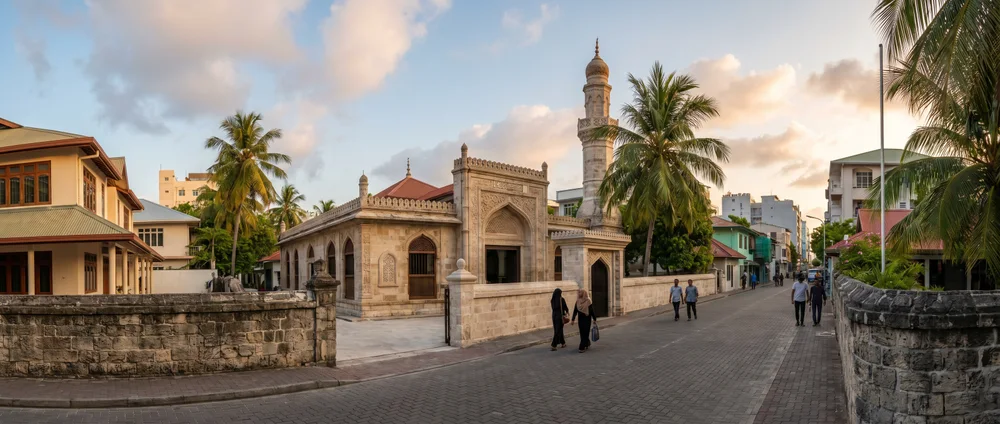
Hukuru Miskiy (Old Friday Mosque)
Hukuru Miskiy, the Old Friday Mosque, is the Maldives' oldest mosque — built in 1658 from carved coral stone, with intricate lacquer-work interiors and a stepped minaret. A UNESCO Tentative List site, it is the single best reason to walk old Malé. Free to visit, but non-Muslim visitors need permission and modest dress; a small donation is expected.
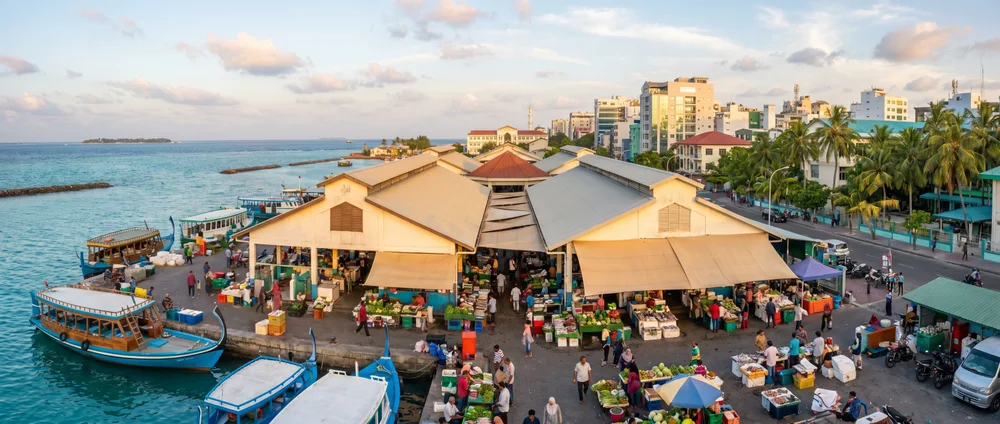
Malé Fish Market & Local Market
On Malé's north waterfront, the fish market is the working heart of the Maldivian capital: skipjack and yellowfin tuna landed straight off the dhonis, gutted on tiled slabs and sold off through the afternoon. Next door, the local produce market piles up coconuts, bananas, chillies and betel. It is noisy, slippery and entirely unpolished — the most honest hour you will spend in the city. Busiest in the late afternoon as the boats come in. Free to wander; you only pay if you buy.
Where to stay first
The areas that make a first visit easier — not an exhaustive directory.
Hulhumalé
£ valueThe reclaimed island bridge-linked to the airport, and the sensible place to actually sleep in transit. Wider streets, modern guesthouses far cheaper than a resort, a long public beach, and a 10-15 minute taxi to the MLE terminal. Not a holiday base, but the right transfer-buffer overnight.
Best for: Pre-seaplane or late-landing overnights
Old Malé (Henveiru / Maafannu)
£ valueThe dense historic core where the mosque, fish market and Sultan Park sit within a 15-minute walk of each other. Walkable and interesting by day, but cramped guesthouses and no beach make it a daytime stop rather than a base. Closest you'll get to the real city.
Best for: A culture-led half-day on foot
Hulhulé (airport island)
£££ premiumThe airport's own island holds the Hulhulé Island Hotel, the one property within walking distance of the terminal — useful only for a very early flight or a very short layover where even the ferry to Malé feels like a stretch. Pricey for what it is.
Best for: Ultra-short layovers and dawn departures
Airport to city centre
| Option | Time | Cost | Book ahead? |
|---|---|---|---|
| Public ferry to Malé city | ~10 min | about £1.50 (Rf25) one way | Runs every 10-20 min from the terminal jetty |
| Taxi via the Sinamalé Bridge to Malé | ~15-20 min | about £3-5 (Rf60-100) | Quickest with luggage or late at night |
| Taxi to a Hulhumalé hotel | ~10-15 min | about £3-5 (Rf60-100) | Bridge-linked, no ferry needed |
| Resort transfer to your island | Speedboat 15-90 min / seaplane 20-45 min | ~£150-650pp return | Arranged and billed by the resort |
When to go
Sweet spot: The same dry north-east monsoon that suits the whole country, roughly December to April, gives Malé its calmest ferry crossings and clearest skies — useful if your transit hinges on a daylight seaplane. The wet south-west monsoon, May to November, brings short heavy downpours that can make the open-deck airport ferry a soggy 10 minutes, though the city itself stays functional year-round.
Malé has no real high or low season as a destination because nobody holidays here — but it tracks the country's resort calendar, busiest with transiting arrivals over December to April and the Christmas, New Year and February half-term peaks. Ramadan (dates shift yearly) is the one period to plan around: many city cafés close during daylight hours and the pace slows, so carry snacks if you're transiting through then.
What it costs
Nonstop return economy from Heathrow to Velana (MLE) runs roughly £550-£850, dipping nearer £500 on cheap June dates and topping £900+ over Christmas, New Year and February half-term. Gulf-hub connections from Manchester, Edinburgh, Birmingham or Glasgow are often a little cheaper. Malé is only ever the arrival airport — you won't pay separately to reach the city beyond the ~£1.50 (Rf25) ferry.
Daily budget per person
Malé is far cheaper than any resort because it's an inhabited city, not a captive island — local cafés ('hotaa') serve a mas huni breakfast or a curry-and-rice for £3-6. There's no alcohol anywhere in the city, so an all-inclusive resort's drinks premium simply doesn't apply here.
Book the essentials
Where to stay
Tours & tickets
Airport transfers
Stay connected
Also in Maldives
Malé FAQs
Is it worth staying in Malé on a Maldives trip?
How do I get from Velana airport to Malé city?
What is there to do in Malé for a half-day?
Ready to book?
Find hotels in Malé